The UAE business environment is undergoing a great transformation. For years, the standard for B2B transactions has been the static PDF. By 2026, these formats will be replaced by a structured, machine-readable process. This moves away from manual data entry toward an automated and truly real-time system where invoices are verified and exchanged electronically across the entire supply chain.
By mandating the UAE electronic invoicing system, the FTA aims to create a “frictionless” economy. The primary goal is to modernise the tax landscape, ensuring that businesses can scale with lower administrative overhead. With e-invoicing UAE, the FTA can ensure higher tax compliance rates. Here’s more on UAE VAT digital transformation, requirements, and implementation timeline.
What is E-Invoicing in UAE?
So, what is e-invoicing UAE? In the UAE, an e-invoice is a machine readable document that records a commercial transaction, according to Federal Decree-Law No. 16 of 2024. An e-invoice is generated, transmitted, and received in an XML format that can be processed automatically by the ERP of the supplier, the system of the buyer, and the FTA without any effort.
Now that we have discussed UAE e-invoicing meaning, here is a look at key features:
- Structured Data Formats (XML): E-invoices must be generated in a machine-readable format, specifically the PINT-AE. PINT-AE stands for Peppol International Invoice Transition. This ensures that invoice data, such as TRN, tax breakdowns, and item descriptions, can be instantly interpreted by compliant accounting software.
- Decentralised Validation via ASPs: Businesses cannot connect directly to the government’s tax infrastructure. Instead, they must course all invoices through an Accredited Service Provider (ASP). These vendors act as trust anchors that validate the invoice for FTA standards, ensure secure transmission, and manage the complex Peppol network protocols.
- Integration with FTA Reporting Systems: The e-invoicing framework functions as a CTC system. By integrating with the FTA’s reporting node, invoice data is shared with the tax authority in near real-time. This automation allows for instant validation and provides the FTA with a transparent, audit-ready record of every taxable supply. The electronic invoicing system UAE reduces the risk of manual reporting errors and VAT fraud.
UAE E-Invoicing Framework
The UAE e-invoicing framework is built upon the Peppol standard. Peppol is the short for Pan-European Public Procurement On-Line. This is a globally recognised network that ensures secure, standardised, and interoperable digital document exchange.
The 5-Corner Model Explained
The UAE has adopted the 5-Corner Model, which extends on the 4-corner interoperability framework by adding a reporting node for the tax authority. This model ensures that while businesses exchange invoices privately, the government maintains complete visibility. Below is an overview of the 5 corner model UAE:
- Corner 1 (The Supplier): The business that starts the transaction. The supplier creates the invoice within their local ERP/accounting software, which is then changed into the XML structure.
- Corner 2 (The ASP of the Seller): The ASP chosen by the supplier works as the access point, validating the XML invoice and routing it toward the recipient’s ASP using the Peppol network.
- Corner 3 (The Buyer ASP): The access point serving the buyer. This provider receives the invoice from the Seller’s ASP, performs a final security check, and ensures the data is compatible with the buyer’s internal accounting systems.
- Corner 4 (The Buyer): The buyer’s system automatically checks the structured data, enabling immediate reconciliation, automated ledger entry, and instant VAT input calculation.
- Corner 5 (The FTA): This is the critical addition to the model. The Seller’s ASP simultaneously sends a copy or a validated metadata record of the invoice to the FTA node. This allows the tax authority to monitor taxable supplies in near real-time, automating VAT compliance and reporting.
Peppol Interoperability: The Backbone of Exchange
The decision to utilise the Peppol network is a move to eliminate technical silos. Because different businesses use different ERP systems, direct integration between every business in the UAE would be technically impossible. To understand the Peppol UAE, here is a quick overview:
- Unified Language: Peppol provides a protocol that acts as a bridge. Regardless of the software, the Peppol Access Point makes sure that the message is delivered and interpreted accurately by the buyer’s system.
- Secure Data Transfer: The network uses a layered system for security and verification, ensuring that invoice data cannot be modified any further during transit.
- Global Standard: By adhering to Peppol, UAE-based companies are compliant for global trade. If a UAE firm needs to send an e-invoice to a partner in Singapore, the same interoperable framework applies, reducing the friction in trading.
Because the UAE framework is ASP-based, your responsibility as a business owner is the selection of a robust, FTA-accredited ASP. The right ASP not only handles the technical Peppol connection but also ensures your invoices always reach the FTA with all required fields and without formatting errors, which could otherwise mean unnecessary audits.
Key Requirements for E-Invoicing in UAE
To ensure full compliance with the Federal Tax Authority (FTA), businesses must move beyond usual accounting practices and adopt a rigorous technical standard. The UAE’s system relies on interoperability, meaning your internal accounting systems must use the same digital language as the government’s infrastructure.
Technical UAE e-invoicing requirements include:
- XML Formats: All e-invoices must be generated in the PINT-AE format based on UBL standards. PDFs or Excel sheets are no longer sufficient, and your system must output data in this specific UAE invoice format XML structure to be accepted by your ASP.
- ERP & Software Integration: Manual entry is effectively being phased out. Your ERP, CRM, or accounting software must be capable of integrating with an ASP via API. This integration ensures that the moment an invoice is created, it is converted to the XML format and routed for validation.
Mandatory Invoice Fields
The Ministry of Finance has introduced a strict Data Dictionary for e-invoicing compliance UAE. Any invoice missing these mandatory elements will be rejected by the system:
- TRN: The unique identifier for both the supplier and the buyer.
- Metadata: Header information including invoice, currency, and issue date.
- Tax Summaries: Breakdowns of VAT rates, taxable amounts, and the specific VAT amount applied.
- Unique Invoice Identifier: A UUID that ensures every invoice is traceable and non-duplicable.
Compliance Requirements
Meeting the technical standard is only half the battle as businesses must also maintain strict governance. Below is the UAE e-invoicing compliance checklist:
- Digital Signatures & Validation Stamps: Every e-invoice must be digitally signed to guarantee its authenticity and integrity. Once the ASP validates the invoice against the FTA’s rules, it receives a validation seal, confirming that the invoice is officially recognised for tax purposes.
- Data Storage: Businesses are mandated to store all issued and received e-invoices for at least five years. Because these are digital details, you must ensure the storage system is secure and easily accessible in case of an audit.
If your current accounting software cannot natively support PINT-AE/UBL XML output, you have two options. You can either upgrade your software or engage an ASP that offers a middleware solution. This is a portal where you can upload simple data, and the ASP converts it into the mandatory XML format for you.
UAE E-Invoicing Implementation Timeline (2026–2027)
The UAE is implementing its e-invoicing mandate through a multi-phase rollout. This phased approach provides businesses with a critical window to select ASPs, upgrade their ERP infrastructure, and test the mandatory PINT-AE XML workflows. UAE e-invoicing timeline can be divided as follows”
Phase 1: Voluntary Adoption
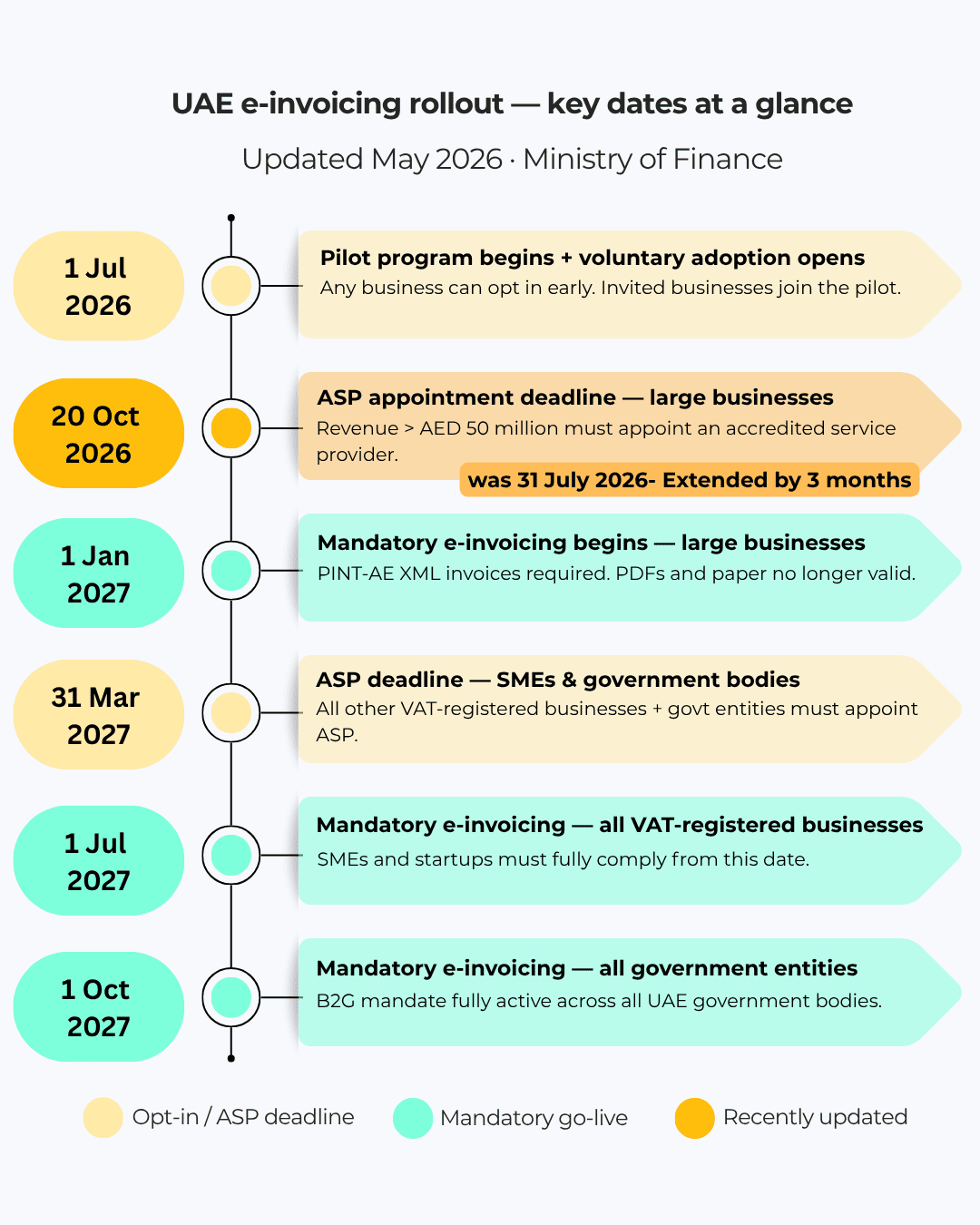
Starting 1 July 2026, the UAE starts a Pilot Program. Participation in e-invoicing UAE 2026 is limited to businesses invited by the Ministry. Simultaneously, any business may opt to go for e-invoicing voluntarily from this date. Early adoption is advantageous, as it allows businesses to improve integration without worrying about the upcoming penalties.
Phase 2: Mandatory Rollout
The first mandatory phase is for companies with an annual revenue of AED 50 million or more. For these entities, the deadline to appoint an ASP is 31 July 2026. Full compliance is active from 1 January 2027.
Phase 3: SME and General Market Rollout
The mandate extends to all other VAT-registered businesses starting 1 July 2027. These businesses must appoint an ASP by the deadline of 31 March 2027. This timeline ensures that smaller businesses and startups have time to learn from the Phase 1 rollout.
Phase 4: B2G Mandate
The final phase of the current roadmap focuses on government entities. All government bodies in the UAE must use the e-invoicing system by 1 October 2027. Like SMEs, these entities must follow e-invoicing UAE 2027 and appoint ASPs by the deadline of 31 March 2027 milestone to ensure alignment with the broader market transition.
As the mandate requires invoices to be exchanged through the Peppol network, the transition is not as simple. If your business falls in Phase 2 or Phase 3, this is a good time to do a review and a detailed audit to check whether you are ready for e-invoicing. This involves looking at the ERP software and ensuring it can generate the XML format. The alternative is to check if a middleware option is needed to ensure compatibility of invoices.

Latest Updates & Regulatory Developments
The UAE’s e-invoicing framework has been clarified by MD No. 243 and 244 of 2025. The Version 1.0 Electronic Invoicing Guidelines was published by the Ministry in February 2026, offering a clear outline for compliance.
These are the UAE e-invoicing latest updates:
- MD No. 243 of 2025: Clears the system, outlines scope of transaction, and sets out the obligations for businesses, including the appointment of an ASP.
- MD No. 244 of 2025: Includes information of the phased implementation plan, establishing the deadlines based on revenue and the launch of the Pilot Program.
Among other UAE e-invoicing 2026 updates is the 24-month grace period for transactions between members of the same VAT group. Intra-VAT group transactions remain within the scope of the e-invoicing framework.
However, to allow large organisations time to work on their internal billing systems, the Ministry has given relief from issuing e-invoices for specific supplies. This grace period is from 1 January 2027 to 31 December 2028. This is temporary relief, not a perpetual exemption. Once this period is over, all VAT group members must fully sync with e-invoicing obligations for intra-group supplies. Businesses must consider this two-year window for planning and integrating internal ERPs so they are prepared for the change.
Other Critical Regulatory Updates (2026)
Other FTA e-invoicing news include:
- Electronic Invoicing Guidelines (v1.0): Published in February 2026, these guidelines act as the primary technical manual. Businesses may store e-invoice data on servers outside the UAE, provided the data remains secure, complete, and instantly accessible to the FTA.
- TIN-Based Participation: The mandate uses the TIN as the primary identifier. The guidelines state that even businesses not currently registered for VAT or CT must register with the FTA to get a TIN.
- Transitional Requirements: For suppliers that are ready to issue e-invoices but have buyers who do not yet live on the system, the guidelines make it necessary to generate two invoices. You must issue both a PDF tax invoice and the mandatory XML e-invoice to ensure the buyer remains VAT-compliant during the transition period.
Regulatory clarity is now sufficient for businesses to conduct audits for E-Invoicing Readiness. It is time to review your master data to identify every intercompany recharge, management fee, and commercial transaction to ensure your system is configured.
Who Needs to Comply?
So, who needs e-invoicing UAE? The UAE e-invoicing for businesses is comprehensive, designed to capture the vast majority of commercial activity within the country. While the scope is broad, understanding who falls into the mandatory bucket is the first step toward building your compliance roadmap.
The mandate centers on B2B and B2G transactions. If you conduct business in the UAE, you are in-scope regardless of your VAT registration status. The list includes:
- VAT-Registered Businesses: All VAT registered businesses UAE are required to issue e-invoices for taxable supplies, including standard-rated, zero-rated, and deemed supplies.
- Non-VAT Registered Businesses: The mandate applies to all persons conducting business in the UAE. If you perform commercial activities, even if you are not registered for VAT, you are obligated to use the electronic invoicing system for B2B and B2G invoices.
- Free Zone Entities: There are no blanket exemptions for Free Zone companies. Whether your supplies are taxable, exempt, or out-of-scope, if the transaction is B2B or B2G, you must comply.
- Non-Resident Businesses: Foreign entities that have taxable supplies in the UAE and are required to issue tax invoices under VAT rules are also in-scope.
Current Exclusions & Exemptions
While the framework is expansive, there are certain e-invoicing exemptions:
- B2C Transactions: Invoices issued to individual consumers are currently out of scope. You may continue to issue traditional invoices for B2C sales. Note, however, that if your business operates a hybrid model, you must implement e-invoicing specifically for the B2B portion of your sales. In short, B2C e-invoicing UAE is excluded.
- Sovereign Activities: Business transactions performed by government entities in a sovereign capacity are excluded.
- Specific Aviation Services: International passenger transport involving an electronic ticket and ancillary passenger services are excluded. A 24-month temporary exclusion also applies to international cargo transport by airlines where an Airway Bill is issued.
- Exempt Financial Services: Certain financial services that are VAT-exempt under Article 42 are excluded.
Do not assume an exemption based on your industry or tax status. Because the mandate uses the TIN, the FTA expects all businesses to register within the system. If you are uncertain about your status, consider a readiness audit.
Benefits of E-Invoicing in UAE
What are the advantages of digital invoicing UAE? We take a look below:
- Efficiency & Cost Savings: There is enough research that shows that companies can reduce invoice creation and processing expenses with e-invoicing. By removing manual tasks such as printing, physical mailing, and data re-entry, your finance team can shift their focus to more pertinent initiatives.
- Accelerated Payment Cycles: One of the other benefits of e-invoicing UAE is accelerated payments. Because e-invoices are processed, validated, and delivered instantly, the DSO metric is significantly improved. Automated invoice matching against purchase orders ensures that payment disputes are identified and resolved in real-time. This can mean better cash flow.
- No Human Error: Manual data entry is a factor for invoice rejection and reconciliation issues. The XML structure ensures that data is accurate, minimising the risks of incorrect VAT calculations or data errors.
- VAT Compliance & Risk Mitigation: UAE tax compliance benefits also include validation of tax data. This automated compliance reduces the risk of underreporting or VAT leakage, protecting your business from the penalties associated with audit findings.
- Data Record: Since electronic invoices cannot be modified once issued, the system creates a transparent audit trail. This level of data authenticity is ideal for financial reporting.
- Smarter Financial Control: With all transaction data available in a structured, machine-readable format, CFOs gain instant access to live dashboards showing the growth and cash flow.
- Global Interoperability: By adopting the Peppol-based model, UAE businesses are instantly positioned for global trade. Whether you are dealing with local government tenders or international partners, your system is already configured for digital trade.
- Enhanced Security: Moving away from insecure PDF attachments, which are prone to phishing fraud, the Peppol network offers secure, encrypted transmission. Your financial communication is protected by design.
Viewing this transition purely as a cost is a common mistake. Early adopters who implement these automated workflows before their mandatory deadlines are finding that the internal savings often cover the cost of the e-invoicing implementation.
Challenges Businesses May Face
So, what are some of the e-invoicing challenges UAE? Getting ready for UAE’s e-invoicing framework is a complex project that extends far beyond a simple software update. Businesses, particularly SMEs, often underestimate the depth of the shift required. Typical UAE invoicing system issues and challenges include:
- Technical Concerns: Most current accounting systems and ERPs are designed to output invoices for human consumption, primarily as PDFs. Moving to the XML format requires a central change in how your software handles transactional data. E-invoicing depends on high-quality data, and when your data, such as customer TRNs, company addresses, or tax codes, is incomplete or outdated, you will find errors that the system will flag. Cleaning and correcting this data are often the most critical steps of the integration.
- Middleware Complexity: Many legacy ERPs cannot natively support direct API connections to an ASP. Businesses may need to implement a “middleware” layer to translate internal data into the required XML schema. Misconfiguring this layer is a frequent cause of transmission failures and rejected invoices.
- Other Obstacles: If your system is not configured to handle real-time feedback, invoice rejections can paralyse your accounts receivable. You need a dedicated workflow to handle and resolve rejections immediately, or else, there is a risk of payment delays.
- Behavioral Shift: Employees accustomed to traditional methods may struggle with the new, rigid digital requirements. Invoices are no longer documents that can be fixed later. Each is a digital event. Businesses must ensure staff understand the importance of data accuracy.
- Data Security: Tackling sensitive data and invoices in real-time increases cyber threats for many businesses. Businesses must have a robust system and security plan and stick to data retention measures to prevent breaches.
- Compliance Hurdles: The mandate requires near real-time reporting to the FTA. Managing this reporting cycle, ensuring timely transmission, and reconciling internal ledgers requires a level of diligence that finance teams may not have.
- The Penalty Trap: The fine schedule is strict. Many businesses risk compliance and fines if they lack automated monitoring tools to track the health of their ASP connection and transmission status.
In short, this transition is not an IT upgrade.
How to Prepare for UAE E-Invoicing
So, how to implement e-invoicing UAE? Preparing for the UAE e-invoicing mandate requires a move from manual processes to digital format. Below are steps in UAE e-invoicing preparation:
Step 1: Gap Assessment & Data Readiness
- Check your current ERP or accounting software and check if it can output data in the mandatory PINT-AE format.
- Data Cleaning: Review your customer and supplier master data. Ensure all records are accurate. Incomplete or incorrect data is the primary cause of invoice rejection in the new 5-corner model.
- Gaps to Find: Map your current invoicing fields against the Ministry of Finance’s Data Dictionary. Identify every mandatory field that is currently missing from your system.
Step 2: ASP Selection
- Provider Evaluation & Signing: Select the right ASP. Prioritise vendors with deep experience in Peppol network and native integrations with your specific ERP. Finalise the agreement with your ASP. Ensure the contract clearly defines roles for invoice monitoring, error resolution, and technical support.
- Onboarding: Register your business through the EmaraTax portal and complete the onboarding with the chosen ASP to get your unique Peppol Participant Identifier.
Step 3: Integration & Testing
- Workflow Check: Shape your ERP to push invoice data to your ASP. Whether you use direct API integration or middleware, ensure the data mapping is precise.
- Testing: Use the Pilot/Testing environments provided by your ASP to run scenarios. Test standard invoices, credit/debit notes, and scenarios like discounted transactions.
- Error Resolution Testing: Try triggering errors to verify that your team is alerted and that the resubmission functions work correctly.
Step 4: Training & Governance
- Train your teams on the new digital status indicators. The people handling both accounts payable and accounts receivable need help.
- Update your internal steps to reflect the 5-year digital storage requirement. Ensure your archival systems are secure, managed for backup, and encrypted.
- Create a clear escalation path for technical issues. Note that failing to report system outages to the FTA within the timeframe triggers daily fines.
Step 5: Go-Live
- If possible, go live voluntarily before your mandatory date. Start with a single business unit or subsidiary to monitor performance before a full-scale company rollout.
- In the first 30 days, reconcile your e-invoices against your VAT returns daily to ensure that the data reported to the FTA via your ASP aligns perfectly with your internal ledgers.
The most successful businesses are those that treat the new system as an opportunity to clean their master data and automate their reconciliation processes, but don’t think this is a quick process.
Penalties for Non-Compliance
The UAE government has clear and strict penalty rules under Cabinet Decision No. 106 of 2025 to ensure system integrity. As the 5-corner model provides the FTA with real-time visibility into records and transactions, non-compliance is detected automatically. The following UAE e-invoicing penalties apply:
- Failure to implement a system or appoint an ASP comes with a penalty of AED 5,000 for each month.
- Failure to issue or transmit invoices/credit notes comes with a penalty of AED 100 per document. This is capped at AED 5,000 per calendar month for invoices and a separate AED 5,000 per calendar month for credit notes.
- Failure to notify FTA of system malfunctions has a penalty of AED 1,000 for each day. If your e-invoicing system experiences a technical outage, you are required to notify the FTA within two business days. Failing to report this triggers daily fines until the notification is submitted.
- Failure to update registered data is considered non-compliance with e-invoicing UAE. There is a penalty of AED 1,000 for each day of delay. If your company’s registered details change, you are obligated to notify your ASP and the FTA within the timeline.
These penalties are independent and cumulative. A business could theoretically be charged for failing to appoint an ASP, failing to transmit invoices, and failing to report a system failure at the same time. While the Pilot Program allows for voluntary testing without penalties, once your business hits its mandatory go-live date, the FTA penalties UAE VAT apply immediately.
Have a question? Connect with the 10XMHub team for detailed guidelines. At 10XMHub, we are helping businesses assess their readiness for an e-invoicing system in the UAE. Our team will be glad to answer your queries and take you through the new process. Learn more about our services today.
 info@10xmhub.com
 +971522527368