A trade licence allows a company to register and operate in Dubai, but it does not itself set up a way to receive payments or run payroll. Most businesses need to open a corporate bank account in Dubai under its own name before the first invoice or salary goes out, particularly given WPS requirements. Many founders treat this step as a formality, only to find that it is subject to its own scrutiny. This requirement is often underestimated relative to the incorporation process itself, and it can hold up a business before a single payment clears.

Free Zone companies, Mainland businesses, and offshore entities are each subject to a distinct set of banking requirements, documentation lists, and processing timelines. A Mainland company, for instance, often faces different requirements than a Free Zone entity, even within the same emirate. An offshore company works within a narrower set of banking options altogether. Founders relocating from other markets frequently discover that UAE business banking operates differently from what they are accustomed to. This distinction typically becomes apparent during the first meeting with a bank’s relationship manager, when the questions go deeper than most founders expect.

This article covers every detail, including the function of a corporate account and the reasons banks and government authorities treat it as a standard requirement. It walks through the stages involved in opening an account, along with the practical benefits that follow once it is active. Between securing a trade licence and processing the first client payment, this administrative step often proves more significant than founders initially anticipate. Getting it right early can save weeks further down the line.

Corporate Bank Account in the UAE 

A corporate bank account is an account opened under a company’s legal name. It separates business transactions from personal finances. Within the UAE, Mainland companies, Free Zone entities, and offshore structures are each eligible to open one, although requirements vary by category. A Free Zone company, for instance, sometimes needs a No Objection Certificate from its Free Zone authority before a bank will proceed, a step Mainland companies rarely encounter.

Defining characteristics of the account include:

  • Registration under the company’s trade name rather than a shareholder’s personal name
  • A requirement for a trade licence, Memorandum of Association, and shareholders’ passports prior to approval
  • Proof of a physical office address, particularly for Mainland companies; some Free Zone companies can rely on their flexi-desk agreement instead
  • Availability in single-currency or multi-currency formats, depending on the nature of the business
  • Provision through banks such as Emirates NBD, Mashreq, ADCB, and RAKBANK, along with several international banks operating in the region, though bank eligibility and onboarding appetite can vary by company jurisdiction and business profile. 
  • More extensive compliance checks than personal banking, including anti-money-laundering rules, source-of-funds verification, and beneficial ownership disclosure

Banks apply these checks with varying degrees of strictness depending on the nature of the business activity. This layered process reflects how UAE business banking generally operates for corporate clients, regardless of company size. 

Why a Corporate Bank Account Matters for UAE Businesses 

  • Legal separation: UAE law treats Mainland and Free Zone companies as legal entities separate from their owners. A dedicated corporate account helps maintain clear financial separation between the company’s transactions and the personal finances of its shareholders, which matters if a dispute or audit ever reaches a court. 
  • Credibility: Suppliers and clients may ask for proof of a registered business account before extending credit terms or signing longer contracts. An invoice from a personal account raises questions that one from a corporate account usually does not.
  • Tax reporting: A dedicated account gives an accountant one clean source to work from at filing time. Under UAE corporate tax rules, a clear audit trail for revenue, expenses, and VAT reduces the time spent separating personal spending from business spending.
  • Access to financing: Banks are more likely to offer overdrafts, letters of credit, and business loans to companies with an operating history on record. A personal account with six months of activity usually does not satisfy that requirement; a corporate account with consistent transactions does. 
  • International trade: Multi-currency accounts reduce the conversion fees that come with paying overseas suppliers from a single-currency account. For a company importing stock or paying contractors abroad, that difference shows up on the bottom line every month. 
  • Payroll compliance: For companies registered with MOHRE, the Wage Protection System requires salary transfers to run through an approved corporate bank account. Some free zones run their own parallel systems, so the exact requirement depends on where the company is registered. 

Benefits of Opening a Corporate Bank Account

Opening a corporate account provides several practical advantages beyond fund storage:
  • Clear separation between personal and business finances
  • Stronger credibility with banks, clients, and government authorities
  • Access to business loans, overdrafts, and trade finance facilities
  • Simplified VAT filing and corporate tax reporting
  • Multi-currency support for international trade
  • Online banking tools built for handling business transaction volumes
  • Dedicated relationship managers at most banks for corporate clients
  • Higher transaction limits compared to personal accounts

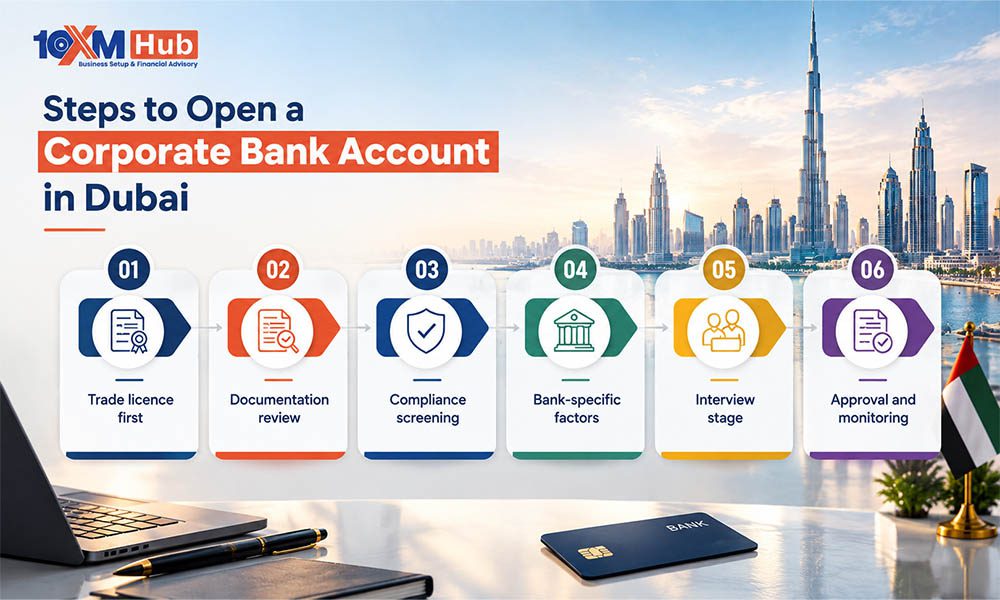
Steps to Open a Corporate Bank Account in Dubai 

Steps to Open a Corporate Bank Account in Dubai

Opening a corporate account in Dubai follows a general sequence, although banks vary in how strictly they apply it and in the time each stage requires.

  1. Trade licence first. Banks will not consider an application from a company that has not completed incorporation, so this step precedes all others. Even a provisional licence is generally insufficient, since banks want confirmation that the entity is fully registered before allocating resources to onboarding.
  2. Documentation review. Shareholder passports, proof of address, the Memorandum of Association, and a description of the business activity are included in the file. Some applications also require a business plan or projected transaction volumes. The exact list shifts depending on the bank and the shareholding structure, and a missing document can reset the review clock.
  3. Compliance screening. UAE banks conduct extensive Know Your Customer (KYC) and anti-money-laundering reviews before approving any corporate account, and shareholders or directors may be asked to explain the source of company funds. Activities associated with cryptocurrency and precious metals tend to receive closer scrutiny. Banks also cross-check shareholder names against global sanctions and watchlists, which can add time regardless of outcome.
  4. Bank-specific factors: Prior banking history, other factors specific to the applicant, and whether the Free Zone maintains an existing relationship with a given bank all influence the review. These factors are not always disclosed publicly by banks. Two similar applicants can receive different outcomes from the same bank, depending on the bank’s internal risk appetite. 
  5. Interview stage. Many banks ask for an in-person or virtual meet to check identity and discuss account activity. Banks often use this to check whether the answers match the paperwork, and any inconsistency is a common reason compliance teams ask for more documents. Preparedness matters here, since inconsistent answers about business activity or sources of funds tend to trigger additional requests.
  6. Approval and monitoring. Timelines range from a few weeks for straightforward applications to more than a month for higher-risk categories. Even after approval, many banks monitor early transaction patterns closely. A sudden spike in deposits or an unexpected counterparty can prompt further questions, even for an account that is already active.

Timelines vary considerably from one stage to the next, and documentation gaps remain among the most common reasons applications are delayed. Most rejections trace back to unclear source-of-funds documentation or an unclear business activity, and those same gaps tend to resurface if the application moves to another bank unchanged. Reapplying without addressing the original concern does little to change the outcome. 

Given the extent to which outcomes depend on matching the appropriate bank to the business profile, many founders seek professional support before submitting an application. 

Conclusion 

A corporate bank account serves a function beyond holding funds. It gives a business a dedicated channel for receiving revenue, making payments, and maintaining a clearer record of its financial activity. That record also matters for tax purposes, since the Federal Tax Authority expects VAT and corporate tax filings to reconcile against a company’s bank movements. For founders considering whether to open a corporate bank account in Dubai, the decision extends well beyond convenience. It affects payroll compliance and the ease with which international clients can process payments. 

Dubai’s banking sector continues to attract businesses due to the range of options available, from accounts designed for small trading companies to those structured for larger multinational operations. Selecting the appropriate account requires some comparison, as fees, minimum balance requirements, and service quality vary considerably between banks.

Founders who plan in advance, gather documentation early, and understand what banks require tend to progress through the process with fewer delays than those who apply without preparation. A Dubai business bank account, once active, becomes a routine component of operating a company, although reaching that stage requires some patience.

For founders who prefer to have the account-opening process managed on their behalf, 10XMHub works directly with UAE banks and Free Zones to guide applications from the documentation stage. This reduces the uncertainty that affects most first-time applicants.


By 10XMHub admin
October 5, 2026
Category: Business setup
Previous Next

Refer and Earn

Turn your network into opportunity. Refer clients to 10XMHub and earn substantial rewards for every successful business setup. We handle your referrals with premium support; you gain trusted commissions and long-term partnership benefits.