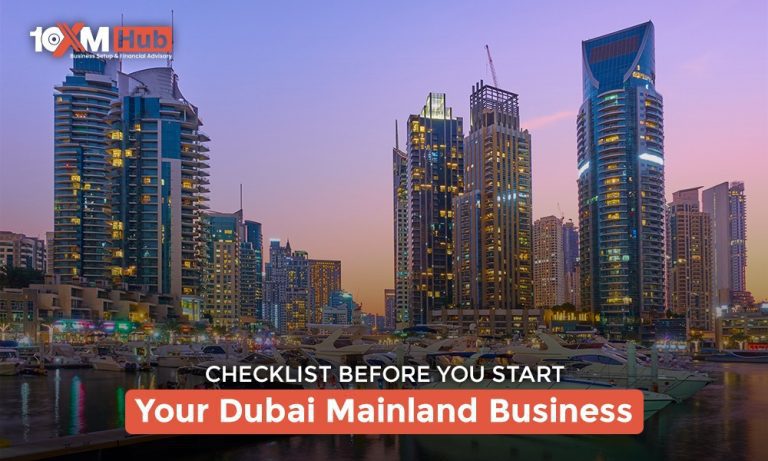
From being entirely dependent on oil to becoming a preferred and principal hub for innovation, manufacturing, real estate, tourism, and trade, Dubai is growing beyond all expectations. Dubai is now the gateway to the emerging markets of the Middle East, Africa, and South Asia, with countless opportunities for investors and entrepreneurs. 

While the Free Zone ecosystem has its benefits in many ways, the Mainland offers an all-access pass to the UAE market. If you decide to go for a Dubai Mainland business setup, you will have a DET-issued license, which allows you to trade freely across all seven Emirates and even bid for lucrative government contracts. Before you start, here is your detailed Dubai Mainland business checklist.

What is Mainland Business in Dubai?

A Mainland business in Dubai refers to an onshore company licensed by the DET. Unlike Free Zone entities, which are confined to specific geographic areas, a Mainland license allows you to operate throughout the entire UAE and trade globally. In 2026, many investors are choosing to start Mainland business in Dubai for local market penetration and total flexibility.

Characteristics:

  • Mainland companies can trade directly with any business or consumer in the local UAE market and bid on government contracts.
  • As of the latest changes, foreign investors can own 100% of their business for over 1,000 commercial and industrial activities. This removes the older need for an Emirati partner in most sectors.
  • You also have the choice to open office or retail space anywhere in Dubai, and this gives the freedom to select a location based on foot traffic, logistics, or closeness to clients.
  • The number of visas a Mainland company can issue is primarily linked to the size of its physical office space, and this is usually one visa per 9 square meters. There is no cap or fixed packages. 

With Mainland company formation Dubai, you can have branches across other Emirates and easily move goods and services across the borders.

How Do Mainland Businesses Operate?

All Mainland entities are governed by the DET, which sets the norms for licensing, trade names, and commercial conduct. A core operational rule for Mainland companies is the requirement for a physical workspace registered through Ejari, and this works as proof of address for the business. Mainland companies often find it easier to open corporate bank accounts with Tier-1 local banks. This is due to transparency and government oversight associated with DET licenses. Operating on the Mainland ensures a strong ground for contracts and disputes, often integrated with the federal court system

Pre-Setup Requirements for Mainland License in Dubai 

What do I need before starting a Mainland business in Dubai? This is the first question people have. Before any official paperwork is filed with the DET, you must consider the basic & critical aspects of the venture. When it comes to Mainland company setup UAE, these initial decisions matter because they dictate your liability, ability to scale, and tax obligations. Skipping or rushing this phase can mean amendments that can be expensive or licensing delays later on. Here is a simplified UAE Mainland business guide. 

  1. Define Your Business Activity: The first step is to identify your business activities from the DET’s directory, which contains over 2,000 approved codes. This choice is critical because it categorises your business into one of three license types:
  • Commercial License: For those involved in trading, such as import/export, retail, or general commerce.
  • Professional License: Meant for service providers, such as business consultants, artists, and IT professionals.
  • Industrial License: Meant for companies engaged in goods manufacturing, assembly, or any production-related activity.

Choosing the activity is more nuanced than it seems on paper. For instance, certain activities may require external approvals from specific UAE ministries. Selecting a broad trading license may seem like a flexible choice but often comes with higher fees compared to a specialised niche license.

  1. Choose the Legal Structure: Once the activity is decided, you must choose the legal structure for your business. This decision determines how many shareholders you can have and who is responsible if the business faces debt. Options: 
  • An LLC is the most popular choice for commercial ventures, as it keeps your personal assets safe, as shareholders are only liable for their percentage of the company’s capital. An LLC can have between 1 and 50 shareholders.
  • Sole Establishment: This is for single entrepreneurs offering professional services. You will own 100% of the business but also have unlimited personal liability for its obligations.
  • Civil Company: This is for professionals who wish to enter into a partnership. While it allows for multiple owners, there is also higher personal liability compared to an LLC.
  1. Confirm Ownership Eligibility: The relaxation of ownership laws is among the latest changes. For over 1,000 commercial and industrial activities, foreign investors can now enjoy 100% ownership of their Mainland business, as there is no need for a 51% local Emirati partner. However, you must confirm if your activity falls under the mentioned sectors. Industries such as defense, oil and gas, telecommunications, and banking still require local participation. If your business requires a Professional License, you may still need to appoint a Local Service Agent (LSA).
  2. Trade Name Reservation: Your trade name is the official identity and used in all legal contracts. Reserving this name is among the first steps in the Mainland setup process, and it must follow guidelines. The name cannot be identical or confusingly similar to an existing trade name. There shouldn’t be religious or political references, and the name must reflect the activity of the license. Ensure the name doesn’t have offensive terms. 

The Setup Checklist: What are the Critical Steps?

Getting your Mainland license in Dubai is a meticulous journey that involves several layers of government oversight. While the DET has digitised a lot of this workflow in 2026, the integrity of each step matters. This is a Dubai Mainland setup checklist for foreigners.

Step 1 – Get Initial Approval: You need to get the IA, which is a certificate issued by the DET acknowledging that your business activity and legal structure are acceptable. Note that this is not a license to trade but the first step to proceed with further legal and physical requirements. You need to submit the trade name and business activities for review. Typically, this approval is valid for six months, giving you a window to finalise other physical and legal arrangements.

Step 2 – Notarise Legal Documents: Once you have the IA, you must complete the company’s internal governance and shareholding. This is done through the MOA for LLCs or a LSA Agreement for professional sole establishments. In 2026, even for businesses that are owned entirely by foreign firms, the MOA must comply with the UAE Commercial Companies Law. These documents must be signed and notarised, either physically at a Dubai Court notary or electronically through an approved digital notary platform.

Step 3 – Register Ejari: One of the steps to open a Mainland company in Dubai is to get a physical office. Unlike virtual Free Zone setups, a Mainland license cannot be issued without a tangible office or warehouse. You must find a commercial space that matches the requirements of your business activity. 

For instance, a trading company needs an office, while a manufacturing firm needs a warehouse in an industrial zone. Once the lease is signed, it must be registered through the Ejari system with RERA. The Ejari work as the legal proof of address. In 2026, it is directly linked to your license issuance and your visa quota.

Step 4 – Request External Approvals: While the DET manages most commercial activities, certain specialised sectors are regulated and require an additional layer of vetting. For clinics and medical services, approval from DHA is a must, while for schools, training centers, and educational ventures, approval from KHDA is required.

Step 5 – Final License: Once your legal documents are notarised, your Ejari is registered, and any necessary external approvals are uploaded to the DET portal, you must make the payment. The DET issues a single payment voucher covering license fees, administrative costs, and any relevant trade name fees. Once the payment is made, the DET issues the Trade License along with your Commercial Register and Certificate of Membership in the Dubai Chamber of Commerce.

Post-Licensing Compliance: Mandatory Legal Filings

Your Mainland company setup UAE isn’t complete without post-licensing compliance steps. You must stick to federal laws that have become increasingly sophisticated. You need to keep up with mandatory, as failing can mean heavy fines, license suspension, or difficulties in renewing your EC. Once you start Mainland business in Dubai, complete these steps: 

  • CT Registration: Every Mainland company must register for CT with the FTA, regardless of their profit levels. A standard rate of 9% applies to profits exceeding the amount AED 375,000. Also, check whether your business can get Small Business Relief, which may allow for a 0% rate for CT, provided revenue is below a certain threshold, though registration for CT and filing remain mandatory. CT returns must generally be filed within nine months of the end of your financial year.
  • VAT Compliance: If your annual taxable supplies and imports exceed AED 375,000, you are legally required to register for VAT. If your turnover exceeds AED 187,500, you can register voluntarily, and this move is often recommended for startups looking to reclaim VAT on their setup and operational expenses. Once registered, you must file quarterly or monthly VAT returns. Also, it is essential to maintain financial records for at least five years.
  • Wage Protection System (WPS): All Mainland companies must pay their employees’ salaries through the WPS, which is overseen by the MoHRE and the Central Bank. Salaries are transferred through authorised banks or exchange houses that provide a salary file to the government as proof of payment. Missing a payment cycle or paying less than the contracted amount can trigger immediate blocks on your ability to process new visas or renew existing ones.
  • UBO Declaration: You must maintain a Real Beneficiary Register and a Partners/Shareholders Register at your office and file this information with the DET. This is to align with AML standards. A UBO refers to any individual who directly or indirectly owns or controls 25% or more of the company’s capital or voting rights. Note that any change in ownership must be updated in the UBO register, and this must be done within 15 days of the change.
  • Economic Substance Regulations: If your business engages in sectors like banking, insurance, investment fund management, or shipping, you fall under ESR. You must demonstrate that you have substance in the UAE, which means you have adequate employees, physical premises, and that income-generating activities are performed locally. Affected companies must submit an annual ESR Notification and, in many cases, a full ESR Report is required.

Documentation Checklist: Things to Have Ready

You need to have a checklist for documents required for Mainland company in UAE, and that includes: 

  • Personal Documents: Every individual involved in the ownership or management of the entity must provide clear, high-resolution copies of their identification, which include passport copies, current UAE residence visa (as applicable), and passport-sized photographs. You must have physical copies of recent photos against a white background for visa processing and labor files.
  • NOC: The NOC is also a critical document for those already residing in the UAE under a sponsorship. If any shareholder is currently employed by a UAE-based company, they must provide an NOC from their employer. This letter shows that the current sponsor has no issues with the individual’s decision to become a partner or owner in a new business.
  • Corporate Shareholder Documents: If your new Dubai entity is being owned by an existing corporation, the paperwork becomes more complex. You must submit a certificate of incorporation and a board resolution. Board Resolution is a formal document signed by the board of directors authorising the setup of the new branch or subsidiary in Dubai. For international companies, these documents must be attested by the UAE Embassy in the home country and the MOFA in Dubai. They must also be legally translated into Arabic.
  • Proof of Physical Address: A Mainland business is legally tied to its physical location; therefore, proof of premises is mandatory. You must submit a tenancy contract, which is a signed lease agreement for your commercial office, warehouse, or retail shop. Your tenancy contract must be registered with RERA to generate the Ejari certificate. The DET will not issue a trade license without a valid Ejari.
  • Notarised Legal Agreements: For LLCs, MOA details the shareholding, ratio for sharing of profits and losses, and management powers. For professional licenses, LSA defines the relationship that the business has with the UAE national agent. Both the MOA and LSA must be finalised and notarised by a public notary approved in the UAE. 
  • External Approval Letters: If your Dubai Mainland setup falls under a regulated sector, you must include approval letters from the relevant governing bodies. For instance, an approval from the DHA is required for medical centers or while approval from the RERA is required for real estate brokerages.

If you get these documents ready for Dubai Mainland business setup, you reduce the risk of delays. 

Conclusion 

Going through government portals and ensuring compliance with evolving regulations related to CT and VAT can be complex. At 10XMHub, our professional consultants guide you through each step and ensure your business is built for longevity. Experts from our team can help with business activity selection, coordinate document attestation, and advise on the bank account opening process.  

Contact us for Dubai Mainland business setup guidance!


By 10XMHub admin
June 6, 2026
Category: Business setup
Previous Next

Refer and Earn

Turn your network into opportunity. Refer clients to 10XMHub and earn substantial rewards for every successful business setup. We handle your referrals with premium support; you gain trusted commissions and long-term partnership benefits.