info@10xmhub.com
 +971522527368


How to Get an Industrial Licence in the UAE
Published on : October 9, 2026

Manufacturing and production businesses fall under a different licensing category than trading companies or service firms in the UAE. Assembling parts, packaging goods, or processing raw materials may require an industrial trade licence rather than a commercial one. The paperwork differs, and so does the type of space that is permitted under the lease.
Many business owners researching company formation in Dubai only learn about the industrial route once their chosen activity gets flagged at the initial approval stage. An industrial licence comes with a higher bar than a commercial one. Factory space and production capacity are both reviewed. Compliance with safety and environmental rules matters just as much before approval is granted. This guide walks through what the licence covers and who needs to apply. It also lays out the paperwork involved.
An industrial licence is a permit issued by a UAE economic department or a Free Zone authority, allowing a company to carry out approved industrial activities such as manufacturing, processing, assembly or packaging of goods. The exact scope depends on the activities listed on the licence. That sets it apart from a commercial licence, built around buying and reselling, or a professional licence, which covers the provision of services.
Scale also plays into the classification:
Disclaimer: Classification criteria, including premises size, vary by jurisdiction. The licensing authority confirms the applicable category.
Knowing which category an activity falls into early helps size the facility search and the budget correctly.
Here is a table comparing industrial and commercial licences:
| Feature | Industrial licence | Commercial licence |
| Purpose | Covers manufacturing and other approved production work | Covers buying, selling and distributing goods |
| Premises | Industrial premises that suit the activity | Premises that suit the approved trading activity |
| Issuing authority | The Mainland or Free Zone authority that licences the activity | The Mainland or Free Zone authority that licences the activity |
| Other approvals | Environmental, safety or sector-specific approvals may apply | Approvals depend on the goods being traded |
| Capital | Set by the jurisdiction and the regulations that apply | Set by the jurisdiction and the activity |
| Federal requirements | Registration with MoIAT and other federal rules may apply | Federal rules may apply to certain sectors |
| Possible benefits | Industrial incentives and customs duty exemptions for eligible businesses | Opportunities to trade and distribute under the approved licence |
Note: Requirements vary by jurisdiction and activity. Confirm the details with the relevant licensing authority before applying.
Because the two licence types serve different purposes, choosing the wrong one at the application stage can delay your launch. A trading company that also does light assembly, for example, may need both commercial and industrial licences, or a combined activity list approved by the authority in advance.
Not every business that comes into contact with a product requires an industrial licence. The requirement applies once a company physically changes the form, composition, or state of goods, instead of simply moving them from a supplier to a customer. Businesses that generally require this licence include:
Businesses that only import finished goods, distribute stock, or provide consulting and repair services generally fall under a commercial or professional licence instead. Where an activity list includes both trading and light production, the relevant authority should confirm whether a combined licence or two separate licences are required.
Once you know your activity qualifies, gathering the paperwork ahead of time keeps things moving. Exact requirements vary by emirate and Free Zone, but most applications ask for:
Free Zone applicants may face a shorter list, since some approvals get handled inside the zone itself. Mainland applicants usually coordinate directly with the Department of Economy and Tourism and outside bodies like MoIAT and the municipality.
Approval takes more than paperwork. Authorities also want to see a working setup that generally includes:
Free Zones and the Mainland do not work the same way here. Dubai Industrial City and KIZAD, for instance, often fold leasing, approval, and licensing into one process. On the Mainland, a business ends up dealing with the Department of Economy and Tourism, the municipality, and MoIAT as three separate steps, so it helps to know which path applies before signing a lease.
Paperwork alone will not clear an inspection. Inspectors check the layout, the safety gear, and the machinery against what was filed. A mismatch is one of the more common reasons a licence application gets held up.
Capital and staffing requirements depend on the licensing jurisdiction and the federal services applicable to the business. For manufacturers seeking MoIAT’s Industrial Production Licence, the Ministry specifies a minimum capital requirement of AED 250,000 and at least 10 employees. These thresholds should not be treated as universal requirements for every local industrial licence.
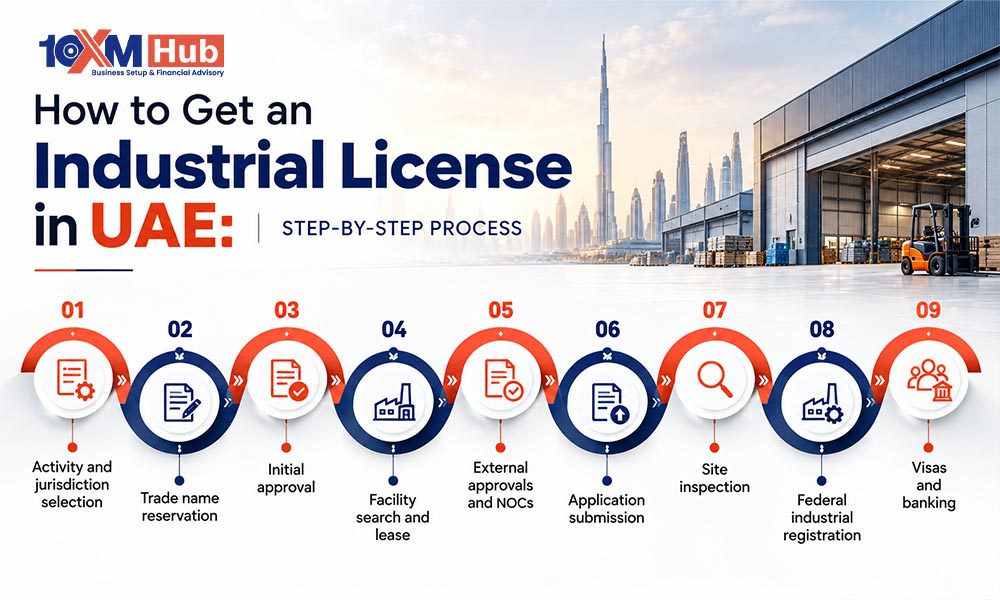
Getting an industrial licence in the UAE generally follows the same broad sequence. The exact order shifts somewhat by emirate, Free Zone, and activity. The stages behind how to get industrial licence in UAE approval are outlined below.
Documentation requirements, processing time, and potential delays vary by stage. Inspections and No Objection Certificates for regulated products are the most common sources of delay. Costs also vary by activity, facility size, and jurisdiction. A fixed cost estimate is often inaccurate; a budget range is more appropriate.
Licensing involves several authorities at once, including the relevant economic department, MoIAT, and the municipality. The overall timeline depends largely on how thoroughly the application has been prepared. A missing NOC or a discrepancy between the project report and the actual facility is often sufficient to return an application for correction.
Free Zones often combine leasing, approval, and licensing into a single process. Mainland applicants generally manage these as separate steps. This distinction accounts for why comparable applications can result in markedly different timelines.
An industrial licence in the UAE covers manufacturing, processing, and production activities that a commercial licence does not. Requirements typically include a physical factory or workshop, minimum capital, and minimum staffing. Safety and environmental compliance are required, along with registration with more than one authority. These conditions reflect the risks associated with industrial operations.
Planning for these requirements in advance supports better budgeting, facility selection, and timeline management. An application built around a clear activity and complete documentation moves faster than one submitted without preparation.
For manufacturers preparing an application, 10XMHub provides guidance on activity selection and documentation. Businesses considering an industrial licence can contact 10XMHub for assistance.
Disclaimer: The information in this blog is for general guidance only. Licensing conditions, including documentation, minimum capital, approval procedures and other applicable criteria, are subject to change. Always confirm the latest information with the relevant UAE authorities or seek professional advice before making business decisions.


Share this post :





Turn your network into opportunity. Refer clients to 10XMHub and earn substantial rewards for every successful business setup. We handle your referrals with premium support; you gain trusted commissions and long-term partnership benefits.
Please share your details and we’ll contact you shortly.