For years, the common question among entrepreneurs was: Can a foreigner own 100% of a company in Dubai? The answer is yes. Investors can have 100% ownership of their businesses on both the Dubai Mainland and within its Free Zones. Here is a guide that takes you through the details. 

What Is 100% Foreign Ownership in the UAE?

There was always a typical question: Can expatriates start a company in UAE? Today, the sponsor requirement of the past is gone for many industries. Here is exactly what 100% foreign ownership looks like now:

  • Share Control: You own 100% of your equity. You are no longer required to give up a 51% majority stake to a local UAE partner or sponsor to operate on the Mainland.
  • Profit Retention: You have the right to repatriate 100% of your earnings back to your country without any restrictions.
  • Decision-Making: You hold authority to sign contracts, hire talent, and pivot your business strategy without needing permissions from an outside local partner.
  • Legal Protection: Your ownership is recognised on your licence, eliminating the need for complex side-agreements to protect your capital.
  • Jurisdiction Choice: You can choose to set up your enterprise inside a Free Zone or on the Dubai Mainland to trade across the entire local market, while maintaining full control.

Can Foreigners Own 100% of a Company in Dubai?

In most cases, full foreign ownership is now by default in Dubai. After the UAE government scrapped the mandatory 51% local partner rule, foreigners can own their company outright. This applies to both Free Zone and Mainland setups.

Situations Where Ownership Restrictions Still Apply

Businesses that fall under the UAE Cabinet’s Strategic Impact List cannot be 100% foreign-owned. These are sectors the government considers sensitive and critical to national security or public welfare:

  • Defense: Arms manufacturing, ammunition trading, military equipment, explosives, and private security operations.
  • Banking, Finance, and Insurance: Retail banking, currency exchange, money printing, and insurance underwriting are regulated directly by the Central Bank.
  • Telecommunications: Businesses touching national infrastructure, including cell towers and fiber-optic networks.
  • State Utilities: Electricity generation, water distribution, and core public utility infrastructure are also on the list. 
  • National Interests: Domestic land transport, businesses governed by local legislation, and pilgrimage-related tourism services.

Understanding the UAE’s 100% Foreign Ownership Law

For a long time, setting up outside a Free Zone came with a fixed cost: 51% of your company went to a local partner.  So, is 100% ownership allowed in Dubai? The UAE has opened full ownership across more than 1,000 activities. 

  • Attract FDI: Removing the local sponsorship requirement puts Dubai in direct competition with established financial centres. 
  • Draw in Tech and Innovation: Founders in AI, SaaS, and digital business now have a real reason to base their headquarters here. 
  • Clean Up Ownership Structures: Before the reform, many businesses ran on informal side-agreements with local partners. 
  • Build Investor Confidence: Direct title over your own shares strengthens investor confidence for both SMEs and multinationals.

Key Benefits for Foreign Investors

  • Full Control: Governance, hiring, and strategic direction. None of it requires sign-off from a partner with no skin in the game.
  • Full Profit Repatriation: Every dirham of invested capital and net profit can be moved out of the UAE.
  • No Local Partner Costs: Annual fees and renegotiated agreements are no longer part of your budget.
  • Visa Pathway: Equity in a registered company gives founders, executives, and investors a credible route to 5 or 10-year Golden Visas.
  • Market Access: A Mainland company can sell across the entire UAE and bid on government contracts with no limitations.

Can Foreigners Own 100% of a Mainland Company in Dubai?

Yes, foreigners can fully own 100% of a Mainland company in Dubai. The requirement mandating that a UAE national hold a 51% majority stake has been eliminated for most activities. 

So, is a local sponsor required in Dubai? Today, the Department of Economy and Tourism (DET) permits 100% expatriate equity ownership across more than 1,000 commercial and industrial activities through an LLC. 

For professional or service-based setups, appointing a local Emirati as a Local Service Agent (LSA) is necessary for paperwork and liasoning in most cases. But, this agent holds 0% equity or rights and is compensated via a flat annual service fee. The only exceptions to this 100% rule for Mainland company registration Dubai are businesses operating within designated strategic impact sectors.

Mainland vs Free Zone Ownership – Which Option Is Better?

Deciding whether to base your 100% foreign-owned business on the Dubai Mainland or within a Free Zone is one of the most critical choices you will make. Read our comprehensive guide on Mainland vs Free Zone company setup to decide which suits you best.  

The right choice after considering UAE foreign ownership rules comes down to one thing: where your customers are.

  • Dubai Mainland company setup: The stronger option if your customers are inside the UAE. That means retail shoppers, local businesses, or government entities placing tenders. 
  • Dubai Free Zone Company: This is the ideal choice for businesses that don’t depend on the local Mainland market. However, selling directly to Mainland customers requires either a local distributor or a separate Mainland branch.

The table below compares Dubai Mainland company setup vs. Dubai Free Zone company:

Ownership Dubai Mainland (DET Jurisdiction) Dubai Free Zones (Zone Authorities)
Market & Trade  Unrestricted Limited to zone & internationally. To sell on the Mainland, distributor or separate Mainland branch mandatory
Workspace Rules Physical office, shop, or warehouse with Ejari certificate Flexible. Virtual “flexi-desks” available
Corporate Tax (CT) compliance Standard 9% on profits over AED 375,000. Eligible for 0% CT on qualified income
Customs & Import Duties Standard 5% Tariff.  Exempt from duties on all goods traded within the Free Zone.
Visa  Visa quota scales on the basis of the square footage of your space. Capped Packages. Visa quotas based on setup package
Laws Federal Commercial Law Independent By-Laws

Types of Companies Foreigners Can Fully Own in Dubai

When exploring options for a 100% foreign ownership Dubai setup, selecting the correct structure is essential. The primary company types that qualify for full ownership include:

  • LLC: This is the most popular structure for trading and light manufacturing on the Mainland. Today, international entrepreneurs can claim 100% foreign ownership of a Mainland LLC.
  • Sole Proprietorship: This entity is owned by a single individual who retains absolute authority. Under new guidelines, foreigners can fully own a Mainland Sole Establishment for professional, digital, and service-oriented activities.
  • Civil Company: A Civil Company is a structure designed for licensed professionals, including business consultants, legal advisors, engineers, and doctors. It allows multiple foreign partners to hold 100% of the equity collectively. If established on the Mainland, it requires a LSA to handle government procedures.
  • Branch of a Foreign Company: For international companies looking to expand here, opening a branch office is a great option. The branch operates as an extension of the parent company, retaining 100% foreign control. 

Business Activities Eligible for 100% Foreign Ownership

The shift in laws has expanded the list of business activities eligible for 100% foreign ownership. The DET permits complete expatriate equity ownership across thousands of individual activities. 

Categories of Eligible Activities

  • Tech & Digital Services: This sector is open to 100% expat ownership. It covers software development, Artificial Intelligence, IT consulting, digital marketing, and cybersecurity. For example, an international software engineer can open a Mainland development studio, employ a team, and retain total ownership of their source code and profits.
  • Trading: If your business model involves the movement of consumer goods, you qualify for complete ownership under a commercial licence. Eligible activities include general trading, e-commerce, clothing, retail, cosmetics, and electronics. In simple terms, a fashion entrepreneur can import apparel, lease a local warehouse, and sell directly to Mainland UAE consumers.
  • Professional Services: This branch includes expertise-based businesses such as consulting, human resources, design, and educational training. An international corporate consultant can open a Mainland advisory firm to serve local enterprises. While they may need a LSA for government paperwork, the founder owns 100% of the equity.
  • Manufacturing & Light Industry: The UAE allows the full ownership of factories and processing plants. This covers many activities, including processing of food, textile production, furniture fabrication, and electronics import & export. A food-tech brand can have a kitchen or packaging plant on the Mainland, managing industrial assets and logistics with complete autonomy.

Activities Not Permitted for 100% Foreign Ownership

While the majority of activities are wide open, there are specific activities not permitted for 100% foreign ownership on the Dubai Mainland. There are restricted niches that are considered vital to national security, sovereign strategy, or public infrastructure.

Examples of Non-Permitted Activities: 
  • Security, Defence, and Military: Manufacturing, importing, or trading firearms, tactical weapons, ammunition, explosives, and pyrotechnics. 
  • Banking and Finance: Retail banking, sovereign asset management, and Central Bank-regulated financial services are out.
  • Telecommunications: Owning, deploying, or managing critical national communication infrastructure, public satellite links, radio frequencies, or fibre-optic networks. 
  • Utilities and Sovereign Resources: Infrastructure projects including water filtration and distribution networks, electricity generation plants, and oil and gas exploration or production.
  • Religious Tourism: The organisation of pilgrimage services (Hajj and Umrah), domestic land transportation, postal mail services, and commercial agency operations where a local Emirati serves as the exclusive brand distributor.

Benefits of Owning 100% of a Company in Dubai

Benefits of Owning 100% of a Company in Dubai

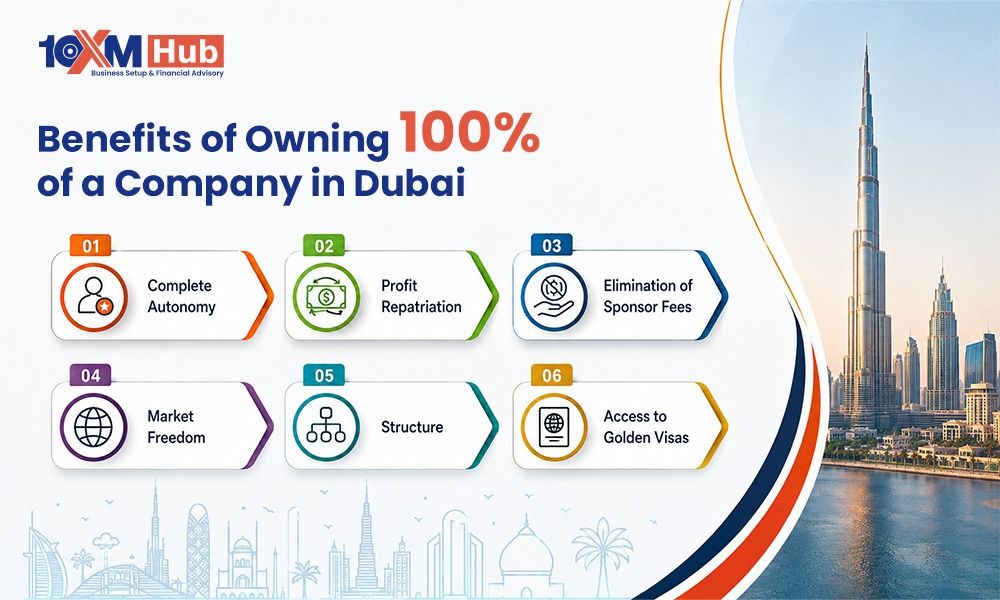
Securing a 100% foreign ownership Dubai business licence shifts how international entrepreneurs scale their companies. Benefits include: 

  • Complete Autonomy: You maintain full managerial control and independent voting power over every decision. This allows you to hire staff, sign major deals, and pivot your strategy. 
  • Profit Repatriation: 100% of the money you invest and all net profits generated by your business belong to you. You are allowed to transfer all earnings back to your country. 
  • Elimination of Sponsor Fees: You bypass the recurring annual costs paid to corporate nominal local sponsors to keep a licence active. This saves your enterprise anywhere from AED 15,000 to over AED 50,000 every year. 
  • Market Freedom: Setting up on the Mainland allows you to trade directly with consumers anywhere across the UAE. 
  • Structure: Your setup remains clean, transparent, and completely free of side-agreements previously used to shield assets. 
  • Access to Golden Visas: Holding legal title to a trade licence makes it easier to secure long-term residency. Founders, executive directors, and core investors can qualify for 5 or 10-year UAE Golden Visas. 

How to start a business in Dubai as a foreigner? Step-by-Step Process

Can foreigners own companies in Dubai? That question is best answered through the setup process, which shows how investors and founders can pave their way. 

Going through a 100% foreign ownership Dubai setup requires a systematic approach to clear compliance checks. The registration process is largely digitalised. Below is an overview for business setup in Dubai. 

  • Select the Exact Business Activity

Choose your business activity from the official DET or Free Zone activity registers. The activity code you select determines your licence type and verifies your 100% ownership eligibility. Make sure to check UAE government resources. 

  • Choose Your Structure

Match your business format with an entity type that permits foreign equity. The most common options include a LLC for trading, a Civil Company for professionals, or a Branch of a Foreign Company.

  • Reserve Trade Name

Submit preferred company names. The trade name must comply with UAE naming regulations. It cannot be offensive, cannot reference political or religious bodies, must not contain abbreviations if named after a person, and must end with your appropriate legal suffix. 

  • Apply for Initial Approval

Secure an IA certificate from the DET or Free Zone authority. This document acts as a no-objection nod from the government, certifying that your activity complies with local laws. 

  • Notarise Documents

Draft the company’s MoA or a LSA agreement. Under new regulations, these agreements must be notarised through the court portal or digital notary systems. 

  • Secure Space and Register Ejari

Lease a physical business location. For Mainland setups, this tenancy contract must be registered through the Ejari system to provide valid proof of the address.

  • Obtain External Approvals

If your selected activity falls under a regulated niche, secure additional clearances from external ministries. For example, medical clinics must be cleared by the Dubai Health Authority (DHA). 

  • Pay Fees and Collect Your Trade Licence

For company formation Dubai, the next step is to submit your documents, including the Initial Approval, trade name, notarised MoA, and Ejari contract, to the DET or Free Zone office. Pay the fees to receive your trade licence.

Post-Licensing Requirements

Once your trade licence is issued, you must complete three steps:

  • Register with the Dubai Chamber of Commerce: Without this, you can’t substantiate invoices, sign cross-border contracts, or clear goods through customs. 
  • Initiate Visa Allocation: File for your investor or partner visa and lock in your employee residency quotas through MOHRE and the GDRFA portal.
  • Register for CT: All new businesses must register for CT via the EmaraTax portal within three months of licence issuance. 

Always check Free Zone or DET guidelines before you start. 

What are Documents Required for Foreign Investors?

  • Passport Copies: For all shareholders, directors, and the appointed manager, passports must carry at least six months of remaining validity.
  • Passport-Sized Photograph: A digital photo of each stakeholder against a plain white background.
  • UAE Visa and Entry Proof: If you’re in the country, a copy of your current visa. If applying from outside the UAE, a scan of your most recent UAE entry stamp.
  • Emirates ID Copy: Only required if any foreign shareholder or manager already holds UAE residency.
  • NOC: Needed if a foreign investor is currently employed by a UAE-registered company. 
  • Proof of Address: A utility bill or bank statement from your home country, issued within the last three months.

Checklist for Corporate Investors 

If an international business entity is expanding into Dubai, the document requirements scale up:

  • Certificate of Incorporation: The registration certificate or trade licence issued by the commercial registry in the home country.
  • MoA / AoA: The legal documents of the parent company detailing its purpose, share capital structure, and operational bylaws. 
  • Board Resolution: A resolution from the parent company’s board of directors authorising the setup of the new enterprise in Dubai.
  • Power of Attorney (POA): A document vesting power in a local business setup consultant or legal representative to sign registration paperwork, submit applications, and collect the licence. 

Cost of Setting Up a 100% Foreign-Owned Company in Dubai

The capital required to establish a 100% foreign ownership Dubai entity depends directly on your jurisdiction and line of business.

Here is a table on the estimated costs

Expense Component Dubai Mainland LLC (AED) Dubai Free Zone Entity (AED)
Trade Name & IA 1,000 – 2,500 (One-time) Included in package / 500 – 1,000
Licence Fee 10,000 – 25,000 (Annual) 8,000 – 20,000 (Annual, varies by zone)
MoA 1,500 – 3,000 (One-time) Included in standard setup package
Immigration Card 1,500 – 3,000 (Annual) 1,000 – 2,000 (Annual)
Workspace / Office Rent 15,000 – 45,000+ (Annual physical lease) 5,000 – 15,000 (Annual flexi/co-working desk)
Investor / Partner Visa 3,500 – 6,000 (Valid for 2-3 years) 3,000 – 5,000 (Valid for 2-3 years)
Medical Test & Emirates ID 500 – 1,000 (Per visa application) 500 – 800 (Per visa application)
Estimated First-Year Total  AED 32,500 – 85,500+ AED 17,500 – 43,800+

Common Mistakes Foreign Investors Should Avoid

Plenty of international founders rush through registration and end up dealing with delays, fines, or structural errors that cost far more to fix than they would have to avoid.

  • Choosing a jurisdiction based on initial cost.
  • Selecting mismatched business activities. 
  • Underestimating capital requirements.
  • Drafting weak agreements.
  • Treating setup as a one-time event.

Conclusion

Do I need a local sponsor in Dubai? That question is already answered. Foreign founders can now own, run, and profit from their businesses in Dubai without handing equity to a local partner. The hard part isn’t the Dubai company ownership laws. It’s the execution. 

If you’d rather have someone in your corner from day one, a 10XMHub Dubai business setup consultant can guide you through the entire process. 

FAQs

1. Is a local sponsor still mandatory to start a business on the Dubai Mainland?

No, the requirement for a 51% local Emirati sponsor has been eliminated for 1,000+ Mainland activities. 

2. What is the difference between a Local Sponsor and a Local Service Agent (LSA)?

A local sponsor owns 51% of your company’s shares and holds voting control, whereas an LSA holds 0% equity and zero management rights. Mainland service setups use an LSA strictly as a liaison for paperwork..  

3. Can an existing Dubai Mainland company switch to 100% foreign ownership?

Yes, existing entities can transition by amending their MoA and transferring the sponsor’s 51% shareholding to the foreign investor. This restructuring process requires approval and updated registration from the DET.  

4. Does Full Foreign Ownership Mean I Don’t Pay Taxes?

No. Ownership structure has no bearing on tax obligations. All companies are subject to the standard 9% CT on net profits above AED 375,000. That said, if your annual revenue stays under AED 3 million, you may qualify for Small Business Relief.

5. Can a Free Zone Company Sell Directly to Mainland Customers?

Not directly. To move goods onto the Mainland, you either open a Mainland branch or work through a local distributor.


By 10XMHub admin
July 17, 2026
Category: Business setup
Previous Next

Refer and Earn

Turn your network into opportunity. Refer clients to 10XMHub and earn substantial rewards for every successful business setup. We handle your referrals with premium support; you gain trusted commissions and long-term partnership benefits.