 info@10xmhub.com
 +971522527368


How to Start Import Export Business in Dubai
Published on : July 13, 2026
Dubai has handled more than $500 billion in trade in 2025. That number alone tells you why entrepreneurs from every corner of the world treat it as their first choice for building an import-export operation. The city sits in a perfect location that turned into a deliberate advantage, backed by Free Zones, zero Corporate Tax (CT) on qualifying income, and ports that never sleep. If you want access to global markets, learning about how to start an import export business in Dubai is critical. Here is a detailed overview:
An import-export business sells goods across borders. You get products that are cost-effective or plentiful in one market and sell them into another where demand is much higher than the local supply.
Importing means bringing goods, which could be materials, components, or ready products, into a country to sell to local customers. Exporting is exactly the opposite, where you take internal produce and sell it to other nations.
Dubai moves everything. Before you lock in a product category, know where the real volume is. The usual question is what products can be imported into UAE? Here is a quick overview:
So, is import export business profitable in Dubai? The short answer is yes, and there are many categories to choose from.
| Top Trading Sectors in Dubai | ||
|---|---|---|
| Category | Classification | Key Authority |
| Gold, Diamonds & Jewelry | High-Value Commodities | Dubai Gold & Jewellery Group / DMCC |
| Smartphones & Computers | Consumer Electronics | TDRA (Telecommunications And Digital Government Regulatory Authority) |
| Packaged Foods & Dairy | FMCG | Dubai Municipality |
| Pharmaceuticals & Medical | Health Products | MOHAP (Ministry of Health & Prevention) |
| Automotive Spare Parts | Industrial Goods | RTA (Roads and Transport) |
Note: Some categories are not included in import and export. Check your chosen segment against the Dubai Customs restricted list before you take a step to set your import export company UAE.
Choosing between a Mainland setup or a Free Zone jurisdiction is the most critical decision you will make when initiating your import-export company setup Dubai.
Can a Free Zone company import goods into the UAE Mainland? While you can hold bulk cargo inside a Free Zone indefinitely without paying any customs duties or taxes, moving those goods past the Free Zone gates requires you to either pay the 5% duty, hire a Mainland clearing agent, or sell through a local distributor.
Here is a table for your help.
| Mainland vs. Free Zone Comparison for Traders | ||
| Feature | Mainland | Free Zone |
| Import to UAE Market | No need for a local agent or intermediary. | Requires a Mainland distributor, a broker, or paying a 5% customs duty. |
| Customs Duty Exemptions | Standard 5% customs duty | 0% customs duty within the Free Zone |
| Physical Location of Warehouses | Lease warehouses across Mainland | Warehousing strictly inside Free Zone |
| Re-Export Ease & Procedures | Requires customs declarations & duty refund processing | Highly streamlined |
| Local Government Tenders | Bid on UAE government trade and supply contracts. | Generally restricted from bidding |
Most trade hubs offer a location. Dubai offers location, infrastructure, and a legal framework deliberately built around moving goods across borders. The advantages become apparent quickly:
To move goods across borders, you must have the appropriate license issued by either the DET for Mainland companies or the respective Free Zone Authority. Obtaining the correct import export license Dubai is the pillar of your start, dictating what commodities you can process through customs checkpoints. There are two primary licensing routes you can take to establish your business:
Commercial License
A Commercial License is for businesses that focus on an interconnected category of goods. When applying for this trading license Dubai, you are required to select your precise activities from a comprehensive list.
General Trading License
For merchants who require maximum agility without boundaries, the General Trading License is the best choice.
The process of executing an import export company setup Dubai involves a systematic path. Here is the step-by-step process explained.
Step 1: Choose Your Structure and Activities
The first phase of learning how to start an import export business in Dubai is defining where your company will live and what it will sell.
Step 2: Register Your Trade Name
Your trade name must follow government guidelines before it can be reserved, and this is as critical as the UAE import regulations. Note: The trade name must translate across both English and Arabic characters without changing meaning.
Step 3: Secure Your Initial Approval and License
This step establishes your business identity. You submit your background documents to get permission to register your trade venture. Submit shareholder passports and initial application forms to the relevant authority. Receive your Initial Approval and pay the required fees to get your license Dubai.
Step 4: Arrange Your Office and Warehouse
To clear shipments through customs, a trading business must have a physical address. Lease an office space or a flexible desk that fulfils the minimum requirements for your visa allocations. Also, get a commercial warehouse that matches your product category. Register your lease with the government to receive your Ejari (for Mainland) or Free Zone tenancy agreement.
Step 5: Complete Customs Registration
You cannot move a single shipping container through UAE ports without an active customs profile. For this, you need to keep up with import & UAE export regulations, and that includes the following steps:
Step 6: Corporate Banking and Visas
The final step is opening a corporate bank account and getting visas for your management team and foreign staff. Steps include:
So, how can foreigners start an import export business in Dubai? While other rules are the same, bank account opening for international trade companies means strict compliance checks. Be prepared to show your business plan, proof of capital, and verified source of funds.
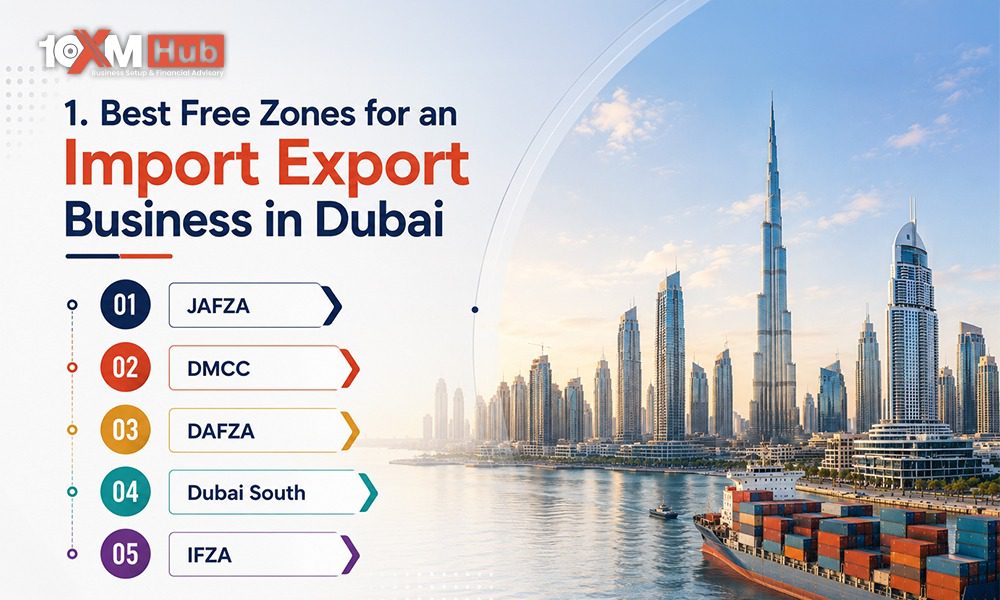
Dubai has 25+ Free Zones, but for trade businesses, a handful carry the weight. Here is what each one actually offers for international trade Dubai:
JAFZA: Located very close to Jebel Ali Port and Al Maktoum International Airport, this Free Zone offers a strong combination of logistics advantages. For businesses moving physical goods at a much higher scale, it offers several advantages.
DMCC: The name to know if your business touches gold, diamonds, energy, or agricultural commodities. The trading infrastructure here is well established, and a DMCC address is widely recognized by financial institutions. Key draws:
DAFZA: Shares a fence with Dubai International Airport, which makes it the obvious pick for anything that moves by air. Customs clearance here is faster than anywhere else in the city. Key draws:
Dubai South: Built around Al Maktoum International Airport, Dubai South is the hub for the future. The airport is positioned to become one of the region’s largest aviation hubs. Key draws:
IFZA: The most straightforward entry point into Dubai’s Free Zone ecosystem. No frills, no heavy price tag. Key draws:
| Free Zone Comparison for Import-Export Businesses | ||||
| Hub | Specialty | Access & Infrastructure | Entry Cost Positioning | Key Advantage |
| JAFZA | High-volume cargo, re-exports, & industrial trade | Access to Jebel Ali Port & Al Maktoum Airport. Bonded warehouses | Premium investment | Raw logistics, sea freight handling capacity |
| DMCC | Gold, diamonds, gems, energy, agro-commodities | Located in central Dubai (JLT); advanced commodity exchanges | Premium setup costs, but offset by ecosystem value | Elite international credibility, bank recognition |
| DAFZA | Electronics, pharma, perishables | Shares a fence with DXB for tarmac access | Mid-to-high investment | The fastest air freight customs clearance |
| Dubai South | E-commerce fulfilment, manufacturing, & last-mile | Built around Al Maktoum International Airport | More cost-effective than JAFZA or DMCC. | Ideal for scalable e-commerce setups |
| IFZA | Small-to-mid-scale trading, multi-activity operations | Access to logistics networks; focuses on digital/virtual setups | Highly economical | fast setup, licensing flexibility, and low entry costs |
Dubai’s setup process is straightforward. The costs, however, vary more than most guides admit. Mainland and Free Zone structures carry different price points, warehousing adds a separate layer, and certain product categories trigger additional approval fees. Here is an overview of costs* related to logistics business Dubai.
| Category | AED | Frequency | Operational Context & Scope |
| Free Zone Commercial License | AED 9,000 – AED 15,000 | Annually | Base license fee covering up to 3 related activities. |
| Mainland Trading License | AED 12,000 – AED 25,000+ | Annually | Commercial registry fees, market fees, & chamber of commerce fees. |
| General Trading License Premium | AED 15,000 – AED 30,000 | Annually | Required only if trading unrelated multi-product inventories. |
| Trade Name Approvals | AED 620 – AED 2,000 | One-time | Covers name reservation |
| Virtual Office / Flexi-Desk Lease | AED 3,000 – AED 12,000 | Annually | Minimum requirement to get an address. |
| Warehouse Lease | AED 40,000 – AED 150,000+ | Annually | Scaled by square footage |
| Establishment Card | AED 1,000 – AED 2,000 | Every 2 Years | Registration with the UAE Ministry of Interior. |
| Investor/Employee Visa (Per Person) | AED 3,000 – AED 6,000 | Every 2 Years | Medical check, biometrics, and Emirates ID card. |
| Customs Registration Code | AED 500 | One-time | Fee to issue your customs code Dubai. |
| Customs Code Renewal Fee | AED 25 | Annually | Processing fee to keep your trade portal active. |
*The costs mentioned are tentative and subject to change based on discretion of the authorities.
To activate your trading license Dubai, you must prepare a comprehensive dossier. Here is a list:
Company Registration & Licensing Stage
These records are required for the company registration & licensing by the DET or your chosen Free Zone Authority for the import business in UAE:
Dubai Customs Registration Stage
Once your trade license is issued, you must upload these files to the Dubai Trade portal to link your import or export business UAE to the active clearance networks:
Gathering and verifying these files ensures that your submission goes through safely, allowing you to get an active import export license Dubai.
Launching an import export business in the UAE is a profitable move for growth-focused businesses and merchants. By matching product categories to the correct license type, selecting the best Free Zone (or Mainland), and maintaining a customs registry, you unlock access to Dubai’s trade lanes.
For founders who want to move through every phase of the trading company setup Dubai, expansion and marketing, working with consulting specialists at 10XMHub can provide clarity. At 10XMHub, the focus is on the groundwork so that you can focus on your company.
1. How can foreigners start an import export business in Dubai?
Foreigners can start by selecting a jurisdiction, registering a trade name, and obtaining a trading license. Once licensed, you must secure a physical or flexi-desk office space, open a bank account, and complete your Dubai customs registration.
2. Is an import export business profitable in Dubai?
Yes, international trade operations are highly lucrative due to the UAE’s zero personal income tax, low 5% customs tariff, and infrastructure networks. By leveraging a Dubai Free Zone trading license, re-export companies can eliminate CT and import duties.
3. Do I need a customs code in Dubai?
Yes, any commercial business that intends to clear shipments through air, sea, or land border points must hold an active registration. You can apply for your customs code Dubai online via the Dubai Trade Portal for a fee.
4. What is the cost of an import export license in Dubai?
The total first-year setup cost typically ranges from AED 15,000 to AED 30,000 for a Free Zone business, and AED 25,000 to AED 50,000+ for a Mainland entity. This investment varies based on jurisdiction, warehouse requirements, and the number of visas your import export company setup Dubai requires.
5. Can a Free Zone company import goods into the UAE Mainland?
A Free Zone company cannot clear goods into the UAE retail market without paying duties or involving a mainland framework. To sell on the mainland legally, you must appoint a mainland distributor/broker or open a mainland branch. You may also apply for a Free Zone Mainland Operating Permit, which allows direct trading on the mainland without an intermediary.
Note: Mainland-sourced revenue is subject to the standard 9% CT.


Share this post :





Turn your network into opportunity. Refer clients to 10XMHub and earn substantial rewards for every successful business setup. We handle your referrals with premium support; you gain trusted commissions and long-term partnership benefits.
Please share your details and we’ll contact you shortly.



