If you are looking for a market where online shopping is not just growing but genuinely embedded in daily life, Dubai is worth your attention. A resident here will order lunch, book a flight, and restock their kitchen, and all from their phone, all before noon. The UAE e-commerce market has approached USD 12.3 billion, and the average spend per order ranks among the highest recorded anywhere.
For investors and founders, that is not a small detail. It means you are not fighting for low-margin customers. You are selling to people who spend freely, trust online retail, and rarely leave home without their phone. Here’s how to open an e-commerce business in Dubai.
Can Foreigners Start An Online Business In Dubai?
So, can foreign investors consider e-commerce business Dubai? Yes, the UAE has been removing the barriers that used to make foreign business ownership complex. Here is what the current scene looks like for international founders:
- Full ownership is yours: Both Free Zone and Mainland setups now allow 100% foreign ownership. You do not need a local sponsor or a UAE national as a silent partner.
- Your licence comes with a visa pathway: Once your business is registered, you become eligible for a visa. That opens the door to living in Dubai, opening a bank account, and sponsoring employees or family members.
- There is no minimum capital trap: Unlike many markets, Dubai does not force early-stage e-commerce businesses to lock away large sums as share capital.
- You do not need to be in the country to get started: The formation process can run entirely online. Documents, approvals, and registrations can be handled before you book a flight.
What Type of E-Commerce Business Can You Set Up in Dubai?
Dubai does not have a singular or same licensing structure, which is good news. Here are the main models to start online business in Dubai:
- Single-Brand Store (B2C): You sell your own product directly to the customer. No commission splits, no platform dependency. First-time founders often start here because the paperwork and bank work are minimal.
- Multi-Vendor Marketplace: This is the model where you build the site, while third-party sellers do the actual sales. Your profits come from commissions, listing fees, or premium placements. Note that this model often requires more approvals because you are handling money between parties.
- Drop-shipping: No warehouse, no stock sitting in a storage unit. A customer orders from your Dubai store, and your supplier ships directly to their door. Dubai’s logistics infrastructure makes this work well, but pick your Free Zone carefully, as not all of them are set up for cross-border fulfilment.
- B2B E-Commerce: You sell in bulk to other businesses rather than individual shoppers. Given that Dubai already functions as a major re-export hub, a digital B2B operation sits naturally here.
- Social Commerce: Not every Dubai e-commerce business has a website. Plenty of founders here sell entirely through Instagram and WhatsApp and do just fine. You still need a licence.
Mainland vs Free Zone E-commerce licence Dubai: Which One Should You Choose?
The decision comes down to one question: who are you selling to?
- Mainland licences are issued by the DET and let you sell directly to UAE consumers, open warehouses anywhere in the city, and bid for government contracts.
- Free Zones offer tax exemptions, zero customs duties, and complete profit repatriation. The problem is that you cannot sell to Mainland customers, unless you have a local distributor or partner.
A simple way to think about it:
- Selling to UAE shoppers → Mainland
- Selling regionally or globally, drop-shipping, or keeping costs low → Free Zone
Most foreign founders starting out lean toward Free Zones. But if you are serious about capturing the local market from day one, the Mainland licence is worth the extra cost.
What Are the Best Free Zones for E-Commerce in Dubai?
There are over 25 Free Zones in Dubai. Most of them will happily take your application. Only a handful actually make sense for e-commerce. Here are the four worth your time:
- Dubai CommerCity (DCC): This one was built specifically for online retail, which is rare. Fulfilment centers, customs clearance, logistics partners – You have everything. For a regular e-commerce business, this is the best.
- Dubai South: Closeness to Al Maktoum Airport and Jebel Ali Port is a good reason to consider this location. If your business depends on moving large volumes of physical stock, the location alone justifies the choice.
- Dubai Silicon Oasis (DSO): Better suited for founders building technology rather than shifting boxes. Marketplace platforms, custom apps, SaaS tools — DSO has a startup campus called Dtec, where that kind of business actually fits in.
- IFZA: Where most solo founders and first-timers end up, and for good reason. It is affordable, the paperwork moves quickly, and you can complete the entire process without setting foot in Dubai.
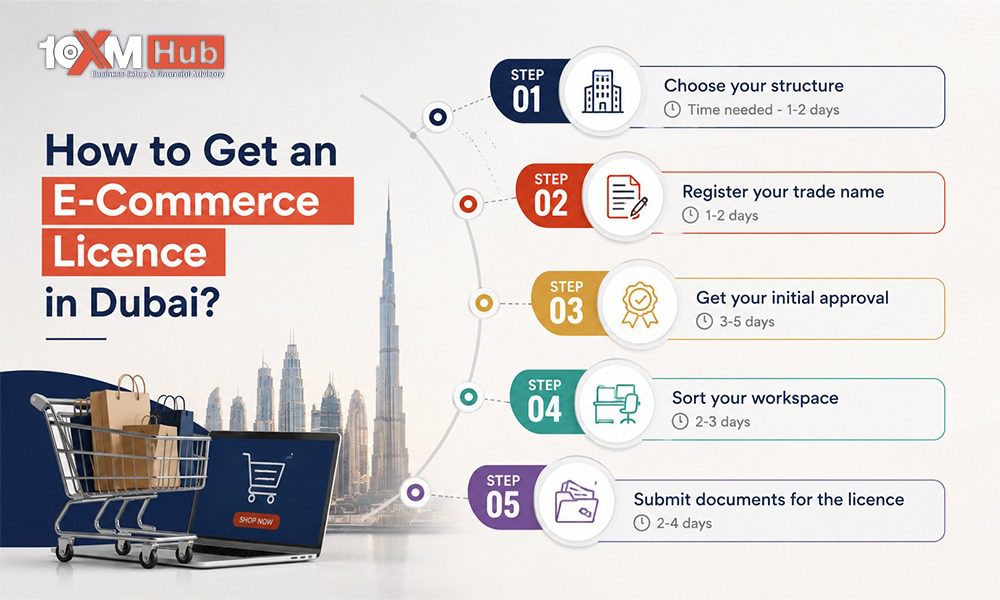
How to Get an E-Commerce Licence in Dubai?

Here is how the process runs from start to finish for Dubai online store licence:
- Step 1: Choose your structure (Time needed – 1-2 days): Start whether you want Mainland or Free Zone first, then decide your structure, and finally, your activities. Getting the activities wrong means fixing it later, which can get expensive.
- Step 2: Register your trade name (1-2 days): Pick three names that do not sound like a government body, does not include anything that will get flagged, such as religious details, and is not just your own name abbreviated. Approval does not take much time when the names are clean.
- Step 3: Get your initial approval (3-5 days): This is the official go-ahead to start building your business infrastructure. If your store involves telecommunications or data networks in any way, you will need a NOC from the TDRA before you can proceed.
- Step 4: Sort your workspace (2-3 days): Mainland setups need a physical lease registered through Ejari. Free Zone setups can go with a flexi-desk or virtual office, which is cheaper and faster.
- Step 5: Submit documents for the licence (2-4 days): Pull all documents together, including approvals, ID documents, the lease agreement, and pay the fees. This should help to get your e-commerce licence.
Once the licence is issued, you can start your visa processes and register with Dubai Customs, which is a must to get the Import/Export Code.
What Documents Do You Need for E-commerce Company Setup Dubai?
The paperwork for online business licence UAE includes:
- Passport copies of all owners, partners, and managers
- Emirates ID and visa page if you already live in the UAE
- Entry stamp or UID number if you are applying from outside the country
- Trade name approval certificate
- An initial approval certificate from your chosen registry
- MOA for Mainland setups or any entity with multiple shareholders
- An Ejari contract for the Mainland, or a flexi-desk allocation for Free Zones
How Much Does an E-commerce Licence Cost in Dubai?
The honest answer is it depends on where you set up and whether a visa is part of the package. Here is Dubai e-commerce licence cost at a glance:
- Budget Free Zones (Sharjah, Umm Al Quwain): For founders who do not need a Dubai address, a licence can cost around AED 5,500 to AED 6,500 a year. It is a legitimate setup but not a Dubai one.
- Dubai Free Zones (IFZA, Dubai CommerCity): A Dubai-registered entity with one visa bundled in sits between AED 12,000 and AED 16,000. The step up in cost buys you something real, as banks and suppliers treat a Dubai address differently.
- Dubai Mainland: You need to have at least AED 25,000 to get started. The headline number starts at AED 15,000 but office costs and other fees add up soon.
Two costs that tend to catch people off guard:
- Establishment Card: AED 1,800 to AED 2,200 yearly, and you cannot sponsor a single visa without it
- Residency Visa: AED 3,500 to AED 5,000 per person, which includes the costs of medical tests and Emirates ID processing
Note: Free Zones often have promotions, include visas into packages, and remove setup fees more often, so always get updated information from your consultant.
Do You Need a Physical Office to Run an Online Business in Dubai?
Yes. Free Zones allow you to operate entirely via virtual office or flexi-desk packages. For Mainland setups, physical space is technically mandatory. However, Dubai’s Instant Licence waives this requirement for your first 12 months.
How Do UAE E-Commerce Regulations Affect Your Online Store?
Three laws matter the most for your online store:
- Consumer Protection Law (Cabinet Decision No. 66/2023): Trade licence number must be mentioned on your storefront, prices should be in AED, and there should not be any surprise charges. The invoices have to be in Arabic.
- TMTM Law (Federal Decree-Law No. 14/2023): Customers need a place to complain and an answer on refunds and warranties. If your return policy is vague, there could be major concerns.
- Personal Data Protection Law (PDPL): Every store collects emails and addresses. You need a privacy policy that covers how you use that data — and you cannot alter it for marketing unless the customer has actively said yes.
Founders who skip these and come back to fix them later always end up paying more.
Which Payment Gateways Can You Use for Your Dubai Online Store?
The gateway you choose affects conversion more than most founders expect. Here are the main gateways for E-commerce business setup UAE.
- PayTabs: The setup takes three to five days, and it handles all GCC currencies without the friction.
- Stripe: Stripe has a neat API and offers easy integration with Shopify and WooCommerce. This is a good choice for subscription-based businesses.
- Checkout.com: Better suited for stores doing serious volume. Settlement in AED is fast.
- Telr: Popular with UAE startups, as the pricing is affordable and setup is straightforward.
Essential Tip: Ensure your gateway supports Apple Pay and integrates popular Buy Now, Pay Later (BNPL) layers like Tabby or Tamara.
How to Source Products and Manage Logistics after E-commerce Company Formation Dubai?
Dubai’s location is genuinely useful here. You are sitting between major manufacturing hubs in Asia and a consuming market that expects next-day delivery. Here is how to take advantage of that:
- Sourcing Your Inventory: Most Dubai sellers source from China through Alibaba and similar B2B platforms. If waiting weeks for a shipment from China does not work for your business, Dragon Mart and the Deira Souks solve that problem. Dragon Mart claims to be the largest Chinese products trading centre outside China, with thousands of suppliers offering diverse products. Dubai’s Deira Souks are wholesale markets located in Old Dubai where locals and tourists barter various products.
- Logistics: Consider choices like Aramex and other UAE-based third-party logistics (3PL) companies that can handle the warehousing, packing, and delivery side while you focus on marketing and your website. This is worth outsourcing from day one if you don’t want to stay concerned about last-mile delivery.
Aspects to sort out before you launch:
- Cash on Delivery: Digital wallets are used extensively, but COD is relevant and is used considerably. Make sure your logistics provider can take care of COD reconciliation and transfers funds on a schedule you can plan around.
- Customs Code: Importing physical goods into a Mainland warehouse requires a Customs Code from Dubai Customs. Free Zone businesses can hold inventory duty-free until products cross into the local market.
How To Sell Products Online In Dubai?
Building and launching your online store in Dubai requires aligning your digital platform with your structure. You cannot simply build a website and start selling, as your technology stack must comply with your licence parameters. Below is the exact process to take your store from a concept to a live digital asset:
Choose E-Commerce Platform
- Shopify & WooCommerce: These are options for solo founders and typical B2C brands in the UAE. They work well with local shipping apps, such as Aramex, and other local payment gateways.
- Magento (Adobe Commerce): This is a good option for a complex B2B enterprise that needs backend features and extensive customisation.
List on Local Marketplaces Through Dubai Traders
Building your own store takes time. While that is happening, the Dubai Traders program gives registered SMEs a faster route to customers. It is a government initiative under the D33 Agenda that gets your products listed on Amazon UAE and Noon with reduced fees and simplified onboarding.
Integrate Your Essential Business Stack
Before you hit “Publish,” ensure your storefront has the following three direct API connections set up:
- Payment Gateway API: Link your approved local processor (such as Stripe or PayTabs) so payments settle cleanly into your bank account in Dirhams (AED).
- Logistics Webhooks: Integrate your courier’s plugin (such as the Shipa or Aramex Shopify app). This generates shipping labels, calculates custom duties if applicable, and sends tracking links to your customers.
- Compliance: You are required to display your Licence number and registered entity name on your website’s footer or “About Us” page.
What Taxes and Fees Apply to E-Commerce Businesses in UAE?
The UAE is still one of the most tax-friendly places to run an online store or e-commerce business. Here is what you would be dealing with:
- Corporate Tax (CT): A 9% CT applies to net profits above AED 375,000. If you meet the Qualifying Free Zone Person criteria, you can bring that rate down to 0%. Businesses earning under AED 3 million in total revenue also qualify for Small Business Relief at 0%.
- VAT: The UAE charges 5% VAT on local sales. You must register once your taxable turnover hits AED 375,000 in a rolling twelve-month period. If your turnover exceeds AED 187,500, voluntary registration is also available.Exports outside the GCC are zero-rated.
- Customs Duties: Mainland imports are charged at 5% of the cost, insurance, and freight value of the goods. Free Zone businesses get an advantage here. You can bring inventory into the zone without duties. The 5% is only for stock that crosses into the Mainland.
For most early-stage e-commerce businesses, the tax burden here is genuinely light compared to most markets.
Common Mistakes to Avoid When Setting Up an E-Commerce Business in Dubai
Most of these are easy to avoid if you know about them early:
- Wrong licence activity for marketplaces: A standard e-commerce retail licence does not cover a platform where third-party vendors sell. You need a Portal activity licence for that.
- Assuming your Free Zone covers local delivery: Some founders pick a remote Free Zone for the low cost and later discover they cannot deliver directly to UAE customers without a Mainland distributor. Check this ahead.
- Ignoring what banks actually look for: Your licence can be ready in days. Your bank account is a different story. Banks want to see a live website with AED pricing, a refund policy, and a privacy disclaimer before they approve anything.
- Spending everything on setup and forgetting renewals: Your licence, establishment card, and workspace allocation all renew annually. Founders who do not budget for this get hit with fines that wipe out what they saved on the initial setup.
- Skipping Dubai Customs registration: Your e-commerce licence does not give you the right to import goods. That requires a separate Customs Code from Dubai Customs. Without it, your inventory sits at the border.
How Long Does It Take to Set Up an E-Commerce Company in Dubai?
The time to get your e-commerce store ready depends on your chosen jurisdiction and setup route:
- Mainland Instant Licence: This is the fastest route. If you utilise the Invest in Dubai portal, your digital license can be issued in under 1 hour (or up to 24 hours), completely bypassing the initial physical office check.
- Standard Free Zones: A standard digital e-commerce setup in agile Free Zones like IFZA or Meydan typically averages 2 to 5 working days from the time you submit your verified passport scans.
- Standard Mainland: A traditional Mainland company setup involving custom Memorandum of Association (MOA) drafting and registration takes 5 to 10 working days.
The Post-Licence Reality: While getting the licence is fast, you must budget an additional 2 to 4 weeks to complete your medical checks, get Dubai Customs Code, and bank account compliance.
Conclusion
Dubai rewards founders who do their homework before they start. The market is real and the setup process is genuinely accessible to foreign entrepreneurs. Get steps right and everything else becomes easier. Get them wrong and you spend the next twelve months fixing what should have been sorted in week one. If you want to skip that part, the team at 10XMHub works with founders at every stage of the setup process, right from picking the right hub to getting your store live.
FAQs
1. Can a foreigner own 100% of an e-commerce business in Dubai?
Yes. Both Free Zone and Mainland setups allow full foreign ownership.
2. What is the cheapest way to get an e-commerce licence in Dubai?
A budget Free Zone licence starts at AED 5,500, but Mainland licences can cost much more. That does not include visa or other fees.
3. Do I need a warehouse or office to start selling online?
No. A virtual office or flexi-desk is enough to get licensed. Most founders outsource storage and fulfilment to a 3PL provider.
4. Does CT apply to e-commerce businesses in the UAE?
Yes, but CT is only applicable on net profits over the threshold of AED 375,000. Free Zone companies that meet the QFZP criteria can hold that rate at 0%.
5. How quickly can I get my e-commerce licence?
A Mainland Instant Licence through the Invest in Dubai portal can come through in under an hour. Free Zone setups usually take two to five working days.
 info@10xmhub.com
 +971522527368