Dubai has been a popular choice for ambitious founders, tech innovators, and solopreneurs in the UK, and the reasons are incredibly valid and worth exploring, especially in the current time. Once seen as a vacation spot with incredible luxury options, the UAE has turned out to be the best choice for many British business owners looking to expand their wealth, escape tax pressures back in the UK, and scale internationally.
The UAE offers everything that entrepreneurs and investors need, right from no taxes on personal income and zero dividend tax, to 0% Capital Gains Tax (CGT), 100% foreign ownership in Free Zones, and an effective system that doesn’t take away business profits entirely. Also, there are the relevant advantages of living here, including the quality of life, unmatched infrastructure, safety, and a vibrant networking culture. Here’s why Dubai has become the hub for UK Entrepreneurs. We also have UAE corporate tax explained for UK businesses.
What Are the UAE Tax Advantages Over the UK?
When considering the idea to relocate your business or starting in the UAE, understanding taxation is critical for both locations. The UAE has built a system to reward growth, and that is completely different to the UK’s high-rate tax environment. Here is exactly how the UAE tax advantages stack up against the UK.
Corporate Tax (CT) Structure
- The UK Framework: As per HM Revenue & Customs (HMRC), the UK levies a standard 25% main rate on corporate profits exceeding £250,000. For smaller profits between £50,000 and £250,000, there is marginal relief with a tax rate of up to 26.5% within that band.
- The UAE Advantage: The UAE features a competitive, flat 9% CT rate. However, this only applies to taxable net profits exceeding 375,000 AED (approximately £80,000). Any business profit below this threshold is subject to a 0% CT rate. UK founders establishing their setups within designated Dubai Free Zones can qualify for a 0% CT rate on qualifying income.
Personal Income and Capital Gains
- The UK Burden: Personal income tax in the UK scales dramatically up to 45% for high earners, penalising individuals who take substantial salaries. Furthermore, CGT stands at 24% for higher-rate taxpayers, which reduces the payout if you decide to sell your business or personal assets.
- The UAE Advantage: The UAE has no personal income tax, no matter how much you earn or take as a bonus from your business. Also, there is no capital gains tax, ensuring that any future exit, sale, or asset disposal doesn’t impact what you take.
Dividend Distributions and Extraction
- The UK Burden: Extracting profits via dividends in the UK has become notably expensive. Outside of a small £500 tax-free allowance, basic-rate taxpayers face a 10.75% tax, while higher-rate taxpayers are hit with 35.75%. Additional-rate taxpayers pay 39.35% on company profits.
- The UAE Advantage: The UAE imposes a 0% tax on dividends. Business owners can distribute profits from their UAE entities directly to their personal accounts without losing money to withholding or distribution taxes.
Indirect Taxes and Hidden Levies
- The UK Burden: More than income taxes, UK business owners also have to deal with a 20% VAT rate on almost everything, alongside insurance contributions for both employers (13.8%) and employees.
- The UAE Advantage: While the UAE does have a VAT rate, it is kept at a low rate of 5%. Also, there are no payroll taxes, drastically lowering the cost of hiring people.
While the UK system creates extensive tax friction, the UAE system ensures that your revenue remains untouched, offering a predictable space to build your legacy.
UAE vs UK Tax Comparison: How Big Is the Difference?
To understand UAE vs UK corporate tax rates, you need to check the differences. In the UK, a business is taxed on its profits, the founder is taxed to extract those profits as dividends, and any eventual sale of the company faces steep capital gains hit. In Dubai, that entire multi-layered cycle is replaced by a single, low corporate rate, while personal income remains taxed at 0%.
Here is a table on UK vs UAE tax comparison:
| The Tax Matrix: UK vs. UAE |
| Tax Category |
United Kingdom (2026) |
UAE / Dubai (2026) |
| Corporate Tax |
19% to 25% |
0% up to AED 375,000 (£80k); 9% above (0% in Free Zones) |
| Personal Income Tax |
Up to 45% |
0% |
| Capital Gains Tax (CGT) |
Up to 24% |
0% |
| Dividend Tax |
Up to 39.35% |
0% |
| Standard VAT |
20% |
5% |
| Payroll Tax / National Insurance |
13.8% (Employer) |
0% (for expatriates) |
What Are the UAE Tax Benefits for UK Entrepreneurs Specifically?
Relocating your business activities from the UK to the UAE opens up specific advantages that directly address the pain points British founders face under HM Revenue & Customs (HMRC) regulations. The benefits go far beyond tax savings, offering legal protection and asset security.
Here’s more on Dubai tax benefits for UK business owners:
- Protection Under the UK-UAE DTA: The Double Taxation Agreement (DTA) signed between the UK and UAE ensures you are not taxed twice on the same income from your company. Provided you have established non-residence in the UK, the treaty dictates which jurisdiction handles the taxing.
- Elimination of Withholding Taxes: A UAE-registered entity can receive dividends, interest, and royalties from the UK with no withholding tax deducted at source.
- Tax Residency Certificates (TRC): As a business owner in Dubai, you can get a TRC from the FTA. This document is the proof to HMRC that your business is situated in Dubai.
Here’s more on personal tax advantages in UAE:
- Removing the 45% Top Rate Spike: Drawing a big salary or bonus from a UK company pushes you into high personal income tax bands. In Dubai, any salary, director’s fee, or bonus paid from your UAE business is subject to 0% tax.
- Exemption from Dividend Loss: UK dividend taxes reach up to 39.35% for high earners. UAE companies allow you to distribute 100% of your post-CT profits to your account with zero distribution tax.
- No Insurance Obligations: Having a company in the UK means paying 13.8% to Employer National Insurance on salaries. The UAE does not have payroll taxes.
Wealth Preservation and Succession Planning
- 0% Capital Gain: If you build a company in the UK and sell it, you face up to a 24% CGT hit. In the UAE, selling company equity, property, or business assets triggers 0% CGT.
- No Inheritance Tax: The UK enforces a steep 40% inheritance tax on estates for domiciled individuals. Relocating your core assets to the UAE removes those assets from the UK inheritance tax net.
Corporate Exemptions
- Zero-Tax Threshold: For smaller setups, consultancies, or early-stage startups, the UAE CT system waives the 9% rate on all net profits up to 375,000 AED (which is around £80,000) per year.
- Free Zone Optimisations: If your company is set up within a designated Dubai Free Zone, you can structure your activities to qualify for a 0% CT rate on your qualified foreign income.
What is UAE Corporate Tax for Foreign Businesses?
The UAE CT system applies cleanly to foreign-owned businesses based on their setup.
- Free Zone Entities: Foreign businesses within a Free Zone can maintain a 0% CT rate on “qualifying income”. To keep this rate, businesses must maintain economic substance and submit annual audited financials.
- Mainland Businesses: UAE corporate tax for foreign businesses with a Mainland license fixed at a flat 9% CT rate on net business profits.
- Zero-Tax: To support early-stage setups and consultancies, the first AED 375,000 (of annual net profit is taxed at 0%, regardless of whether the business is Mainland or Free Zone. The 9% rate only applies to profits exceeding this amount.
All corporate entities in the UAE, including those owned by foreign investors, must register with the FTA and file a CT return each year, even if there is no tax liability.
Moving business from UK to UAE: Is Dubai Really a Tax-Free Business Destination?
The short answer is no, but it remains one of the most tax-efficient options in the world. Here is a breakdown:
- Personal Tax: Genuinely 0%. Salaries, dividends, capital gains, and personal wealth remain untaxed.
- Corporate Tax: A flat 9% CT on business profits exceeding AED 375,000. Profits below this are taxed at 0%.
- Free Zones: You can still achieve a 0% CT rate indefinitely, but it is now conditional on maintaining physical office substance and earning qualifying income.
What Are the Personal Tax Advantages of Living in the UAE?
While the CT system in the UAE has evolved, the personal tax advantages remain intact. For UK founders who transition residency to Dubai, the relief is immediate and substantial. The UAE completely removes the multi-layered personal taxes that heavily penalise high earners and wealth creators in the UK.
Here is a breakdown:
- 0% Personal Income Tax: In the UK, personal income tax is progressive and can reach up to 45% for earnings over £125,140. In contrast, the UAE has no personal income tax. Whether you draw a small salary from your business, get paid as a director, or earn from rental assets or properties, everything lands in your bank account.
- 0% Tax on Dividends and profit Extraction: Extracting corporate profits in the UK is a friction point, with dividend tax rates reaching as high as 39.35%. The UAE charges 0% tax on dividend distributions. Once your company pays its CT (if applicable), you can distribute the profits directly to your accounts without losing a fraction to withholding or distribution taxes.
- 0% CGT: If you sell shares in a company, cryptocurrencies, or sell investments in the UK, the CGT could be as much as 24%. The UAE has no tax on capital gains. This makes Dubai a better choice for founders who wish to build equity, reuse their profits, or plan an exit.
- NO Hidden Payroll Levies: The UK system applies NICs to employee salaries, creating an extra burden on top of income tax. The UAE has no national insurance or social security taxes for expatriate residents. What your business pays you is exactly what you keep, with no mandatory deductions eating into your cash flow.
By removing income, dividend, and capital gains taxes, Dubai allows UK founders to compound their wealth at a much faster rate. Every pound saved from tax can be used for scaling the business, investing, or elevating your lifestyle.
How Do UK Founders Actually Save Tax by Moving to the UAE?
To understand the impact of relocating, let’s look at a scenario comparing a UK founder running a tech consultancy versus the exact same business in Dubai.
The Scenario
- Founder: A UK tax resident running a tech consultancy.
- Annual Net Profit: £250,000 (approx. AED 1,170,000).
- The Plan: The founder takes a basic salary and uses remaining profits through dividends to fund their life and investments.
Scenario A: Staying in the UK
Operating as a UK Limited Company, the tax burden hits at multiple stages:
- CT: The UK charges a 25% rate on profits over £250,000.
- HMRC takes: £62,500
- Remaining corporate profit: £187,500
- Dividend Tax: The founder takes £187,500 as dividends. After a small allowance of £500, this income is taxed across higher bands.
- MRC takes (approx.): £68,500
- Total Tax Paid to HMRC: £131,000
- Take-Home Cash: The founder gets £119,000 of the £250,000 profit. The effective rate is over 50%.
Scenario B: Moving to Dubai
The founder shifts operations to Dubai and sets up a Free Zone entity.
- CT: The UAE has a flat 9% on profits, but the initial AED 375,000 is taxed at 0%.
- Taxable profit subject to 9%: £170,000
- UAE Federal Tax Authority takes: £15,300
(Note: If the founder qualifies for Free Zone exemptions, this corporate tax drops to £0).
- Personal Income & Dividend Tax: The founder extracts the remaining £234,700 into their bank account. The UAE personal tax rate is a flat 0%.
- The UAE Government takes: £0
- Total Tax Paid to UAE: £15,300 (or £0 in a qualifying Free Zone).
- Take-Home Cash: The founder keeps £234,700.
By changing their residency to Dubai, the founder legally saves up to £119,400 every year on the exact revenue. This is how UK founders save tax in UAE. Over a three-year period, that is over £350,000 in retained wealth that can be used to reinvest in business growth and other things. While technically having a tax free business Dubai is possible, you need to consider all aspects during the setup to see if you can get a 0% CT rate.
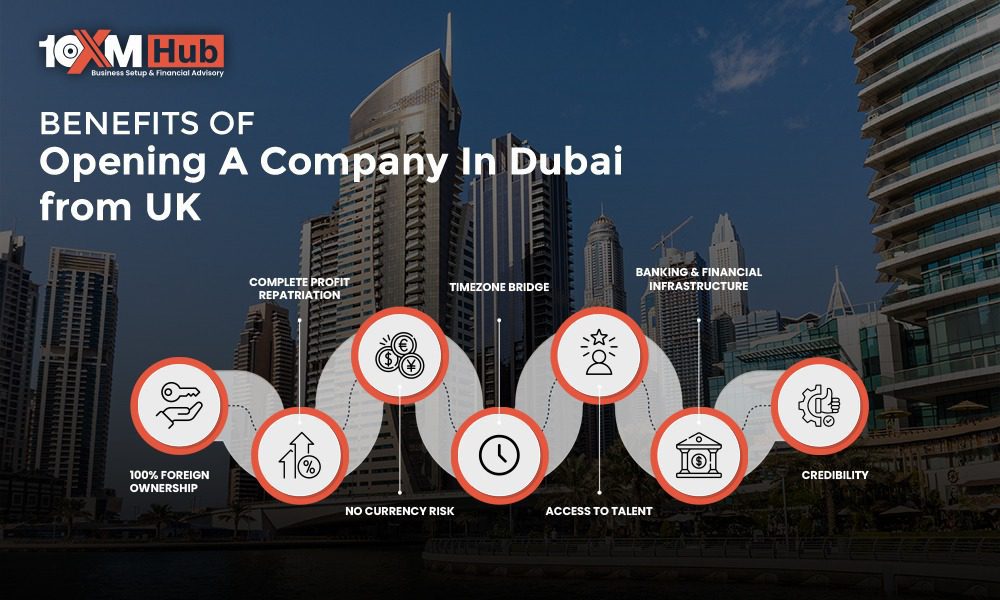
What are the Benefits of Opening A Company In Dubai from UK?

Opening a company in Dubai provides massive operational and financial advantages that go beyond tax savings.
Here are the benefits for UK entrepreneurs:
- 100% Foreign Ownership: Dubai allows UK founders to retain complete, 100% ownership of their Free Zone companies without the need for a local Emirati partner.
- Complete Profit Repatriation: There are no currency controls or restrictions on moving capital. Every business income can be moved back to the UK or distributed to global accounts without any fines or extra spending.
- No Currency Risk: The AED is pegged to the USD at a rate of 3.67. By invoicing clients in USD or AED, you insulate your revenue from the recent volatility of the GBP.
- Timezone Bridge: Dubai is only 3 or 4 hours ahead of London, and this allows you to manage UK clients or team members easily while tapping into Asian and European markets earlier in your workday.
- Access to Talent: Dubai’s immigration system allows you to hire remote or local workers without much effort and complicated steps, bypassing the restrictive post-Brexit visa rules.
- Banking & Financial Infrastructure: You can open bank accounts that support transactions in many currencies, making it efficient to run certain companies, such as a digital agency, e-commerce store, or SaaS services.
- Credibility: Operating from Dubai shows that your business is a true and compliant international player. The city is known as a growing and future-oriented business hub, giving you an edge when pitching clients.
These are evident reasons why UK entrepreneurs move to Dubai.
What is the Process for UAE Business Setup for UK entrepreneurs?
Setting up a business in Dubai as a UK entrepreneur is a structured process. The UAE government has simplified registration to a point where much of the initial work can be managed from the UK. However, because Dubai regulates businesses by their commercial activities, exploring the administrative steps requires planning. Here is more on the Dubai company setup from UK.
Phase 1: Strategic Choices & Legal Foundations
Step 1: Select Your Jurisdiction
Mainland vs. Free Zone: You must first decide where to position your business. For most UK digital agencies, consultants, and tech founders, a Free Zone is preferred because it offers 100% foreign ownership, simplified customs, and tax exemptions. If your business model requires trading directly within the local UAE market or pitching for government contracts, a Mainland setup is necessary.
Step 2: Define Your Exact Business Activities
The UAE needs you to select specific, permitted activities from a directory of over 2,000 choices. Your selected activities dictate your license type, such as Commercial, Professional, or Industrial, and impact which banks will accept your account application.
Step 3: Get Approval for Trade Name
You must submit your proposed company name to the relevant Free Zone authority or the DET. The UAE has strict laws, and names cannot use abbreviations or initials, and must not contain religious terms, among other things.
Phase 2: Incorporation & Regulatory Filings
Step 4: Document Preparation
You will need to get personal and relevant business documents ready. For UK nationals, this includes passport copies, proof of residential address, and a business plan outlining your expected revenue and market audience.
Your entity requires a foundation document. For simple Free Zone setups, this is a company formation document or Articles of Association. For complex partnerships or Mainland companies, you will draft an MOA outlining share capital distribution and director powers.
Step 5: License Issuance
After submitting your application and paying the government fees, the authority will issue your Trade License and Corporate Registration certificate.
Phase 3: Residency and Financial Activation
A valid trade license allows you to establish a physical and financial presence in the region.
- Visa Track: Your company will need an internal Establishment Card, allowing you to sponsor your visa. While the initial paperwork is handled digitally, completing your residency requires a medical fitness exam and registering biometrics at a government centre to get your physical Emirates ID. You have to be in Dubai for these things.
- Bank Account Opening: UAE commercial banks operate under strict AML (Anti-money Laundering) and KYC guidelines. You must present your Trade License, proof of residency, banking history from the UK, and an explanation of your cash flow pipeline to get your account approved.
Note: The process doesn’t completely end once your bank account is active. You must register for CT within the deadline, maintain accounting records, and ensure your business has adequate economic substance to remain compliant.
What are the UAE Residency Benefits for UK Business Owners?
Getting residency in the UAE is the step that makes Dubai an operational anchor for your business and lifestyle. For UK business owners, obtaining a visa or a 10-year Golden Visa provides protections, asset privacy, and freedoms that cannot be accessed as a standard visitor.
The major UAE residency benefits for British entrepreneurs include:
- Proof of Non-UK Tax Residency: Holding a UAE residence visa allows you to spend most of your year outside the UK, helping break tax ties under HMRC’s Statutory Residence Test (SRT). Once you have a physical Emirates ID, you can apply for an official TRC from the FTA. This document is recognised under the UK-UAE Double Taxation Treaty and works as proof to HMRC that your personal income is no longer subject to UK taxes.
- Self-Sponsorship: Having a UAE business allows you to directly sponsor your visa as a company investor or director. Ambitious founders running tech startups, SMEs, or those with real estate investments can access the 10-year Golden Visa. This removes the need for frequent renewals and gives you stability to scale your business.
- Family Integration: The UAE visa system ensures minimal disruption to your household. As a business resident, you have the right to sponsor visas for your spouse, children, and parents. Under the Golden Visa program, the age limits for sponsoring children are extended, and the visa remains active for your dependents even if the founder passes away during the term.
- Access to Financial Ecosystems: Becoming a resident opens access to premier personal banking, multi-currency accounts, and credit facilities. Local financial institutions have better mortgage rates, auto loans, and corporate lines of credit for legal residents who have a clear credit profile and verifiable local substance.
- Property and Utilities: A residency visa serves as the pass for a quality daily life in Dubai. You can sign residential leases for a longer period and register your home with the Ejari. UK license holders can exchange their British driving license for an official UAE driving license after getting their Emirates ID, bypassing the need to sit for local driving tests.
- 10-Year Visa Advantage: Unlike usual residence visas, which expire if the holder remains outside the UAE for more than six consecutive months, the 10-year Golden Visa allows you to travel across the world to manage clients without risking your UAE status.
What Should an UK Entrepreneur Moving to Dubai Know?
Relocating your life and business to Dubai may sound like a perfect step, but it is not as simple as booking a flight to the UAE and turning off your phone to avoid UK laws. To protect your wealth and avoid missteps, there are a few critical realities worth knowing.:
- Setting up a Company Doesn’t Automatically Erase UK Tax
The most common mistake founders make is assuming a Dubai trade license instantly severs their ties with HMRC. The UK determines your tax status based on the SRT, which evaluates the exact number of days you spend in the UK alongside your remaining ties. If you relocate to Dubai but return to live in the UK within five tax years, HMRC can retrospectively tax the capital gains and certain corporate distributions you made while living abroad.
- CT is Now a Reality in the UAE
The days of the UAE being a completely tax-free zone for businesses are over. The country has modernised its tax system to align with international standards. You have to pay the 9% CT rate on business profits exceeding AED 375,000. While Free Zones still offer a 0% CT rate, it is conditional. Your business must have qualifying income and maintain physical economic substance within that zone.
- Banking Requires Patience
While launching a company in Dubai takes only a few days, opening a business bank account is rigorous. UAE banks follow strict AML and KYC norms, and you must prove your financial record, show active UK bank statements, provide proof of wealth source, and demonstrate a presence in the UAE. Most banks will also require you to maintain a minimum average balance per month.
While you save on personal income tax, Dubai is an expensive city to live in, and you must budget for overheads. Renting a home in Dubai often requires paying for the entire year upfront, while there are also hidden business expenses. You will also have to pay annual fees to renew your license, get health insurance for yourself and your staff, and renew leases for office spaces as required.
Is Moving Your Business from the UK to the UAE Right for You?
Deciding to relocate your business and life from the UK to the UAE is ultimately about calculation. It requires looking past the excitement of a low-tax system and analysing how the shift fits your business goals, client base, and growth.
To determine if making the move to Dubai is the right path for your enterprise, assess where you stand against these three core factors:
- Your Revenue: If your business is in its early stages with unstable cash flows, the overhead of establishing a company in the UAE might outweigh the tax benefits. However, if your business generates over £100,000 in profits after taxes and you find yourself penalised by the UK system because of laws, the math tilts in favour of the change.
- Client Base: Digital-first business models, such as SaaS platforms, e-commerce brands, global consultancies, and remote digital agencies, are uniquely suited for Dubai. Because these models do not rely on local distribution or storefronts, they can easily fit into a flexible UAE Free Zone.
- Exit Strategy: If your ultimate goal is to build equity and develop a major business exit or asset sale within the next few years, the UAE’s no Capital Gains Tax works better.
Verdict: Planning Your Next Steps
Relocating your business requires careful execution. Setting up a trade license in the UAE is relatively easy, but aligning that setup with your activities, opening banking accounts, and ensuring you cleanly exit the UK tax net requires precision.
When you are ready to explore the logistics, working with an experienced partner makes a major difference. Connect with the team at 10XMHub, who focus on guiding international founders through the nuances of UAE company setup, structuring, and compliance. They can help with the process with local expertise to ensure the transition is smooth and compliant.
 info@10xmhub.com
 +971522527368