More British entrepreneurs are now relocating and expanding into the UAE, often because of the unmatched opportunities and tax benefits. The Financial Reality: Operating out of Dubai allows UK founders to trade a complex British tax system for 0% personal income tax and a highly attractive 9% CT rate.
Bolstered by the UK-UAE Comprehensive Economic Partnership Agreement (CEPA), setting up a business in Dubai as a British citizen has never been faster, more streamlined, or more secure. This guide deconstructs everything you need to know about navigating company formation, selecting a jurisdiction, understanding double taxation treaty, and managing your UK tax residency transition seamlessly from afar. Here’s more on how to start a business in Dubai from UK.
Can a UK Citizen Start a Business in Dubai?
Yes, UK citizens can 100% start, own, and operate a business in Dubai, with no requirement for a local Emirati partner or sponsor in most sectors. You do not need to hold a UAE residency visa or physically live in Dubai to incorporate a company, as the entire setup can be managed remotely from the UK. British entrepreneurs enjoy the exact same privileges, protections, and access to local infrastructure as UAE residents.
Why UK Entrepreneurs are Relocating or Expanding to Dubai in 2026
The contrast between the two regions has reached a new level. The UK’s 25% Corporate Tax (CT) rate, coupled with higher personal tax thresholds and National Insurance burdens, can reduce profits, whereas Dubai offers a 9% CT on business profits exceeding AED 375,000, and there is no personal income tax. Here are the key reasons that persuade a UK resident start business in Dubai.
- Capital Gains Preservation: British business owners face the threat of increased CGT at home upon selling shares or selling a company, making Dubai’s 0% capital gains and 0% inheritance tax an incredibly attractive combination for preserving wealth.
- Post-Brexit Drag: Continued stagnation, increasing inflation, and red tape in the UK have stalled business growth, pushing investors to move to Dubai’s ecosystem, which means business from day one.
- Geographic Bridge: Dubai is in a time zone that allows entrepreneurs from the UK to finish their morning calls with clients in Asia-Pacific, manage their day across the Middle East, and catch the London market opening by afternoon.
- UK-UAE CEPA: The UK-UAE Comprehensive Economic Partnership Agreement has reduced trade barriers, reduced tariffs, and streamlined digital services, making business expansion fluid.
- Infrastructure and Safety: Business owners are also moving due to the UAE’s unparalleled infrastructure, a cashless business system, and a great standard of safety and high-end lifestyle.
- Access to VC: The Middle East is experiencing an unmatched VC boom, with wealth funds and private equity firms actively deploying billions into tech, Web3, SaaS, and D2C brands. Having a Dubai business places UK founders in the path of this funding pool.
- Golden Visa: The UAE’s 10-year Golden Visa acts as an anchor and incentive for talent. UK founders can get this visa for themselves, families, and teams, while hiring global talent without the muggy immigration issues and quotas currently faced in Britain.
- Future-Proof Mindset: While UK businesses have to deal with shifting policies, Dubai ensures clarity through initiatives like the D33 Economic Agenda. The government here is geared towards helping businesses through initiatives that actually help.
Dubai Mainland vs Free Zone for UK Businesses: Which Should You Choose?
The decision between the Dubai Mainland and a Free Zone is the most critical choice a UK entrepreneur will make. Mainland companies are governed by the Department of Economy and Tourism (DET) and operate under UAE Federal Law. Free Zones are self-governing enclaves, each tailored to specific industries with their own independent regulations. Here’s more:
- 100% Foreign Ownership: Historically, UK founders chose Free Zones solely because Mainland setups required a 51% local Emirati partner. However, following amendments to laws, UK citizens can now claim 100% foreign ownership on the Mainland for over 2,000 activities. This has shifted the decision matrix, making Mainland setups competitive for British businesses.
- Market Access: If your business model is about selling services or physical goods directly to local consumers within Dubai and the wider UAE, the Mainland is your only option. Free Zone companies are restricted to trading within their specific zone, internationally, or B2B through local distributors. If a Free Zone company wants to sell to Mainland UAE consumers, they must engage a local agent or pay an e-commerce customs duty.
- Physical Office: Physical space is handled very differently across these two jurisdictions. Mainland companies are required to lease a physical office space, and the Ejari must be verified before the license is issued. Free Zones offer far more flexible options for remote UK founders, with affordable flexi-desks, co-working spaces, or virtual office packages that fulfill the address requirement without the overhead.
- Corporate Tax: Both structures are subject to the UAE CT system, but Free Zones offer an advantage known as Qualifying Free Zone Person (QFZP) status. If a Free Zone company generates Qualifying Income, it can maintain a 0% CT rate on those profits. Mainland companies, on the other hand, strictly pay a flat 9% CT on all taxable net profits exceeding AED 375,000.
- Team Scaling: Mainland companies enjoy an uncapped visa quota directly tied to the physical office space, and this is typically 1 visa per 80-100 square feet. This makes Mainland ideal for UK businesses planning to scale in Dubai. Free Zone licenses come with pre-packaged visa allocations, which is usually 1 to 5 visas per flexi-desk. Scaling more than that requires upgrading to a physical office within that zone.
- Banking and Auditing: While both grant access to UAE banking, Mainland companies often face a slightly simpler onboarding process because their footprint is local and transparent. Free Zone companies face Anti-money Laundering AML scrutiny, especially if their revenue is international. Additionally, many Free Zones make it necessary to submit annual audited statements to renew the license, whereas Mainland licenses have annual renewal protocols.
Dubai Mainland vs Free Zone for UK businesses:
| Comparison Matrix: Mainland vs. Free Zone |
| Feature |
Dubai Mainland |
Dubai Free Zone |
| Authority |
DET |
Individual Free Zone Authority |
| Ownership |
100% Foreign Ownership for 2,000+ activities) |
100% Foreign Ownership guaranteed |
| Trade Scope |
Unrestricted trade |
Limited to international trade, B2B within Free Zones |
| Physical Office |
Mandatory physical office space |
Flexi-desk, virtual office allowed |
| CT Rate |
9% on net profits over AED 375,000 |
0% on Qualifying Income |
| Visa Allocation |
Scalable and linked to office |
Fixed allocation |
| Government Tenders |
Can bid for government contracts |
Ineligible for government contracts |
What are the Best Free Zones for Dubai Company Formation for British Citizens?
Choosing the correct Free Zone is not just a matter of finding the lowest price. The choice impacts your business ecosystem, banking success, and remote operations from the UK. Dubai has 25+ Free Zones, each engineered for specific industry clusters. Here are some options for Dubai Free Zone company setup.
- IFZA: Situated within the DSO, IFZA is one of the most prevalent choices for UK freelancers, solopreneurs, and e-commerce companies. It allows founders to combine up to seven different business activities across categories under a single license without charging extra.
- Meydan: Located near Downtown Dubai, this zone has a 100% digital and paperless setup system. It is appealing to UK consultants and digital agencies because the usual license permits businesses to trade on the UAE Mainland using a MoFA-approved LLC structure.
- DMCC: Located in JLT, DMCC has been the top Global Free Zone multiple times. It is the destination for UK companies handling commodities like energy, gold, tea, diamonds, as well as tech fields like Web3 and crypto.
- DIFC: For UK fintech startups, hedge funds, asset management firms, or legal entities, DIFC is the conclusive option. It works under its own English common-law judiciary system, making it familiar and secure for institutional operations.
- DAFZA: Situated next to Dubai International Airport (DXB), DAFZA is built for UK import/export, engineering, and FMCG businesses. It has cold-storage units, bonded warehouses, and fast customs clearance lanes that pointedly reduce supply chain friction.
- Dtec: Operated by the DSO, Dtec is a technology incubator space and is suited for British software developers and SaaS founders. There are tech-specific co-working spaces, lab spaces, and mentorship channels.
| Top Dubai Free Zones for UK Entrepreneurs |
|
| Free Zone |
Focus |
Top Advantage for UK Founders |
Entry Price |
| IFZA |
Freelancers, E-commerce, Consultants |
Combines up to 7 distinct activities under 1 license |
From ~AED 12,900 |
| Meydan |
Luxury Brands, Digital Agencies, Services |
100% remote digital setup in under an hour |
From ~AED 12,500) |
| DMCC |
Crypto, Web3, Commodities |
B2B networking, immense prestige |
From ~AED 20,000+) |
| DIFC |
Fintech, Banking, Venture Capital, Legal |
Judicial system based on English Common Law |
High-End Tier |
| DAFZA |
Logistics, Aerospace, Import & Export |
Closeness to DXB airport; rapid customs handling |
Premium Corporate |
| Dtec |
Tech Startups, SaaS, AI Development |
Tech-focused workspace community |
Moderate |
Can I Open a Dubai Company Without Living There?
Thanks to Dubai’s “Digital First” governance, you can start UAE company remotely. You can complete name reservations, upload documents, and sign your MOA entirely from your laptop in the UK. You can legally own 100% of the corporate shares and act as the sole director without holding a UAE residency visa, an Emirates ID, or physically relocating. Once approved by the relevant Free Zone or the DET, your trade license is issued electronically as a secure PDF directly to your inbox.
Remote founders can bypass expensive leases by utilizing flexi-desk packages to satisfy the legal address requirement. So, while you can open UAE company remotely from UK, opening a local UAE corporate bank account often requires stricter compliance, video verification, or occasionally a single, short trip to Dubai. In short, entrepreneur relocation is a complex aspect, especially with DTA agreement in place (more on that later).
How to Open a Company in Dubai from the UK?

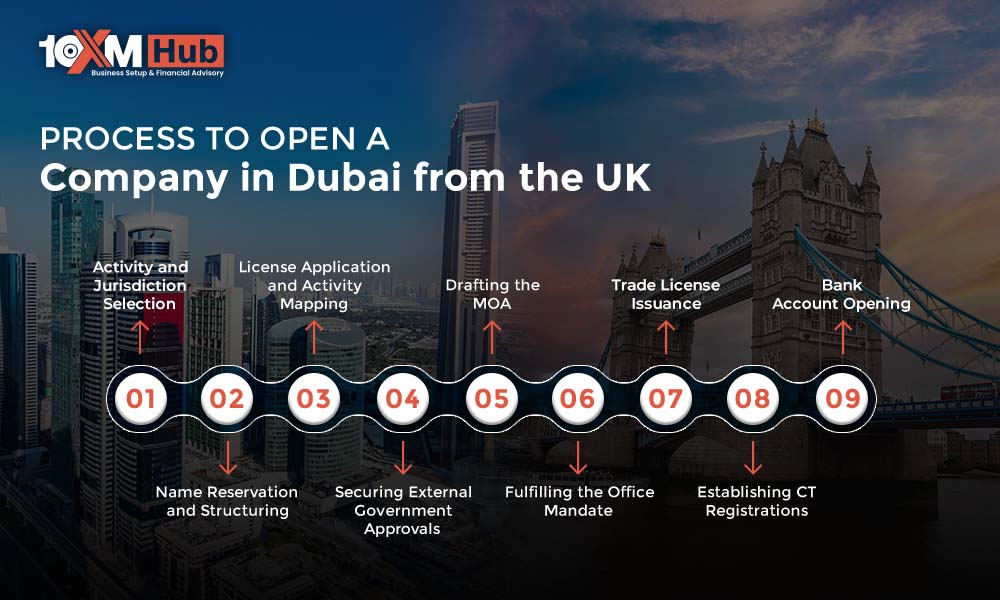
While marketing brochures often pitch Dubai company setup as a simple process, the reality involves moving through a web of intersecting federal laws, municipal approvals, and jurisdiction regulations. Attempting to manage this across time zones from the UK without expertise is a high-risk approach. Here are the steps for Dubai Business Setup from UK.
Step 1: Activity and Jurisdiction Selection
The process begins by defining your exact scope of activity, which dictates the structure. Selecting the wrong activity, or mismatching it with a Free Zone that cannot support it, will crash your model before it begins. You must meticulously evaluate whether your business model requires a Dubai Mainland setup under the DET or a specific enclave among Dubai’s 25+ Free Zones, weighing the long-term tax, visa, and trading trade-offs of each.
Step 2: Name Reservation and Structuring
Next, you must submit three prospective trade names for screening. The UAE maintains strict naming guidelines that surprise many British entrepreneurs. Names cannot include religious terms, political references, established brand names, or offensive language, and they must mirror your chosen structure.
Step 3: License Application and Activity Mapping
Once your corporate name is secured, you must formally apply for your License, which could be Commercial, Professional, Industrial, or Tourism-focused. This step requires compiling documentation, including your business plan, passports, and corporate structure details. If your activities bridge multiple sectors, your application requires custom drafting and negotiation with government registrars.
Step 4: Securing External Government Approvals
Depending entirely on your industry, a trade license is often legally insufficient to begin trading. If your UK business is in fintech, cryptocurrency, healthcare, logistics, engineering, or education, your application is halted until you get secondary approvals from specialised regulatory bodies, such as the DFSA, the KHDA, or DHA.
Step 5: Drafting the MOA
The MOA or AOA is the bedrock of your Dubai entity, dictating shareholder voting power, profit distribution, managerial clauses, and dissolution terms. For Mainland setups or complex Free Zone structures, this document must be drafted to align with UAE Federal Law and notarised. Minor errors or generic templates downloaded online routinely lead to exposure or rejection by the notary public.
Step 6: Fulfilling the Office Mandate
To get your license, your company must establish a physical address within Dubai. This step represents a massive hurdle for remote UK founders. You must either source and execute an Ejari contractor or formally secure a compliant flexi-desk or virtual office lease through the Free Zone authority.
Step 7: Trade License Issuance
Once the authorities approve your lease, verify your MOA, and screen shareholder backgrounds, they will issue your License and Certificate of Incorporation. While receiving this document marks the birth of your Dubai company, your business is still locked. You cannot legally hire staff, import goods, invoice global clients, or process credit card payments until you complete other steps.
Step 8: Establishing CT Registrations
Upon license issuance, the compliance countdown begins. As a part of Dubai company setup for British citizens, the FTA requires all companies, including those operating within Free Zones, must register for CT within a strict timeframe from their incorporation date
Step 9: Bank Account Opening
This is recognised as the single most challenging and stressful step in setting up a business in Dubai from the UK. Due to intense global AML and CTF compliance, UAE banks subject non-resident British founders to extreme scrutiny. You must have bank statements, verified proofs of funds, wealth documentation, and business trails.
In short, UAE business setup for UK entrepreneurs is a complete process, which is why just simply referring to marketing brochures won’t help.
How Much Does it Cost to Start a Company In Dubai from the UK?
One of the biggest pitfalls for UK entrepreneurs planning a Dubai setup is believing marketing material. In reality, company formation in the UAE functions on a multi-tiered cost structure. Here is an overview:
- License Fees: Your cost is heavily dictated by where you start your business. A budget-oriented Free Zone license, such as IFZA or Meydan, with zero-visa setup can vary between AED 12,500 to AED 14,500 per year. If you opt for a premium hub like DMCC or require a Dubai Mainland license, the license fee jumps to AED 18,000 to AED 25,000+, depending on your combination of activities.
- Real Estate Premium: To get and renew a trade license, every Dubai company must map to a physical address. For remote UK founders, Free Zones offer “Flexi-Desk” or virtual office spaces, which are bundled with your license fee for an extra AED 3,000 to AED 6,000 per year. However, if you choose Mainland, you are obligated to execute a property lease. Sourcing an office with a verified Ejari easily adds AED 25,000 to AED 50,000+ in annual overheads.
- Visa and EC Fees: To sponsor yourself, family, or your team, your company must first start the immigration profile through an Establishment Card. This can cost around AED 1,800 to AED 2,500 and requires annual/biennial renewal, which means paying each year. Additionally, each visa costs roughly AED 4,000 to AED 7,000. This figure includes fitness screenings, biometric processing, and health insurance.
- Hidden Costs: Besides the visible setup steps, there are also statutory costs that catch British founders off guard. Document legalisation is a major bottleneck. The UAE is not part of the Apostille Convention, meaning any UK corporate documents or personal certificates used during setup must be formally attested by Foreign, Commonwealth & Development Office (FCDO) in the UK and then legalised by the UAE Embassy in London. This process costs roughly £300 to £500 per document. Additionally, setting up corporate profiles on the FTA portal to comply with CT laws can incur advisory fees ranging from AED 2,000 to AED 5,000.
- Bank Onboarding Fees: Given the forensic compliance checks implemented by UAE banks for non-resident British nationals, attempting a DIY setup frequently leads to rejection. You should hire a professional service provider to handle mapping, legal document drafting, government liaison, and executive banking introductions. The cost of this can vary.
What are the Options for a Dubai Business Visa from the UK?
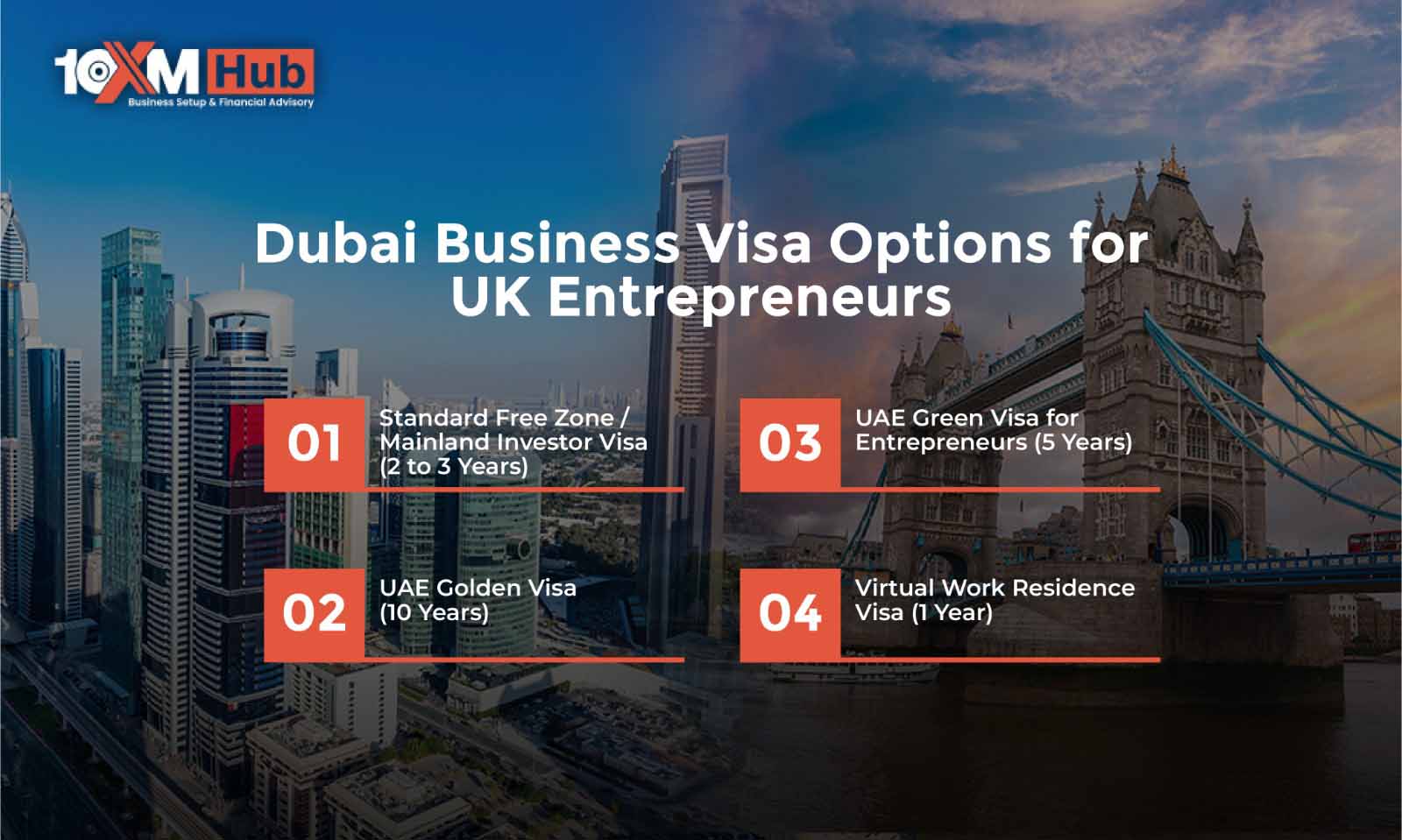
Setting up a company in Dubai unlocks the right to apply for a UAE visa. For UK residents, it is possible to go beyond the 30-day tourist visa and access business and investor visas. Here are the options for UAE residency through business setup.
- Standard Free Zone / Mainland Investor Visa (2 to 3 Years): This is the most common option for British business owners. After setting up your company, your license serves as the direct sponsor for a 2-year (Mainland DET) or 3-year (Free Zone) renewable investor/partner visa. This grants you residency, family sponsorship rights, and the ability to obtain an Emirates ID.
- UAE Golden Visa (10 Years): A coveted option for UK founders with higher net worth seeking stability without regular renewals. To qualify through the entrepreneur or investor stream, you must have a business project or public investment valued at AED 2,000,000 (~£430,000) or more. Alternatively, you can have to secure an endorsement from an accredited UAE incubator for an innovative startup valued at over AED 500,000.
- The UAE Green Visa for Entrepreneurs (5 Years): Working as the middle ground, the Green Visa provides a 5-year, self-sponsored visa. Designed for freelancers, self-employed professionals, and business partners, it requires approval of your investment track record through the ICP investor rating system. There is no need for corporate sponsorship.
- Virtual Work Residence Visa (1 Year): A popular choice for British digital nomads, remote consultants, and solo agency owners who want to test the waters in Dubai before relocating here. This 1-year, self-sponsored visa allows you to live in Dubai while continuing to work for your UK employer or managing your pre-existing UK entity, provided you can prove a monthly income of USD 3,500 to 5,000.
Biometric and Other Mandates: While you can complete your license paperwork remotely from the UK, getting any visa requires you to physically travel to Dubai. You must pass a medical fitness screening and register your biometric data at an official Emirates ID center.
Also, authorities subject incoming UK applicants to thorough background checks. To get approval across any of these visa tiers, founders must maintain a clean criminal record, clear global AML checks, and purchase a compliant health insurance policy.
Can UK Residents Own 100% of a Dubai Company?
Yes, UK residents can legally maintain 100% solo ownership of a Dubai company, retaining complete equity and voting power. Free Zones have inherently guaranteed 100% foreign ownership since their inception, allowing British founders to bypass local sponsors entirely. Following updates to laws, the historical requirement for a 51% local Emirati shareholder on the Mainland has been permanently removed for 2,500+ activities.
Under a 100% foreign-owned structure, you can freely repatriate 100% of your net profits back to the UK or global accounts. Complete foreign ownership is only barred in high-security or regulated sectors, such as defense, oil and gas, and specific banking activities.
What is UAE Corporate Tax for UK Entrepreneurs?
The standard CT rate is set at a flat 9% on all taxable net corporate profits, not gross revenue. Here are some details about UK tax implications after moving to Dubai.
- Net Profit Exemption Threshold: To protect startups and small businesses from immediate tax liability, the FTA enforces a protective 0% tax threshold. Corporate net profits up to AED 375,000 (~£80,000) have a 0% tax rate, meaning you only pay the 9% rate on the slice of net profit that climbs above this threshold.
- Free Zone 0% Dual-Tier Reality: If you establish your company inside a Dubai Free Zone, you are fully within the tax net but can get the 0% CT rate as a QFZP. This coveted 0% rate applies strictly to “Qualifying Income,” which includes revenues from trading with other Free Zone entities or engaging in international activities.
- Penalty for Mainland Trading: If your Free Zone company generates revenue by selling services or goods directly to consumers or unapproved businesses on the Dubai Mainland, that is classified as “Non-Qualifying Income.” This Mainland-sourced income is hit with the standard 9% tax rate. If your total non-qualifying revenue is more than the de minimis threshold, which is 5% of your total revenue or AED 5 million, your entire company loses its QFZP status for that tax year.
- Auditing Rules: Maintaining a 0% tax status inside a Free Zone requires more than a paper presence. Your company must pass the strict “Adequate Substance Test” by showing CIGAs (Core Income Generating Activities) are conducted within the zone, supported by a certain number of qualified local employees, sufficient expenditures, and the submission of audited financial statements per year.
- Window for Small Business Relief: For UK entrepreneurs operating on the Dubai Mainland or as standard taxable entities, the UAE offers a critical transitional buffer known as Small Business Relief. If your total gross operational revenue remains at or below AED 3,000,000 (~£645,000) for the current tax period, you can actively elect to report your taxable income as zero. However, this specific relief program expires on December 31, 2026.
- Strict CT Registration Deadlines: It is a dangerous misconception that tax-exempt or 0% Free Zone companies can ignore the tax system. Every single business in Dubai must formally register for CT with the FTA and get a TRN.
What Are the UK Tax Implications If You Move Business from the UK to Dubai?
Acquiring a UAE visa does not automatically sever your tax obligations to the HM Revenue and Customs (HMRC). The UK taxes its residents on their worldwide income, meaning if you fail to break your UK tax residency, your Dubai business profits remain exposed to UK income tax rates of up to 45%.
- The SRT Matrix: Your tax status is strictly governed by the UK’s rigid Statutory Residence Test (SRT). The SRT evaluates your presence in the UK alongside your lingering connections across three distinct phases: the Automatic Overseas Tests, the Automatic UK Tests, and the Sufficient Ties Test. To claim non-resident status, you must manage your travel and domestic connections so you do not trigger any UK residency parameters.
- The “90-Day Myth”: A critical mistake made by relocating British founders is assuming they can spend up to 90 days a year in the UK without consequence. Under the SRT’s Sufficient Ties Test, the number of midnights you can spend on UK soil drops sharply based on how many connections you retain. If you keep a UK family home, have a spouse or minor children in the country, or carry out sporadic work days, your allowance can quickly drop to just 45 or 16 days per tax year.
- Definition of a UK Work Day: HMRC maintains a broad definition of what constitutes a “work day.” Suppose you spend more than three hours in a single day performing any corporate duties while on UK soil, including sending emails, reviewing corporate documents, or joining virtual board meetings, that is categorised as a UK work day. Exceeding 40 of these days automatically activates a work tie.
- Temporary Non-Residence Trap: If you return to the UK and re-establish tax residency within five years of your leaving, you fall into HMRC’s Temporary Non-Residence rules. Under this, any capital gains realised on personal assets you held prior to leaving, or distributions and dividends extracted from your close companies while living in Dubai, are hit with a UK tax bill in the exact year you return.
- Retained UK Property and the NRLS: Relocating to Dubai does not absolve you of taxes on UK-sourced income. If you choose to retain and rent out your British residential or commercial properties, the amount is subject to UK income tax. Also, you must register for the NRLS to ensure your letting agent or tenant doesn’t withhold a flat 20% tax at source.
- Mid-Year Departure Complexities: Leaving the UK halfway through a tax year forces you to navigate the intricate rules of Split-Year Treatment to avoid paying UK tax on your Dubai earnings. Because qualifying for this relief is difficult and scrutinised by HMRC, tax strategists often advise entrepreneurs to plan their relocation and launch as close to April 6 as possible.
Does the UK-UAE Double Taxation Agreement Benefit British Business Owners?
The UK-UAE Double Taxation Agreement (DTA) functions as a shield for British entrepreneurs, establishing clear boundaries to ensure that the exact same profit is not aggressively taxed by both the HMRC and the UAE FTA.
- Elimination of Withholding Taxes: An advantage of the treaty is the reduction of withholding taxes (WHT) on capital distributions across the border. Under the DTA framework, dividends, interest payments, and technology royalty fees routed from a UK entity to its parent or sister company in Dubai are slashed to a 0% treaty rate.
- Residency Tie-Breaker Rules: If your commercial activities or physical footprint cause you to be viewed as a tax resident by both countries simultaneously, the treaty invokes a rigid, sequential set of tie-breaker legal tests. It bypasses basic day-counting to evaluate where your permanent family home is located, where your center of vital interests lies, or where your abode is anchored, preventing dual-taxation traps.
- International Business Profits: Under Article 7 of the DTA, the corporate profits of your Dubai-registered business are exclusively taxable within the UAE. HMRC cannot legally attach a UK corporation tax bill to those offshore earnings, provided your Dubai company does not cross the line to trigger a “Permanent Establishment” back in the UK.
- Capital Gains: For British founders restructuring their assets, the DTA mandates that capital gains derived from the disposal of movable corporate property, equities, or non-publicly traded shares are taxable only in the country where the seller holds tax residency. By securing a UAE TRC, UK founders can exit or liquidate their Dubai company holdings entirely under the UAE’s 0% capital gains tax system.
- PE Prohibitions: The benefits of the DTA instantly collapse if your Dubai company triggers a UK Permanent Establishment. If you sit in London and regularly sign executive contracts, or if you manage core operations through a UK office or warehouse, HMRC holds the legal right under the treaty to classify your Dubai business as a shadow UK entity, exposing your revenue to the UK’s 25% CT rate.
Is VAT Registration Mandatory for a UK Entrepreneur?
VAT in the UAE operates at a consumption-based rate of 5%. As a UK entrepreneur running a Dubai company, you are not automatically registered for VAT when you get the license. The registration is based on your 12-month taxable turnover or your projected revenue over the next 30 days.
- Threshold: If your business is resident in the UAE, you are legally required to register for VAT if your taxable supplies and imports exceed AED 375,000 (~£80,000). Once your trailing ledger or incoming contracts cross this milestone, you must submit a registration application to the FTA within 30 days.
- Voluntary Registration: To assist early-stage startups and small businesses, the FTA allows for voluntary VAT registration once your taxable turnover exceeds AED 187,500 (~£40,000). Registering voluntarily can be beneficial for UK founders with high initial setup costs, as it unlocks the right to reclaim the 5% input VAT paid on local office leases, corporate equipment, and consultancy services.
- Zero-Rated International Trap: A massive point of confusion for UK software developers, digital marketers, and agencies setting up in Dubai is how international sales are handled. If your Dubai company provides remote services or exports goods to clients based entirely outside the GCC, those supplies are taxed at a 0% rate. Crucially, zero-rated does not mean exempt. Zero-rated revenue is still classified as taxable turnover, meaning you must still register for VAT once your invoice clears the AED 375,000 threshold, even though your net VAT bill to the government will be 0%.
- Non-Resident Zero-Threshold Rule: If you attempt to operate an offshore structure or manage transactions as a non-resident entity without a fixed local place of establishment in the UAE, the standard AED 375,000 safety net will not exist. Non-resident businesses making a taxable supply within the UAE must register for VAT immediately from the very first Dirham earned, unless there is a local buyer who can legally account for the tax via the Reverse Charge Mechanism.
- Penalties for Late Compliance: The UAE has a penalty framework for VAT evasion or negligence. If your business crosses the mandatory threshold and you fail to submit your registration for VAT within the 30-day window, the FTA applies a non-negotiable administrative fine of AED 10,000 (~£2,150), besides compounding interest penalties on any unfiled tax liabilities.
What is an Offshore Company in Dubai and is it Right for UK Founders?
A Dubai offshore company is a non-resident entity designed exclusively for international business operations, which means it cannot lease office space or trade within the UAE market. It functions primarily as a holding company to own global assets, intellectual property, or real estate, rather than a trading vehicle for digital services or consulting. It offers 0% corporate and personal tax, asset protection, and high privacy, as shareholder registries remain confidential.
Note: While it is cheap to set up, opening a corporate bank account for a Dubai offshore company is incredibly difficult. Premier UAE banks often reject non-resident offshore profiles due to AML compliance.
Is it right for UK Founders? It is generally not recommended for UK entrepreneurs or freelancers. If your goal is to invoice international clients, hire staff, or secure a residency visa, a Free Zone setup is far superior, more compliant, and vastly easier to manage.
Can You Use Nominee Services for Dubai Company Formation as a British Citizen?
A nominee arrangement involves appointing a licensed service provider or a third-party individual to stand in as the registered shareholder, director, or General Manager for your company’s paperwork, shielding your name.
- Public Anonymity vs. Legal Disclosure: While British citizens can legally use nominee services in Dubai to maintain discretion or manage administration, true secrecy from the government is next to impossible. Under the UAE’s strict UBO laws, every business must declare its actual UBO to the authority within 60 days of incorporation.
- 100% Direct Ownership Obsoletes Nominees: Historically, foreign investors relied heavily on local Emirati nominee shareholders to meet the need for a 51% local partner on the Mainland. Now that the UAE guarantees 100% direct foreign ownership across both Free Zones and the vast majority of Mainland activities, the need for a nominee shareholder to bypass restrictions is almost gone.
- Banking Bottleneck: If you choose to utilise a nominee structure, your biggest obstacle will be opening a bank account. Due to rigorous global AML and CTF protocols, many UAE banks mandate a forensic look through every layer of your structure, requiring the real British beneficiary to submit source-of-wealth, personal bank statements, and identity documents.
- Safeguards to Retain Control: If you do deploy a nominee structure, you must never rely on a verbal agreement. You are legally required to execute a matrix of secondary contracts notarised via the Dubai Courts to guarantee that all financial, voting, and dividend rights remain securely in your hands.
- Complacency: Relying on undisclosed or poorly documented nominee relationships to mask ownership from the FTA is classified as a violation of UAE tax evasion and compliance laws. Failing to maintain an accurate Register of Nominee Directors at your office, or lagging more than 15 days in reporting any changes to the ownership, can mean automated penalties and compliance blocks on your license.
How Do You Open a UAE Business Bank Account from the UK?
While setting up your Dubai company takes days, opening the bank account takes weeks or months. Due to strict AML laws, UAE banks treat non-resident British founders as high-risk clients.
Step 1: Choose the Right Route
Traditional Tier-1 Banks, including Emirates NBD and Mashreq, are best for stability, multi-currency accounts, and handling a large number of transactions.
Digital Banks / Neo-banks: Recommended for remote UK founders. They offer faster onboarding and a digital interface, though they have stricter initial deposits.
Step 2: Prepare Your Documents
You must provide unedited, certified PDFs of the Trade License, MOA, and Share Certificates. Also, you must submit a detailed Business Plan outlining your exact revenue model and client base. Also required are 6 months of personal or corporate bank statements from your UK business to prove the source of wealth. A proof of address in the UK is also necessary.
Step 3: Establish a Local Footprint
Banks want to see local substance. You must provide a valid office lease, an active local phone number, and a website that clearly maps to your chosen license activities.
Step 4: Execute Verification
While Neo-banks allow passport scanning via mobile apps, traditional UAE banks require the primary director/shareholder to meet a bank representative in Dubai to sign the final application, verify the UK passport, and finalise biometric checks.
How Long Does Dubai Company Formation Take for UK Residents?
Timeline is as follows:
- Phase 1: License Issuance (1–5 Days): Free Zone licenses take 2 to 5 working days. Mainland DET setups take 7 to 14 days.
- Phase 2: Visa (1–2 Weeks): Processing the Establishment Card takes 3 days. Once issued, you must fly to Dubai for a 5-to-7-day process for medical tests and biometrics.
- Phase 3: Banking Onboarding (4–12 Weeks): While digital neo-banks activate in 1 to 2 weeks, tier-1 UAE banks run compliance checks that take 1 to 3 months.
Should You Move Your Business from the UK to Dubai or Just Expand There?
Moving your business to Dubai means winding down or liquidating your UK company and shifting all contracts, IP, and ownership to a new UAE entity. This model is ideal if you are completely severing your UK tax residency, moving your life to Dubai, and looking to shield all future global revenues.
Expanding means keeping your existing UK company active to serve clients there while establishing a separate sister company in Dubai for international work. This is best if you have an established UK workforce, local infrastructure, or a client base that requires a British entity for VAT and invoicing ease.
What UK Entrepreneurs Must Know Before Setting Up in Dubai?
Here is a list:
- Tax Reality Check: While personal income tax remains at 0%, Dubai enforces a flat 9% CT on net business profits exceeding AED 375,000.
- Free Zone “Tax Exemption“: Incorporating in a Free Zone does not guarantee a 0% tax rate. To qualify, your business must meet complex “QZFP” rules, maintain physical substance and derive income from approved international or B2B transactions.
- Tax Trap Back Home: Getting a UAE residency visa does not mean HMRC stops tracking you. If you fail to break your UK tax residency under the SRT, the UK can still tax your global income at rates reaching up to 45%.
- Banking Barrier: Setting up the company structure takes only a few days, but opening a bank account takes between 4 and 12 weeks due to intense scrutiny of non-resident British founders.
- Registrations: Even if your business falls under the 0% tax tier, you are required to register for CT with the FTA. Missing this registration window means a fine of AED 10,000 (~£2,150).
Conclusion
Transitioning your business from the UK to Dubai is a great move for wealth preservation and global expansion, but the complexity requires careful execution.
From mapping activities to banking compliance, the decisions you make during the initial phase will dictate your success. Consider consulting with a specialised Dubai business setup firm as soon as you are clear about the move. At 10XMHub, consultants ensure your company formation, CT structuring, and residency ways are aligned with UAE federal laws and HMRC guidelines. Talk to an expert before the first move.
 info@10xmhub.com
 +971522527368