 info@10xmhub.com
 +971522527368


Do You Need a Local Sponsor to Start a Business in the UAE Mainland?
Published on : June 16, 2026
The UAE remains the preferred destination for global entrepreneurs, offering a pro-business environment. Investors entering the market must choose between two distinct legal jurisdictions: Free Zones and Mainland setups.
Free Zones are designated geographical areas that have traditionally offered 100% foreign ownership, 0% personal tax, and fast setup, though they restrict companies from trading directly with the onshore UAE market without an intermediary. Mainland entities are onshore businesses registered under each Emirate’s Department of Economic Development (DED), allowing completely unrestricted trade nationwide and direct bidding on government contracts.
Historically, setting up a Mainland company required a local Emirati sponsor to hold a 51% stake, which was a deterrent for investors and founders from other countries. New changes to the Commercial Companies Law have changed this. Here’s more on local sponsor UAE Mainland requirements.
A Mainland company is an onshore entity registered under the DED of a specific UAE Emirate. Unlike Free Zone entities, a Mainland company in most cases faces zero restrictions and can trade freely across all local UAE markets, GCC nations, and global destinations.
For most commercial licenses, there is no restrictive minimum capital requirement dictated by the government during the setup. Mainland businesses can open physical offices, retail storefronts, and warehouses anywhere within the chosen Emirate’s onshore territory. There are also scalable visa quotas, allowing businesses to recruit and sponsor an unlimited number of employees.
The bedrock of the UAE Commercial Companies Law (CCL) was based on years of regulation that focused on local participation with UAE nationals holding the majority of shares in onshore businesses. Under the 51/49% rule, any foreign investor looking to have a Mainland Company was restricted to holding a maximum of 49% of equity, while a local sponsor was required to hold the remaining 51%.
UAE Commercial Companies Law (CCL) was formed based on years of regulation that focused on local participation with UAE nationals holding the majority of shares in onshore businesses.
This restrictive system was changed with new decrees, including the implementation of Federal Decree-Law No. 20 of 2025. This decree completely changed the Federal Decree-Law No. 32 of 2021 on Commercial Companies. UAE 100% foreign ownership Mainland law changes include:
Can foreigners own 100% Mainland Company UAE or do I need a local sponsor in UAE? These are often the usual questions asked by businesses looking to invest in the UAE. Expatriates, international companies, and global investment funds can absolutely enjoy full, 100% legal ownership of a Mainland company in the UAE without losing any equity or voting rights to a local Emirati partner. The Federal Decree-Law No. 20 of 2025 permanently changed the regulatory default from protectionist local majority ownership to open global equity control. UAE sponsor requirement 2026 changes include:
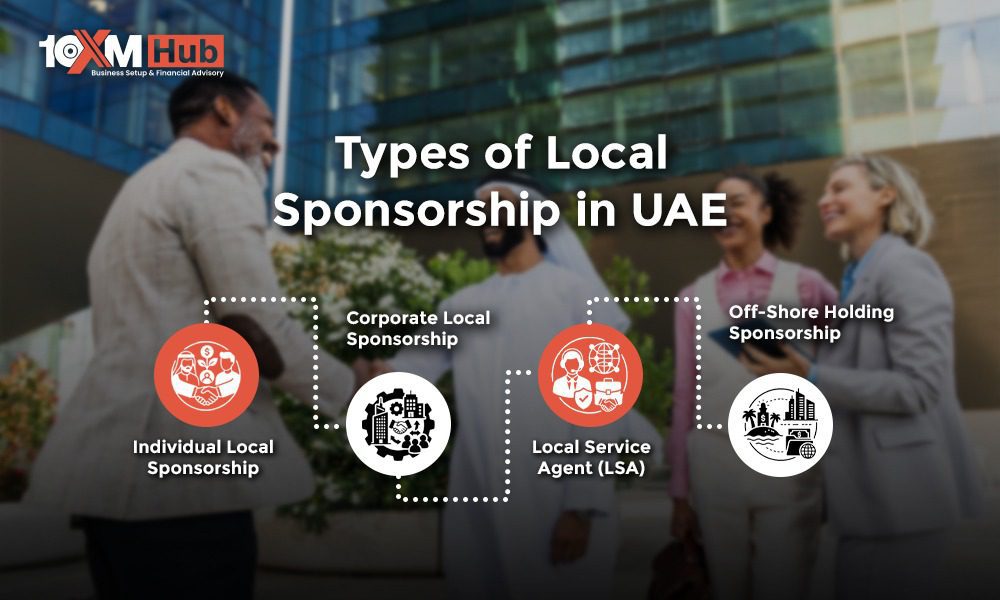
While Mainland Companies can have 100% foreign ownership without the need for an Emirati partner across many sectors, local sponsorship remains a vital legal requirement for companies operating within protected industries. This list includes defence, security, oil and gas, and regulated financial sectors or for legacy structures seeking specialised market entry. To understand Mainland company ownership rules UAE, you must know about sponsorship types and differences.
Individual Local Sponsorship
This arrangement involves a single UAE national who is an Emirati citizen, acting in their personal capacity, who becomes the legal majority shareholder of your Mainland company. By default, under civil law for restricted sectors, the individual sponsor must hold at least 51% of the company’s equity shares, leaving the foreign investor with a maximum 49% stake.
Corporate Local Sponsorship
In this model, the 51% shareholder on your Mainland trade license is not an individual person, but a UAE-owned corporate entity, which is a company 100% owned by Emirati citizens. This structure is considered the safest path for multinational corporations and enterprises with higher capital requirements, requiring a local partner. Because you are contracting with a registered company rather than an individual, the partnership is entirely insulated from personal life events, health issues, or sudden demise.
Local Service Agent (LSA)
The Local Service Agent arrangement is reserved for professional licenses, civil companies, and artisanal setups, such as medical clinics, legal consultancies, architecture firms, accounting practices, or engineering consultancies.
Note: Under recent Mainland Company ownership rules, the requirement to appoint an LSA for opening a branch office of a foreign company or a Free Zone company on the Mainland has been removed, offering cost savings for corporate expansions.
Off-Shore Holding Sponsorship
This advanced corporate architecture utilises a common-law financial free zone, such as the DIFC in Dubai or ADGM in Abu Dhabi. to hold the Mainland company’s shares. So, how does this work? A foreign investor establishes a Prescribed Company or Special Purpose Vehicle (SPV) within the DIFC or ADGM. This offshore holding entity then enters into a joint venture or nominee arrangement with a local sponsor to hold the 51% shares of the onshore Mainland LLC.
Shareholding structures for Mainland Companies work under the regulatory architecture of Federal Decree-Law No. 32 of 2021 on Commercial Companies, and this further had an I impact due to the Federal Decree-Law No. 20 of 2025. These laws dictate how equity is allocated, how voting rights are spread, and how liability is managed.
1. LLC Multi-Shareholder Model
The LLC remains the widely utilised shareholding option on the Mainland, representing roughly 70% of all onshore registrations. An LLC requires a minimum of one shareholder and can scale up to a maximum of 50 shareholders. These shareholders can be individual persons, corporate entities, or international holding groups.
With new laws, the equity model has shifted to the default of 100% foreign ownership for over 2,500 commercial, industrial, and trading activities. The equity is divided into equal, indivisible shares, with each shareholder’s financial liability capped at the value of the share capital contributed by them. Previously, civil law required that all shares in an LLC carry identical economic and voting rights, matching a flat proportional equity model.
Differentiated Rights in LLCs: Following the 2025 updates, Mainland LLCs can now issue multiple distinct classes of shares. Corporate founders can now design structures with separate Founders’ Shares, which have voting rights to ensure control, Preferred Shares, which offer priority dividend payouts and liquidation preferences to VCs, and Restricted Shares, which are used for employee stock option pools or silent partners.
2. Sole Establishment Model
A Sole Establishment has a shareholding structure where 100% of the equity is held by a single individual owner. Unlike an LLC, this structure has no separation between the business entity and the owner. There is no protected shield, and the individual owner carries unlimited liability for debts, lawsuits, and financial obligations.
While UAE and GCC nationals can establish Sole Establishments across all commercial and industrial categories, foreign expatriates can use this structure purely for professional and service activities.
3. The Civil Company Partnership Structure
Designed for Group Professionals: The Civil Company is a shareholding vehicle engineered for licensed professionals, such as doctors, legal consultants, engineers, accountants, and digital branding experts who wish to operate a collective practice. Two or more equity partners can hold up to 100% of the company’s ownership stakes under a professional license.
Similar to a Sole Establishment, partners in a classic Civil Company hold unlimited liability for the firm’s debts. However, it remains highly tax-favoured and ensures easy setup for service businesses that don’t have heavy transactional/supply-chain risks.
Integration of Exit and Protection Mechanics
Capital Contribution
4. Onshore Holding Company
International investors often use a specialised Mainland holding company structure to manage multi-tiered business operations inside the UAE. Under this arrangement, the top-tier Mainland holding company does not engage in direct commercial trading, retail operations, or manufacturing. Its sole purpose is to hold 100% of the equity shares in multiple independent subsidiaries.
By centralising brand intellectual property, real estate assets, and corporate retained earnings inside the holding entity, founders effectively protect their core wealth and simplify expansion.
Shareholder Succession:
Before you start your Mainland business, it is critical to understand that the lines between a “local sponsor” and a “corporate nominee” have completely evolved. Following recent changes in the Commercial Companies Law, choosing the wrong option for legacy sectors can expose your business to numerous risks.
Understanding the Differences
| Nominee vs Sponsor UAE | ||
| Feature | Corporate Nominee | Local Sponsor (Individual) |
| Legal Status of Partner | A 100% Emirati-owned corporate entity. | UAE national citizen acting in a personal capacity. |
| Equity Ownership | Holds 51% legal title to shares via a trust structure. | Holds 51% legal title to shares |
| Economic Rights | 100% contractually assigned to the foreign investor. | Subject to side-letter terms |
| Operational & Voting | Retained entirely by the foreign investor via Power of Attorney. | Subject to interference if the individual demands input. |
| Continuity Risk | Zero Risk. Perpetual existence. | High Risk. Death or incapacitation can mean Sharia laws |
| Fee Structure | Fixed, transparent annual fee. | Subject to increases, hidden costs, or exit penalties. |
| Sign-off Speed | Automated corporate PRO services. | Dependent on the individual’s availability. |
| Compliance & Audit | Matches international corporate governance standards. | High-risk arrangement by global auditors. |
For any business operating in a sector where 100% foreign ownership is excluded, the Corporate Nominee framework is the better choice. It completely reduces the risk for your entity, satisfies compliance, protects intellectual property, and provides the peace of mind needed to scale across the UAE Mainland.
The core cost of local sponsor in UAE or LSA on the Mainland is a fixed, recurring annual service fee. Depending on the complexity of the business setup, the specific Emirate, and the chosen industry, this base retainer typically spans from AED 12,000 to AED 35,000+ per year.
Basic LSA / Sponsor: For single-activity setups for professional or service companies, the cost is within the range of AED 12,000 to AED 15,000 annually.
Institutional Support: Foreign corporate branch offices and multi-activity commercial licenses, generally command AED 18,000 to AED 25,000 annually.
Sector Support: Regulated sectors requiring ministerial approvals or manufacturing companies with higher capital can run from AED 35,000 to over AED 50,000 annually.
Other Expenses to Know
To deduct sponsorship fees as tax-deductible business expenses against the 9% CT norm on profits exceeding AED 375,000, businesses must maintain corporate bank transfer trails, formal invoices, and notarised agreements.
Starting a company on the UAE Mainland without a local sponsor is a digitalised process. Foreign entrepreneurs can secure 100% foreign ownership and total autonomy by bypassing partnership requirements. This requires executing precise steps directly with the DED in your chosen Emirate.
Step 1: Business Activity Selection
Your setup process begins by defining your business operations against the unified DED activity master list, which categorises over 2,500 distinct codes. To eliminate the need for a local sponsor, you must verify that your chosen activities are registered on the Ministry of Economy’s Positive List. Every day, commercial operations qualify for 100% foreign equity control without any hassle.
Note: Selecting the wrong activity code can accidentally push your application into a restricted sector, which means the mandatory 51% Emirati sponsorship requirement.
Step 2: Legal Structure
For the majority of trading, retail, and industrial operations, you will select the 100% foreign-owned LLC structure. This limits your personal liability to your exact capital contribution. If you are a solo entrepreneur operating within service sectors, you can opt for a Sole Establishment, giving you singular control. International corporate groups can choose to establish a direct Branch Office of a Foreign Company.
Step 3: Trade Name Registration
You must submit an application to the DED to reserve your trade name, which will serve as your brand signature across the UAE. Your trade name must not contain offensive language, make references to political or religious organisations, or duplicate any existing trademark inside the country.
Step 4: Getting Initial Approval
You must apply for an Initial Approval certificate from the DED. This document serves as official recognition from the UAE government that there are no baseline legal objections to your foreign investment setup. You must upload passport copies of all shareholders, active visa pages or existing Emirates ID records, and the trade name reservation receipt. Depending on your chosen niche, the DED may mandate additional clearances before the initial approval.
Step 5: Notarising the MOA
If you are choosing an LLC structure with multiple partners, you must draft the MOA. For single-owner entities, an AOA or digital declaration form is used. Your MOA must state that 100% of the equity shares are held directly by the foreign investors with governance clauses, drag-along rights, and partner exit mechanisms. The completed MOA must be officially notarised, and this can be done using digital court notary channels or at an accredited DED service centre where all shareholders virtually sign and execute the document.
Step 6: Registering the Ejari Lease
A Mainland company setup needs a verified physical presence inside the issuing Emirate. You must sign a corporate tenancy contract for an office space, warehouse, or storefront that meets the minimum square-footage guidelines. Once the lease is executed, the property must be registered on the municipal portal to attain an Ejari Certificate.
Step 7: Invoicing and Issuance
Submit your setup file to the DED, including your initial approval, trade name, notarised MOA, and verified Ejari document. The DED issues a consolidated payment voucher, typically including licensing fees, market fees, and municipal property charges, which ranges between AED 10,000 and AED 25,000. After completing the electronic payment, your Mainland trade license is instantly generated.
Step 8: Immigration & Banking Setup
To bring international talent into the UAE, you must register your fresh trade license with the MOHRE and the GDRFA to open your corporate immigration file and receive an Establishment Card. You can also approach banking institutions to initiate corporate account onboarding, which requires submitting clear wealth source records and business plan projections. Your company must be formally registered with the FTA to get a CT Registration Number, to ensure compliance with the 9% federal CT framework for profits exceeding AED 375,000.
The era of mandatory 51% local sponsorship is no longer a barrier for international entrepreneurs entering the UAE. Today, the choice to retain a local sponsor, transition to a structured corporate nominee, or establish an entirely independent 100% foreign-owned LLC relies on your activity codes, market access strategies, and risk tolerance. Bypassing a local partner grants corporate autonomy, access to the onshore economy, and eligibility for government tenders.
If you aren’t sure where to start or need insights for Mainland business setup, connect with the business consultants at 10XMHub. We can help you understand how you can start an onshore business without a local sponsor and how to avoid usual mistakes.


Share this post :





Turn your network into opportunity. Refer clients to 10XMHub and earn substantial rewards for every successful business setup. We handle your referrals with premium support; you gain trusted commissions and long-term partnership benefits.
Please share your details and we’ll contact you shortly.



