Dubai is now an economic powerhouse, moving past AED 3.8 trillion in non-oil foreign trade as reported by Khaleej Times. It serves incredible market access within the UAE and to other continents, supported by an attractive tax regime with extensive exemptions.
If you are entering the UAE market, choosing between Free Zones and Mainland business location Dubai is often confusing, and the latter offers certain benefits that Free Zones cannot match. Free Zones are more ideal for global operations or digital setups, but are also limited by geographic boundaries and cannot trade directly with the local UAE market without an agent. Mainland companies have more onshore commercial freedom, regulated directly by the Department of Economy and Tourism (DET), allowing direct trade across all emirates. Here’s more on how to choose the ideal place for your business and how your office location impacts business success in the UAE.
What is a Mainland Business in Dubai?
A Dubai Mainland business is an onshore company registered under the DET that operates with no geographic limits, allowing direct trade with local UAE consumers, B2B clients, and government entities.
Features and Specifications:
- 100% Foreign Ownership: International investors can maintain full equity and control across standard commercial, trading, industrial, and service sectors. This bypasses the legacy requirement of a 51% local UAE national shareholder and applies to more than 1,000 activities.
- Territorial Freedom: Companies have the right to open multiple retail branches across all emirates without needing a separate local trade license. Businesses can distribute products directly to local consumers, partner with onshore B2B corporations, and have distribution agreements. It also allows bidding for the public sector, semi-governmental, and UAE federal tenders.
- Mandatory Office Space: Mainland licenses must be linked to a physical space, which could be an office, showroom, or industrial warehouse. The commercial lease agreement must be registered to generate an Ejari certificate. Flexi-desks or virtual workspace solutions do not usually meet mainland compliance.
- Visa Quotas: Visa allocations depend on the physical square footage of the registered premises. Companies looking to scale can expand visa quotas by leasing larger spaces or adding branch offices.
License Categories
- Commercial License: This license is for retail stores, trading firms, e-commerce brands handling physical inventory, and traditional import-export operations. Your business can store goods locally, establish retail networks, and manage supply chains. For instance, a brand for consumer goods can get a warehouse in Dubai and supply to supermarkets across Dubai, Abu Dhabi, and Sharjah simultaneously.
- Professional License: This license is meant for corporate service providers, consultancies, digital marketing firms, IT architecture agencies, and legal advisors. The license allows for 100% profit and equity retention for skill-based businesses, through a Local Service Agent (LSA) for administrative and government filings.
- Industrial License: This is the license for large manufacturing plants, material processing facilities, food and beverage factories, and industrial product assembly units. Your company can manufacture products domestically, use local energy incentives, and export goods.
Expectedly, your choice of Mainland business location Dubai should depend on activity and several other factors. Also, it is wise to talk to a business consultant so that you can compare Dubai Mainland vs Free Zone location.
What are the best areas for business in Dubai?
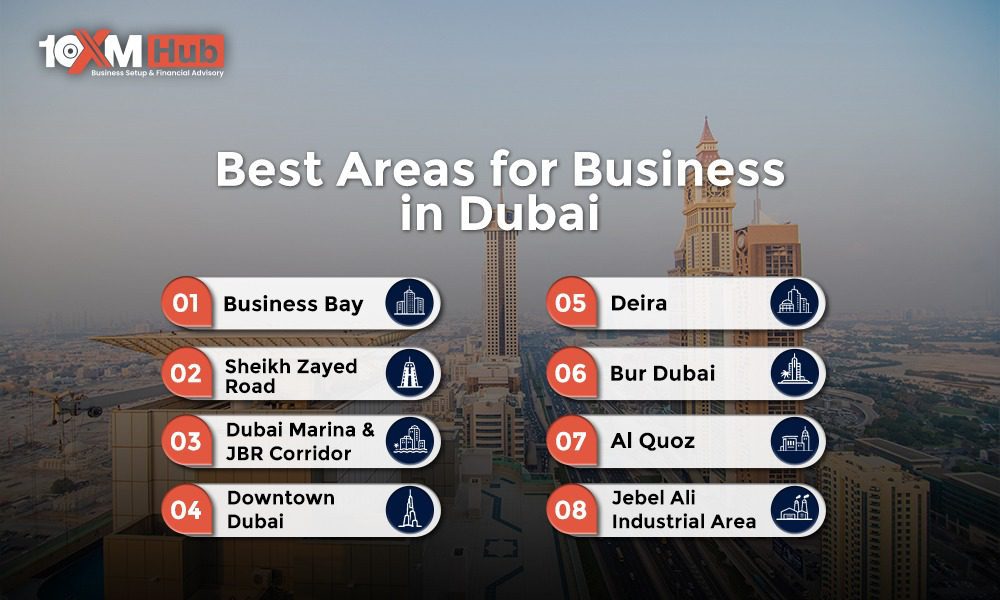
With many commercial areas in Dubai, there isn’t a single answer. For instance, tech and financial companies and consultancies like corporate choices like Business Bay, while retail brands need routes like Sheikh Zayed Road. Logistics or manufacturing firms must look for industrial zones like Al Quoz and Jebel Ali. It all depends on your business and its unique needs, including the audience. Below are the best areas for business in Dubai.
- Business Bay: This is a master-planned district located adjacent to Downtown Dubai. There are high rises, commercial properties on the canal side, and business networks. Your company will be located right next to the Dubai International Financial Centre (DIFC) without the geographic and regulatory constraints of a Free Zone. You get access to high-end infrastructure and upscale corporate offices, making it easier to recruit local and international executives. Business Bay is ideal for consultancies, law firms, private equity groups, real estate firms, and marketing companies that serve bigger firms.
- Sheikh Zayed Road: This is the highway running through the city, lined with some of the most iconic office towers, luxury hotels, and premium commercial properties. If you want brand exposure to daily commuters, this is your choice for having immediate corporate authority and prestige. There is direct connectivity via multiple dedicated Dubai Metro stations, ensuring easy commutes for teams and visiting clients. The location works for retail brands, automotive showrooms, international asset management firms, and real estate companies.
- Dubai Marina & JBR Corridor: This cosmopolitan waterfront district featuring modern high-rise glass towers, pedestrian promenades, and premium retail complexes. Your business will be located within Dubai’s largest concentration of Western expatriates and high-spending professionals. It combines high corporate visibility with an upscale lifestyle environment. This is best for real estate brokerage services, hospitality brands, B2C retail operations, travel agencies, and wellness clinics.
- Downtown Dubai: This is an ultra-modern commercial block featuring incredible office spaces and manicured settings. You get an immediate stamp of elite corporate authority. It is highly attractive to a Western executive demographic that prioritizes a premium work-life balance, high-end dining amenities, and proximity to affluent gated communities. This is the ideal choice for management firms, UK-aligned digital marketing and PR agencies, creative architectural studios, executive search firms, and premium tech consultants.
- Deira: This is one of the older commercial trade centres and among the popular business locations in Dubai, characterised by trading souks, dense retail markets, and offices along the Dubai Creek. You get immediate access to popular trading networks, maritime supply routes, and regional merchant ecosystems. Deira is a good choice for product importers, textile merchants, gold and jewellery wholesalers, and international commodities traders.
- Bur Dubai: This is home to embassy clusters, bank headquarters, and government offices. It brings exposure to the local audience and closeness to government departments. Bur Dubai has more affordable rentals for office spaces and shops compared to Business Bay. The location works for electronics repair centres, local shipping and logistics companies, visa processing services, and retail stores.
- Al Quoz: This is a large industrial area divided into industrial zones and modern warehouse parks. Nestled between Sheikh Zayed Road and Al Khail Road, Al Quoz ensures access to the northern and southern districts of Dubai and is preferred for that reason alone. There are oversized commercial warehouses that can be further designed for industrial storage, manufacturing, or retail experiences. If yours is an e-commerce fulfilment hub, automotive workshop, or engineering service, this is one of the Dubai commercial zones which you can consider.
- Jebel Ali Industrial Area: This is an industrial zone located on the western edge of Dubai, next to the Port and major freight rail lines. It reduces supply chain transport costs for companies dependent on heavy cargo containers arriving via sea or overland freight. You can get large land plots, manufacturing permits, and utility connections tailored for continuous factory operations. This is the best choice for manufacturing plants, freight forwarders, building material factories, and chemical processing facilities.

| Location |
Pros |
Cons |
Ideal for |
| Business Bay |
Close to Downtown Dubai & DIFC, Premium tower spaces, corporate ecosystem, extensive network access. |
Premium rental rates., traffic congestion |
Management consultancies, law firms, private equity groups, tech startups |
| Sheikh Zayed Road (SZR) |
Brand exposure and highway visibility, close to Dubai Metro stations, premium addresses. |
Highest office costs, high property turnover |
Luxury retail, automotive showrooms, asset managers, real estate |
| Dubai Marina & JBR Corridor |
Cosmopolitan waterfront district, access to high-spending expat demographic, beach-adjacent retail, visibility with an upscale lifestyle. |
High rental premiums, traffic bottlenecks on weekends, limited space, high real estate brokerages |
Wellness clinics, retail operations, travel advisories, hospitality brands |
| Downtown & Dubai Hills Business Park |
Ultra-modern commercial blocks, appeal to Western demographic, Grade-A office spaces, close to residential communities |
Expensive leases and strict aesthetic and fit-out guidelines |
Wealth management firms, marketing & PR agencies, architectural studios, premium tech consultants. |
| Deira |
Access to trade networks & shipping lanes along Dubai Creek, lower rental, volume of walk-in buyers. |
Parking constraints, aging buildings, vehicle congestion. |
Trading firms, traditional import/export, bulk distributors |
| Bur Dubai |
Closeness to embassy clusters & government offices, location between old and new Dubai, rental alternatives, local residential consumers. |
Lack of premium commercial towers, traffic delays, strict signage regulations |
Documentation typing centres, electronics repair, logistics agencies, retail services |
| Al Quoz |
Large physical properties, link between Sheikh Zayed Road and Al Khail Road, zoning for different needs, cheaper rental spaces. |
Limited access to metro lines, industrial truck traffic, high summer cooling costs |
E-commerce fulfilment hubs, cloud kitchens, automotive workshops, creative design |
| Jebel Ali Industrial Area |
Closeness to Jebel Ali Port, heavy industrial utilities, large land plots, lowest cost per square foot for vast land sizes. |
Remote location, longer daily commutes, limited retail or corporate amenities. |
Manufacturing plants, freight forwarders, chemical processing, building material factories |
How to choose a business location in Dubai?
Before you check for the right business location on the Dubai Mainland, consider four factors: Customers, total costs, infrastructure, and government activity zoning. Balancing these factors can change your physical workspace from an operational expense into a highlight for revenue growth. So, what factors to consider before choosing? Here is an overview.
Target Audience: B2B vs. B2C
- Your location must match the daily patterns of your primary buyer profile. B2B companies, such as corporate services, legal firms, and asset managers, need visibility and short travel times to regional boardrooms. If you choose a service office in a corporate hub like Business Bay, you can ensure credibility during client onboarding. Closeness to financial nodes like the DIFC speeds up transaction signing and expands the overall networking scope.
- For B2C companies, such as fitness studios, cafes, and premium boutiques, two aspects matter the most: Foot traffic and wealth density. A luxury fashion brand will benefit from being positioned in main corridors like Sheikh Zayed Road or commercial blocks in Jumeirah. Setting up a retail store in a remote area solely to save on monthly lease costs increases your costs of customer acquisition.
In other words, office location impact on business success UAE cannot be undermined and should be checked for many aspects.
Occupancy Cost
Many founders often miscalculate their budget by looking only at the base rent numbers on real estate flyers. DET applies an annual municipality tax calculated as 5% of your property’s total lease value, which is an added expense. This fee is added to your trade license activation and renewal invoices and is a fixed cost. Real estate transactions need a 5% to 10% refundable security deposit paid to the landlord, and this must be paid upfront. Broker commissions add an immediate 5% fee on the total annual lease value.
Infrastructure
Many office spaces are given on lease as raw concrete structures without flooring, ceilings, or internal wiring. Mechanical, electrical, and plumbing installations need certified contracting teams and approvals from the Dubai Municipality. Monthly expenses also add to expenses, including cooling fees, corporate telecom packages, and DEWA security deposits.
Logistics
- An office space that is difficult to reach or navigate can create bottlenecks that hurt retention rates and client relationships. During peak commuting hours, a commercial workspace located within a 5-to-10-minute walk from a metro station holds an advantage. Having access to public transit improves your recruitment, allowing you to hire top talent who choose not to drive daily.
- Typical commercial tower leases allocate only one dedicated parking space per 1,000 square feet of office space. You need to check the cost and availability of RTA parking zones and visitor parking bays. Trading, distribution, and product assembly firms require facilities over office views. Logistics spaces must ensure access to roads for trailers, dedicated loading docks on the ground floor, and cargo elevators.
What are Other Key Factors to Consider When Choosing a Business Location?
- Legal Zoning Laws tops the list. The DET and municipal authorities enforce zoning laws that determine which activities are permitted within specific properties and neighbourhoods. Industrial fabrication, bulk food processing, chemical packaging, and heavy machinery assembly are limited to Al Quoz or Jebel Ali. If you have a similar business, using a commercial office can be illegal and may mean fines or license suspension.
- Specialised sectors must match their physical properties with the building standards of external government ministries. Medical clinics, for example, need medical waste disposal routes, specific room square-footage maximums, and air filtration systems approved by the DHA. Educational institutions should have emergency evacuation paths, maintain space ratios, and drop-off zones approved by the KHDA.
What is the process of Dubai Mainland business setup?
The process of setting up a business on the Dubai Mainland follows a sequence managed primarily through the DET. From an initial concept into an active onshore business, the process requires many steps, including securing approvals, getting a physical lease, and getting corporate visas. Below is a detailed guide on Dubai Mainland business setup.
Phase 1: Pre-Approval
Every company on the Mainland must select its commercial functions from a list of over 2,000 corporate activities maintained by the DET. It is possible to bundle different activities under a single license if they share a category, such as joining retail sales with distribution.
Investors must select the exact structure that matches their ownership model, liability tolerance, and growth goals.
- LLC is the first choice for trading, retail, and manufacturing, allowing 1 to 50 shareholders with 100% foreign equity control.
- A sole establishment is completely owned by a single individual, carrying unlimited personal liability.
- A Civil Company is like a partnership built for certified professionals like doctors, engineers, or accountants.
- You can also have a branch office, which is an extension of the parent company registered outside the UAE or a Free Zone.
Phase 2: First Steps
- Trade Name Reservation: Founders must propose three corporate names and submit them through the DET portal for formal verification. The chosen trade name must comply with national naming rules and cannot use offensive terms, refer to political bodies, or mention religious symbols. The average reservation fee is between AED 620 and AED 1,200.
- Getting an Initial Approval Certificate: This document functions as the certificate from the Dubai Government confirming they have no initial objections to your business setup. To apply, you submit your activity codes, structure choice, and copies of shareholder passports. This gives you the green light to sign a commercial property lease and complete external ministry applications.
Phase 3: Property Leasing & MOA
- Ejari: Every trading license on the Mainland must maintain a verified physical onshore address within the emirate. Once a suitable space is selected, you execute a commercial tenancy contract with the property landlord. This contract is uploaded to the DLD portal to generate an Ejari Certificate, which is the official address for government and banking audits.
- Notarising the MOA: The MOA is the central document that has details for share capital allocations, management titles, profit distributions, and voting rules. If you apply for a professional license, you need to get an LSA Agreement to manage interactions with ministries. Shareholders must sign the MOA digitally via UAE PASS or in person before an official government notary public.
Phase 4: External Authorisations
While standard trading activities skip this stage, certain business sectors require approvals from corresponding ministries before license issuance.
- RTA: Required for commercial delivery, passenger transport, rent-a-car companies, and domestic logistics.
- DHA: Required for pharmacies, medical laboratories, diagnostic clinics, and hospital complexes.
- Dubai Municipality: Required for restaurants, industrial factories, cosmetics trading, and commercial waste handlers.
Final Document Consolidation
Next, you must compile the trade name certificate, IA letter, notarised MOA, attested Ejari contract, and shareholder passport files for final DET submission. The DET processes these files and issues a single payment voucher to cover all government and registration fees. Standard setups take 7 to 14 business days once documentation is complete, with basic licensing fees ranging from AED 10,000 to AED 25,000.
Phase 5: Immigration and Bank Account
- Once the trade license is active, the company must register with the GDRFA to obtain an Establishment Card. This file opens your company’s visa account with the government, and you can issue corporate quotas for hiring staff and investors.
- You can submit residency applications for founders (and core operating staff). Applicants complete medical screenings, blood tests, chest x-rays, and biometric fingerprinting at a government centre. Once passed, the residency visa is stamped digitally, and your physical Emirates ID is delivered.
Corporate Banking Activation
The final step involves opening a corporate bank account with a bank to manage business transactions. You must satisfy KYC background checks, and this requires the trade license, notarised MOA, Ejari certificate, and physical Emirates ID profiles. Processing times range from 2 to 4 weeks based on the complexity of your company’s shareholder background.
How location affects business success?
The location of your Mainland company acts as a marketing asset that accelerates revenue. The wrong choice can drastically increase customer acquisition costs. The location choice directly influences your agility, brand positioning, overheads, and employee retention.
Financial Impact
- Rent vs. Revenue: Your choice of location determines your primary fixed overhead and sets your company’s break-even point. Leasing commercial spaces in high-demand areas like Business Bay or Downtown Dubai requires a larger upfront capital commitment. Visible and popular locations can justify their premium costs if they generate a consistent stream of corporate clients or retail foot traffic. For business models that do not rely on walk-in clients, overpaying for a premium address can drain capital.
- Overheads: Properties in older areas like Bur Dubai or Deira often have lower base rent costs. However, these buildings may come with higher maintenance costs, older cooling systems, and limited power grids, which can mean paying more for utility overheads.
Logistics and Supply Chain
- Reducing Transport Friction: For businesses handling physical products, location directly impacts delivery times, transport costs, and the supply chain. Having a distribution centre or manufacturing warehouse near major highways, such as Al Khail Road, reduces transit times considerably. Heavy industrial businesses need locations near trade entry points like Jebel Ali Port, minimising container drayage costs.
- Fast Fulfilment: For e-commerce companies and businesses engaged in logistics, being located in a central location, like Al Quoz, allows couriers to reach the ultimate users much faster. Choosing an inaccessible hub or congested area can lead to delays in delivering products and driver turnover, and all of that impacts brand value and customer satisfaction.
Talent Retention
- Transit Access and Worker Commutes: Your address plays a role in your ability to recruit, onboard, and retain teams. Office buildings located within a short distance of a Dubai Metro station help when hiring local and international talent. Employees like to save on commuting, and that also helps reduce burnout caused by morning traffic delays.
- Housing: Having your office in the right district provides employees with access to supermarkets, gyms, and dining options. People look for affordable housing, and if the location is right, that makes your company more valuable to staff.
Credibility and Customer Perception
In global business hubs, your location often serves as an informal signal of your business’s corporate standing. Maintaining an office in a landmark building on Sheikh Zayed Road builds trust with international investors and premium clients.
A prestigious address shows clients that your firm is credible and committed. If a company aims to be a premium service provider or luxury brand but has an office in a run-down facility, it can create a mismatch for clients.
B2B vs. B2C Location Importance
B2B firms choose their locations based on credibility and relationship access, while B2C companies focus on foot traffic and density.
- B2B Models: The focus is on credibility, networking access, and meeting infrastructure. B2B buyers generally follow a structured decision process focused on compliance, partnerships, and corporate capability. The best options are central zones like Business Bay, where you are close to regional banks, legal firms, and relevant services. The right location ensures your account managers can handle in-person consultations.
- B2C Models: The focus of B2C companies is on aspects like foot traffic, visibility, accessibility, and wealth density. B2C consumers always consider convenience and visual appeal as the first things and often have impulsive buying ideas. Companies like boutiques, coffee shops, and wellness and spa clinics depend on corridors like Jumeirah or popular street-level spaces on popular roads. Parking for customers and access to public transit are as critical, because if finding your store is inconvenient, consumers will shift to a competitor.
What are Common Mistakes When Choosing Location?
The most critical mistakes when choosing a Mainland business location Dubai are signing commercial leases before verifying DET activity compliance and underestimating the total annual cost of occupancy. Here are these mistakes at a glance.
Getting the Lease Before Initial Approvals
- International founders frequently identify an attractive physical space, sign a commercial lease, and pay high security deposits before verifying if their business activities are permitted in that specific building or zone by the DET.
- There are strict zoning master plans mapped out by municipal authorities, restricting what operations can take place within certain boundaries. If you sign a lease for a property that does not allow your activity, the DET will reject your final trade license. You can find yourself locked into a lease with a landlord for a facility you cannot legally use. Terminating a commercial lease early carries a minimum penalty of two to three months’ rent, along with the loss of broker fees and property deposits.
Underestimating the Total Cost
- Depending on the base rent rate quoted by real estate brokers, building out your cash projection models is a severe financial error. There are add-on expenses to consider, such as the municipal market tax, which is calculated directly as 5% of your annual contract value. If your office relies on a centralised chiller network where cooling charges are billed separately from DEWA, your overheads can spike dramatically during the summer months.
- Launching an onshore workspace requires paying a 5% to 10% refundable landlord deposit, a 5% real estate brokerage commission, and utility connection deposits. You could be ignoring 20% to 35% of the required costs.
Over-Leasing for Visa Quotas
New businesses often lease bigger offices under the incorrect assumption that it is the only way to secure sufficient employment visa quotas. MOHRE establishes an allocation metric requiring approximately 80 square feet of office space per visa; it is a mistake to pay for empty space you do not currently need. Your best bet is to have a hiring plan for the first 12 months and align your physical office with immediate needs.
Overlooking Commute Logistics
Choosing an office based solely on affordable pricing or a modern exterior design without checking transit patterns, parking availability, and public transportation can hurt retention rates and client satisfaction. In many corporate districts, you get only one dedicated parking space per 1,000 square feet of office area. If your office hosts a team of ten employees who all drive, nine of your staff members will be forced to hunt for RTA parking bays, which are expensive. An office location that requires a long walk from the nearest metro station will face challenges with recruitment and employee morale.
Neglecting Property Specs
Trading, distribution, e-commerce, and industrial assembly companies often fail to check the mechanical and logistical limits of a property before selecting a property and signing a lease agreement. Relying on standard passenger elevators to move heavy product boxes can lead to conflicts with building management and slow down fulfilment times. Do a physical audit of your target property during peak hours before signing the lease. Measure entry points, check for three-phase electricity outputs, and test loading dock accessibility.
Conclusion
Selecting the perfect location for your Dubai Mainland business is a decision that directly defines reputation, logistical advantages, and financial health. A successful Mainland setup requires finding the right balance between government zoning laws, client accessibility, and the cost of occupancy. Matching your business profile with the unique strengths of Dubai’s commercial neighbourhoods keeps your business agile.
Taking a methodical approach to evaluating locations, and if you aren’t sure of where to start, make sure to talk to a Dubai Mainland business setup consultant. You can contact 10XMHub’s team to understand how your choice can make a difference, besides getting support for the entire setup process.
 info@10xmhub.com
 +971522527368