Starting a venture in the UAE starts with one foundational step: Getting the documents ready. While the Free Zone ecosystem is popular for easy registration, the velocity and success of your application depend entirely on the accuracy and completeness of your documentation.

Given how fast the UAE economy is digitising, Free Zone authorities have shifted toward automated compliance checks. This means that even a minor discrepancy, such as a slight mismatch in a company name, an expired passport scan, or an incorrectly attested signature, can mean a rejection. Accurate documentation defines your speed to market in many ways, as you can avoid administrative back-and-forth steps and focus your time on products or services. If you approach your paperwork with the same thoroughness as your business plan, you simplify the incorporation process. Below are the documents required for Free Zone company setup UAE. 

What is a Free Zone Company in the UAE?

So, what is a Free Zone company in Dubai? A Free Zone company is a corporate entity registered within one of the UAE’s many independent economic zones. These zones act as self-governing hubs, each with its own regulatory authority responsible for licensing, visa processing, and compliance. Unlike mainland entities, Free Zone companies are designed for growth, offering incentives such as 100% foreign ownership, full profit repatriation, and sector-based infrastructure. If you decide on Dubai Free Zone company setup, one of the first tasks would be to get the documentation right. We will explore what Free Zone company documents UAE you need. 

Why Documentation Matters for Free Zone Company Setup 

Starting your company in a Free Zone in the UAE is about getting paperwork right so that you can reduce the pressure during the initial check. It is pertinent to check Free Zone company setup requirements and ensure all your documents are in order, and that matters because: 
  • Compliance: Free Zones have implemented robust ethics to ensure global transparency. Ensuring that your UAE business compliance documents are accurate is critical to satisfy ESR and the mandatory Ultimate Beneficial Ownership (UBO) declarations. If you don’t offer clear, traceable data, there could be hefty financial penalties, damage to reputation, or even the immediate suspension of your business license.
  • Speed to Market: Free Zones have already adopted the digital-first approach, where authorities use automated review systems. Having missing or incompatible company registration documents UAE is one of the foremost reasons why the application is put on hold. If you get the paperwork right, you don’t have to go through the review loop. 
  • Banking Integrity: Just being a registered entity isn’t enough to run your business in a Free Zone until you have a corporate bank account. Banks now perform stringent due diligence on UAE business compliance documents to ensure your activity matches your revenue model. Discrepancies can mean immediate account rejection, which may force you to start the entire onboarding process from scratch.
  • Reducing Risk: The legal requirements for a Free Zone company are more than just paperwork. Your incorporation papers are the constitution of your company. Properly attested and legally filed documents define shareholder rights, intellectual property boundaries, and operational aspects. This legal clarity is critical for solving internal shareholder disputes or defending your company’s rights.

 Documents Required for Free Zone Company Setup 

Basic Documents Required for Free Zone Company Setup

Knowing all the documents required for Free Zone company setup UAE is essential, which is also a reason why many investors focus on getting help from business consultants. Essential company formation documents UAE include: 

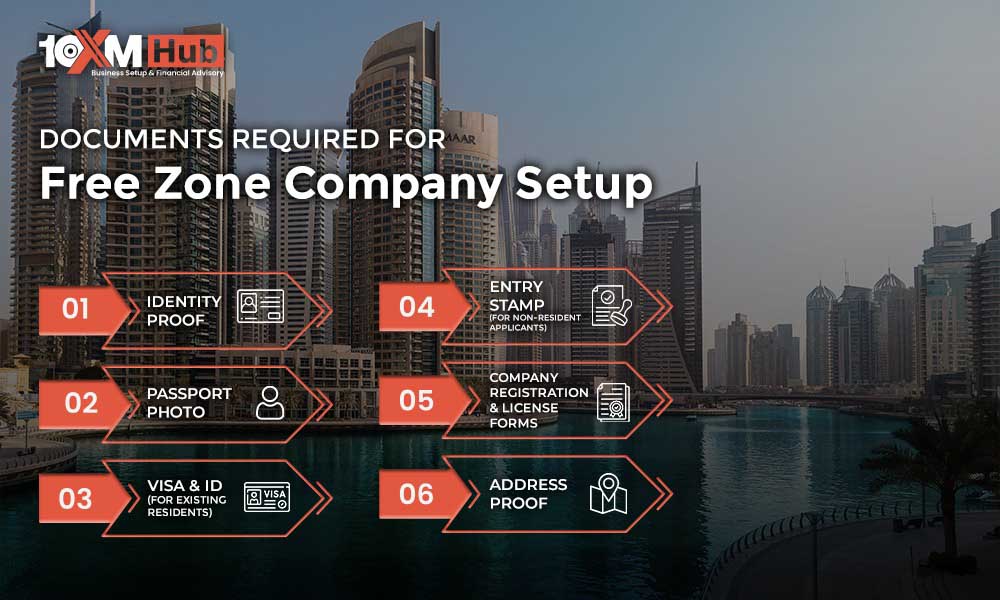
  1. Identity Proof: You need a clear color scan of your full passport data page. It must be valid for at least six months from the date of submission. Ensure all four corners are visible, and avoid any glare or shadows that could obstruct the MRZ at the bottom. You also need passport size photo UAE business. 
  2. Passport Photo: A recent digital photograph captured within the last 3 months is a must, and it must have a plain white background, neutral facial expression, and no headgear. This photo will be used for your official license and establishment card, which is why clarity is critical.
  3. Visa & ID (For Existing Residents): If you currently reside in the UAE, you must submit a clear copy of your residence visa page. This is one of the critical Free Zone license documents. You also need a clean scan of both the front and back of your current and valid Emirates ID card. This is essential to include your profile in the national database.
  4. Entry Stamp (For Non-Resident Applicants): Besides the passport copy requirement UAE business, non-residents applying from abroad may need to submit a scan of the most recent UAE entry stamp or their visit/tourist visa. This verifies your legal status during the Free Zone license documents submission process.
  5. Company Registration & License Forms: These are the primary documents shared by the specific Free Zone authority. They must be filled out with consistency regarding your trade name, business activities, and share capital allocation. Any discrepancies between these forms and your submitted IDs can lead to instant rejection.
  6. Address Proof: To finalise your identity profile, you may need a utility bill or a recent bank statement. This document must clearly display your full name and current residential address and must be dated within the last 90 days.

When submitting the Free Zone application form UAE, treat these files as digital assets. Use consistent file naming conventions and ensure your documents are saved in PDF format rather than images. 

Additional Documents Based on Business Activity 

Besides your identity and personal records, the Free Zone authority needs to verify that your business model is viable and that you possess the necessary expertise to operate. Here are the business activity documents UAE that you may need:

  • Professional Business Plan: UAE company license documents include a business plan, which is between three and five pages that details your model, projected revenue streams, and market strategy. For a UAE startup business plan requirement, the goal is to show that you understand your target market. The business plan for a Free Zone company does not need to be a complex document, but it must be realistic and in sync with your license.
  • Professional Qualifications & Certifications:  If your license covers specialised sectors, such as engineering, medical consultancy, legal advisory, or architectural services, you have to prove your competency. This involves submitting notarised or attested copies of your degree certificates, diplomas, or professional practice licenses. These are basic qualification documents UAE license. 
  • NOC: If you are currently employed in the UAE and are looking to launch a side venture, you may need an employer NOC UAE business setup. This is a formal letter from your current sponsor stating they have no objection to you starting a venture in the Free Zone. While many Free Zones have moved away from this requirement for investor visas, the NOC for free zone company UAE remains a critical check for certain sectors.
  • Regulatory Approvals: Certain business activities are regulated because they impact public health, safety, or education. In these cases, your trade license requirements for the Free Zone are contingent upon external clearance. For example, F&B startups need to go through an inspection and approval from the Dubai Municipality. These requirements are mandatory to ensure that physical premises and procedures meet safety and quality standards.

Before you start with the trade license requirements Free Zone, make sure you have selected the right hub. If your business activity requires many third-party approvals, the setup cost and time-to-market will increase. 
Documents Required for Corporate Shareholders 

Documents Required for Corporate Shareholders

When a legal entity acts as a shareholder, the documentation requirements shift from personal identity to corporate governance verification. You must ensure that the parent company is legitimate, authorised to invest, and that its directors can sign on its behalf. Below are the corporate shareholder documents UAE that you may need: 

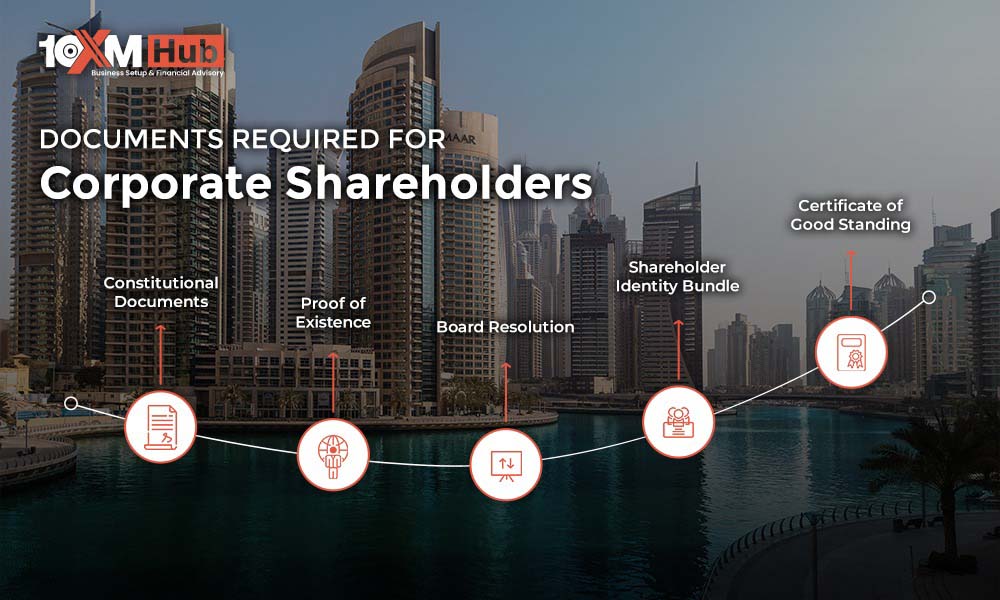
  • Constitutional Documents: You must submit the notarised and attested MOA and AOA of the parent company. These documents define the scope of the company’s activities, management structure, and its internal bylaws. Because these are foreign documents, they must undergo authentication, typically including notarisation in the home country, followed by attestation from the MOFA.
  • Proof of Existence: Other company shareholder requirements Free Zone include a valid Certificate of Incorporation. This is one of the critical parent company documents UAE, which establishes the legal birth of the parent entity. 
  • Board Resolution: Besides incorporation certificate UAE company, you need to share the board resolution. The board resolution for UAE company setup is a must to show that the board has authorised the investment into the new UAE subsidiary. The document should clearly name the UAE Free Zone, the scope of activity for the subsidiary, and appoint an Authorised Signatory. The Authorised Signatory is someone who will sign the UAE incorporation documents on behalf of the parent company.
  • Shareholder Identity Bundle: Along with shareholder resolution UAE, you need to provide a complete identity profile for every key stakeholder involved in the parent company. This includes clear passport copies and digital photos for all individual shareholders, all appointed directors, and the proposed General Manager of the new UAE subsidiary. This allows the authorities to perform Ultimate Beneficial Ownership (UBO) checks. 
  • Certificate of Good Standing: To ensure the parent firm isn’t under liquidation or legal trouble, a valid trade license or a Certificate of Good Standing from the parent country’s registrar of companies is required. This proves that the parent company is active and legally compliant in its home country, 

The attestation chain is where most corporate setups face delays. If your parent company is located in a country that is not a signatory to the Hague Apostille Convention, you may need a multi-step legalisation process.
Documents Required for Opening a Corporate Bank Account 

Documents Required for Opening a Corporate Bank Account

Checking the corporate bank account UAE requirements is just as critical. Because opening a bank account is often the final step, you need to be extra cautious. UAE banks maintain stringent due diligence standards in 2026 to keep up with AML and KYC requirements. Your ability to secure an account depends on the clarity of your documentation. UAE business bank account documents required include: 

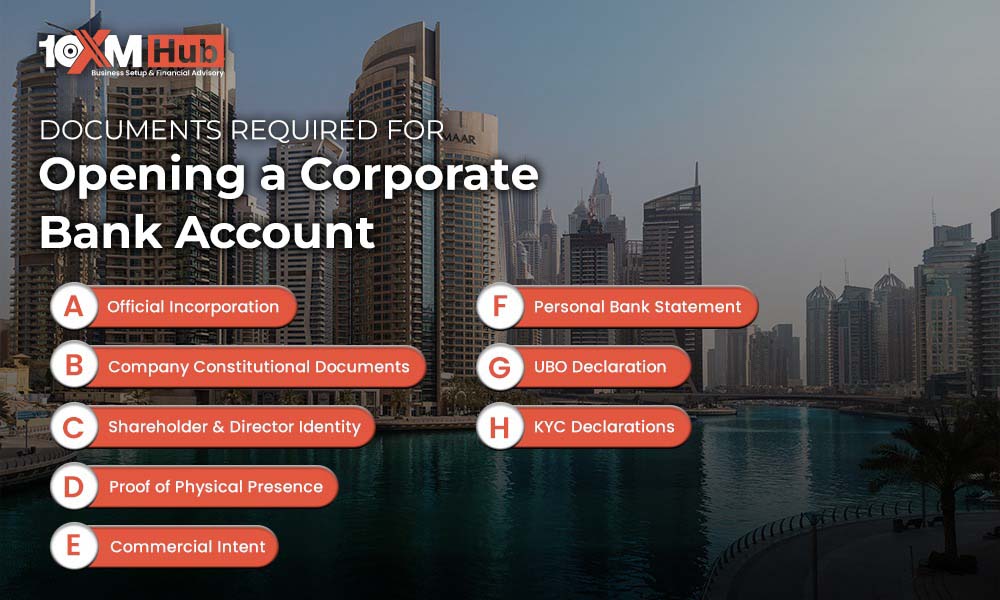
  • Official Incorporation: A certified copy of your active Free Zone trade license, which the bank will use to verify your legal status, expiration date, and permitted business activities.
  • Company Constitutional Documents: You should also have a full set of formation papers, including your MOA, AOA, and your Certificate of Registration. Besides the UAE trade license document, these documents help understand your internal bylaws. 
  • Shareholder & Director Identity: Along with Free Zone license copy, you must have clear copies of the passports, residence visas, and Emirates IDs for all shareholders, directors, and authorised signatories. If a shareholder is a corporate entity, sharing a full chain of ownership documents is essential. There is no respite from shareholder verification UAE. 
  • Proof of Physical Presence: A part of KYC documents UAE bank includes the signed lease agreement or office rental contract issued by your Free Zone authority. This helps the bank know that your business operates from a legitimate location. 
  • Commercial Intent: Banks need to understand how you make money. You must provide documentation that proves your commercial intent. This may include supplier/client contracts, pro-forma invoices, website, and portfolio.
  • Personal Bank Statement: Most banks request at least 3 months of personal bank statements from the shareholders to verify the source of funds for the new business. 
  • UBO Declaration: A signed document identifying the individuals who hold 25% or more of the company’s shares or who exert ultimate control.
  • KYC Declarations: There are also questionnaires that include questions on professional background, source of wealth, and expected transaction volumes. 

Ensure your office address, phone number, and business activity listed on your trade license exactly match the information provided in your KYC forms and banking questionnaires

Free Zone-Specific Document Requirements 

Dubai Free Zone requirements depend on each hub. The core paperwork, which consists of passport, photo, and application form, remains the same, individual authorities may have their distinct ecosystems and compliance thresholds. Here is UAE Free Zones comparison for popular ones:

  • DMCC: DMCC company setup documents are institutional and rigorous, and this Free Zone is ideal for commodities, tech, and financial services. DMCC requirements UAE include comprehensive shareholder verification. You may need to submit proof of share capital deposit for specific activities. There are also strict upload formats, and for corporate shareholders, the authorities are particular about the chain of attestation for foreign MOAs and Board Resolutions. 
  • IFZA: IFZA setup requirements are in sync with the digital-first approach of this Free Zone. The IFZA Application Form and the UBO Declaration are key aspects, and because the Free Zone caters to global digital nomads and small firms, the process is much faster and optimised. IFZA company formation documents are meant for 100% remote formation, provided the documents are clear, and the address verification is accurate.
  • Meydan Free Zone: Meydan Free Zone documents are inclined towards the instant licensing path. The process is largely automated, and correct MOFA attestation for any corporate documents that are from outside the UAE is critical. Meydan license requirements make it easy to complete the process, and all attested documents are read via automated verification tools. 

Certain legacy Free Zones like DMCC & JAFZA need more manual reviews for complex corporate structures. Just looking at the document checklist isn’t enough, so get help before you start paperwork. 

Step-by-Step Process to Submit Documents 

If you are wondering how to start Free Zone company, you need to start with the basic aspects. We have enlisted the setup steps below: 

Step 1: Selection & Activity Audit

Before paperwork, confirm your business activity matches the specific Free Zone’s ecosystem. A mismatch can lead to license rejection later. Check if the activity is regulated, which may mean getting external approvals.     

Step 2: Trade Name 

Submit three preferred trade names through the Free Zone’s digital portal. The Free Zone authority will do a check to ensure the name is unique and complies with UAE naming conventions. These names shouldn’t have been already registered. Once approved, it will be reserved for the setup. 

Step 3: Digital KYC

Upload your verified documents to the portal, which include your identity proof, UBO declarations, and shareholder resolution. All files should be in PDFs with clear naming, so that compliance tools can scan them. 

Step 4: Licensing Fee Payment

Once uploaded, the authority of the Free Zone performs a compliance review. If that goes well, you will get a payment link via the portal. Make sure the payment is done immediately, as the final approval process starts after the transaction is complete.  

Step 5: Electronic Signature 

After payment, you will receive the final legal documents, including the MOA and AOA, generated via the portal. Many Free Zones use secure digital signature tools like UAE PASS. Once all shareholders sign electronically, the documents are legally binding and lodged with the Registrar.

Step 6: License Issuance 

Once signing is complete, the Registrar issues your E-License and Establishment Card. You will get these via email, which serves as your official permission to start the business. You can now apply for your residence visa and open your corporate bank account.

If you are an international applicant, ensure you have your international corporate documents attested by the UAE Embassy in your home country and the MOFA before you start with the KYC process. Once you complete this UAE company setup process, you are ready to roll.

How a Business Setup Consultant Can Help 

It is always better to meet a business setup consultant UAE before you start your launch process in a Free Zone. Working with 10XMHub could change the setup process from a stressful job to a more planned one. Our company setup experts Dubai work as your partner to do an audit of your documentation, finding all red flags, such as incorrect MOFA attestation, blurry scans, or mismatched data. Business formation involves dealing with multiple touchpoints, and our Free Zone company formation services are meant to manage these aspects, tracking every step of the approval process.

If your parent company is based in another country, the legal path for attesting documents can be a maze. 10XMHub manages your document legalisation, coordinating between foreign notaries, the UAE Embassy, and the MOFA, saving you weeks of research. We can also help with opening your corporate bank account by ensuring every detail and KYC data are in line with the bank requirements. 

At 10XMHub, we don’t just process applications; we manage the start of your business. Contact us to know about our business set up services and how we can support you..

FAQs

1. Can I start a Free Zone company without a visa? 

Yes, you can register a company as a non-resident shareholder without obtaining a UAE residence visa. You will be the sole owner but remain outside the UAE. However, you will not be able to sponsor staff or family members, nor will you get an Emirates ID. 

2. Do all Free Zones require a business plan?

While not every single Free Zone mandates a business plan, most now require a concise summary of your business model to satisfy AML and compliance regulations. 

3. Is NOC mandatory for Free Zone company setup?

A NOC from a current employer is rarely required in 2026. However, it may still be mandatory if your business activity is regulated or if you are transitioning from a mainland employment contract with labor restrictions. 

4. How long does document approval take in UAE Free Zones?

Approval timelines depend on the Free Zone. Meydan can issue licenses in as little as 60 minutes to 3 days due, while legacy Free Zones approval may need 7 to 10 working days for a manual compliance review. 


By 10XMHub admin
June 4, 2026
Category: Business setup
Previous Next

Refer and Earn

Turn your network into opportunity. Refer clients to 10XMHub and earn substantial rewards for every successful business setup. We handle your referrals with premium support; you gain trusted commissions and long-term partnership benefits.