 info@10xmhub.com
 +971522527368


Table of Contents
As Dubai becomes the preferred hub for international trade & business, more investors and entrepreneurs are looking to start ventures here. The city serves as a pad for entrepreneurs and corporations, offering a system where global ambition meets ultimate market access. Dubai Free Zone business setup is the ideal choice for those who want to retain total control of their companies and access to 0% corporate tax on qualifying income while completing the process without admin hassles.
Dubai has 25+ Free Zones, and not all are equal for your business. Each has its unique DNA for certain sectors, such as finance, media, technology, and manufacturing. Choosing the best Free Zone in Dubai isn’t about the location only, but ensuring your business is located within the exact network of partners, competitors, and regulations that are required for growth. Below is a guide to choose free zone Dubai.
What is a Free Zone in Dubai?
Before you choose best Free Zone in Dubai, knowing the precise details is vital. A Free Zone is a designated jurisdiction created to promote and invite international investment and trade. These zones work independently of the mainland, governed by their own authorities that manage licensing, compliance, and immigration. UAE Free Zone benefits and features include:
- 100% Foreign Ownership: You retain 100% ownership of your business, which makes decision making easy, and that’s a big advantage for foreign entrepreneurs
- Financial Incentives: If you decide on a Dubai Free Zone business setup, you may have access to 0% corporate tax on qualifying income.
- Profit Repatriation: You also have the complete freedom to repatriate 100% of your capital and profits back to your home, with no currency exchange restrictions.
- Customs: Goods imported or stored within a Free Zone are often exempt from import/export duties, which is a big cost advantage.
- Dedicated Ecosystem: Every Free Zone authority functions as a singular shop for business operations. Everything from registration and licensing to visa services is covered under a single digital system.
- Infrastructure: Free Zones provide access to particular physical and digital infrastructure. This ranges from suites and co-working spaces to warehousing, data centers, and logistic-related facilities.
- Clustering: Each zone is designed around sectors, such as technology, media, finance, or trading. This makes a collective system that helps anyone doing business here.
Key Factors to Choose the Best Free Zone in Dubai for Your Business
Much before you choose best Free Zone in Dubai, you have to consider whether your intended commercial, industrial, or professional activities are permitted within the selected jurisdiction. Each Free Zone maintains a specific list of approved activity codes. If your business model involves multiple functions, such as trading and consultancy, you must confirm that the zone allows these to be bundled under a single license. A mismatch here can mean licensing complications or trouble getting necessary approvals later. For Dubai Free Zone comparison, here are some factors:
- Infrastructure Requirements: Assess your physical footprint. For instance, are you a remote consultant who only needs a flexi-desk? Or is yours a trading firm requiring a warehouse? Infrastructure costs determine your overhead. By choosing a facility that matches your actual needs, you significantly improve your company’s cash flow during the early growth phases.
- Visa Allocation & Workforce Planning: Visa quotas are tied to the size and type of your leased facility. A small flexi-desk package might grant you a single investor visa, whereas a larger office suite could qualify you for multiple employee visas. Before selecting Free Zone Dubai, make your hiring plan for the next 24 months. If you anticipate scaling fast, ensure the Free Zone has a clear, affordable way for upgrading your facility and increasing your visa quota without the need for restructuring.
- Banking Reputation: Not all Free Zones are viewed equally by UAE banks. Jurisdictions with established, long-standing relationships with Tier-1 banks often provide a smoother onboarding experience. Opening a corporate bank account is a major hassle for new startups. If you select a Free Zone known for high compliance and strong banking integration, you may need longer to get started.
- Budgeting: Do not evaluate costs based on the registration fee for the first year. You must create a budget for at least two years that considers all hidden costs, often related to compliance, such as annual renewals, audit reporting needs, and recurring visa charges. Some zones offer attractive initial discounts but have high annual renewal fees, while others may require mandatory third-party audits, which are expensive.
- Connectivity: If your business is trading or logistics-oriented, the location of your Free Zone is a massive aspect to consider. Closeness to international transit hubs, such as Jebel Ali Port, Al Maktoum International Airport, or major road networks, can reduce your daily transportation, warehousing, and customs-clearance costs. Being located near your supply chain and customer base is a great advantage.
Popular Free Zones in Dubai for Business Setup
Dubai Free Zone comparison should start with your activity and specialisation of the zone. Below are some popular options:
- DMCC: Dubai Multi Commodities Centre is best for commodity trading, technology, and high-end professional services. Located in JLT, DMCC is a respected global hub that offers a clear ecosystem for traders and tech firms, offering over 600 business activities. Its primary advantage is its prestige factor. Operating from here immediately signals credibility to global partners. If you want comprehensive support for international trade and digital innovation, this is your option.
- DIFC: Ask any consultant about the best Dubai Free Zones list for banking, fintech, insurance, wealth management, and corporate legal services, and the Dubai International Financial Centre will be at the top. This Free Zone operates under an independent English Common Law framework and offers a perfect environment familiar to global financial institutions. The zone’s legal system ensures regulatory certainty, which is essential for financial operations involving higher stakes.
- JAFZA: If manufacturing, heavy industry, logistics, and distribution are on your list, Jebel Ali Free Zone is the option to choose. JAFZA is not just prestigious but also stands out for its location. It is close to Jebel Ali Port, making it the requisite choice for businesses moving physical inventory. With 10,000+ companies, including many Fortune 500 names, it offers supreme industrial infrastructure, including warehouses, manufacturing units, and access to popular global shipping routes.
- IFZA: For SMEs, professional consultancies, IT, and agile, digital-first startups, the International Free Zone Authority is a great option. If you need to launch quickly with minimal friction, the transparent, modular approach of this Free Zone will help. The system is designed to offer ready packages, which allow businesses to start lean and scale up without the heavy overheads.
- Dubai Media City & Dubai Studio City: These hubs are best for content creation, broadcasting, digital media, advertising, and film/audio production. Designed to promote the creative economy, these Free Zones have broadcasters, boutique studios, and marketing agencies in one location. You can have access to sound stages, podcasting facilities, and co-working spaces.
- DIC: If your business is involved in ICT, software development, AI, or SaaS, Dubai Internet City is an amazing choice. DIC is the region’s primary tech cluster and hosts giants like Microsoft and Google alongside innovative startups. It is the ideal place for any firm focused on the digital economy, thanks to the infrastructure system and a network of professionals that are important for software development, research, and AI.
- DSO: Dubai Silicon Oasis is ideal for companies in innovation, semiconductors, nanotechnology, and research related to education. It has giant industrial parks with housing communities and academic centers. This setup is perfect for firms that need to grow a pipeline of talent directly from local universities.
The best Free Zone in Dubai is the one that works for your vision, which is why you need to think about aspects other than the registration cost. In other words, there is value in being in a zone where your clients, competitors, and potential partners are already established.
Best Free Zone in Dubai Based on Business Type
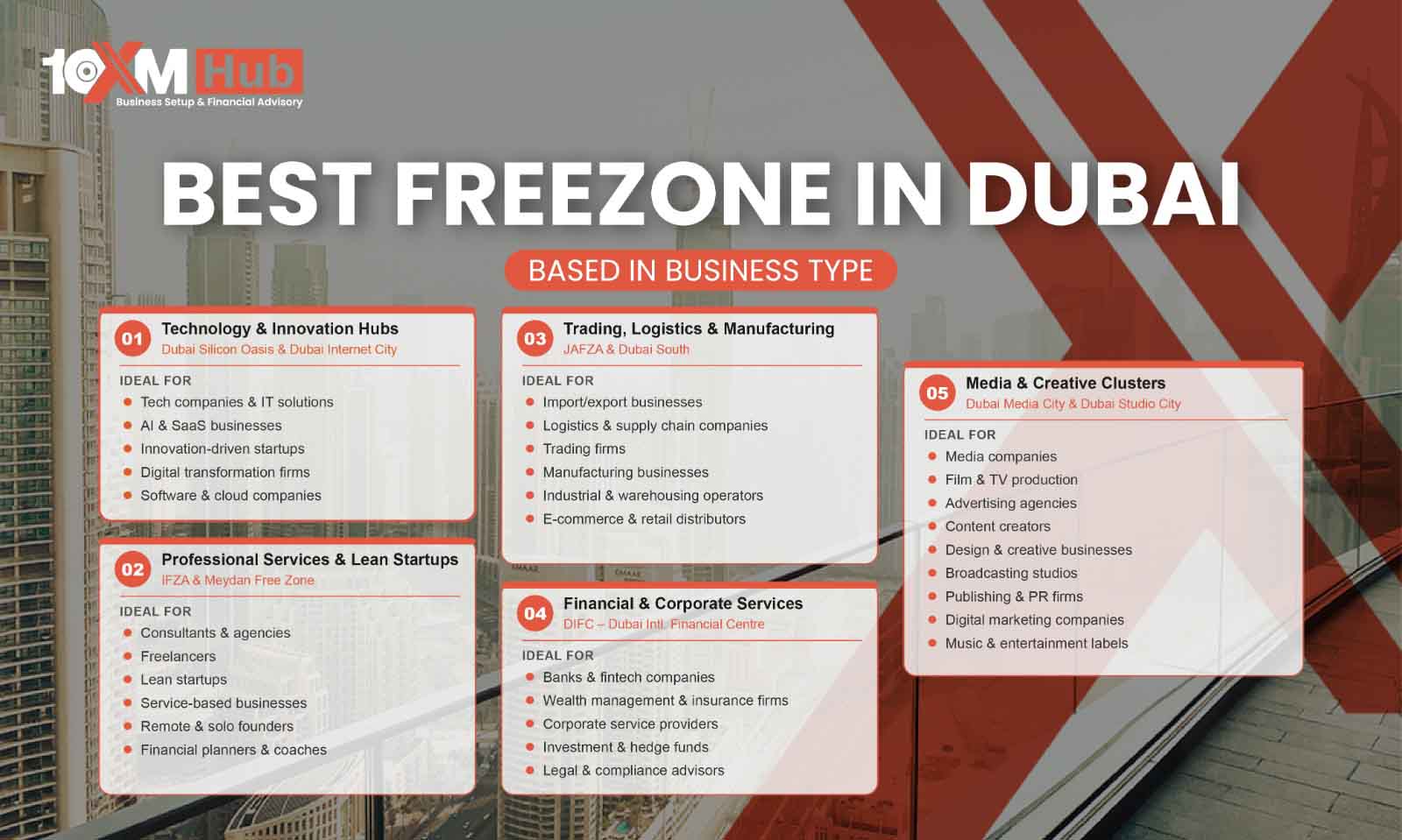
Choosing the best Free Zone in Dubai for business is about matching your company’s DNA with the jurisdiction’s regulatory, infrastructural, and professional ecosystem. Here are options based on business type:
- Technology & Innovation Hubs: For software, artificial intelligence, SaaS, and digital services, the two most critical options are Dubai Internet City( DIC) and Dubai Silicon Oasis(DSO). These zones are engineered for the digital economy and host popular international companies, including Google, Microsoft, and Meta. If you choose DIC, you get an unparalleled network for R&D, partnership opportunities, and access to a deep pool of tech talent. DSO, on the contrary, is best for tech hardware startups and companies that require integration with residential and academic facilities.
- Professional Services & Lean Startups: IFZA and Meydan Free Zone are best for consultancies, agencies, and freelancers. For these businesses, IFZA is widely famous for its agility, allowing businesses to launch with minimal friction and transparent, modular pricing. Meydan Free Zone remains the Dubai Free Zone for startups and provides a prestigious yet accessible address for digital nomads and remote consultancies. You can keep your assets light, thanks to flexi-desk packages.
- Trading, Logistics & Manufacturing: For global trade and industrial projects, JAFZA and Dubai South are the best choices. If your business model involves the movement and shipment of physical goods, closeness to infrastructure is a non-negotiable cost. JAFZA is the industry leader in many ways and is revered by many. It offers connectivity through the Jebel Ali Port, which is something that such businesses need. Dubai South is the emerging Free Zone for logistics related to aviation, as it is close to Al Maktoum International Airport. You also have access to utility connections, warehousing that is custom-bonded, and bigger plots required for starting and scaling your business. These Zones simplify customs clearance and provide cold-storage facilities for sensitive goods.
- Financial & Corporate Services: DIFC is the ideal choice for fintech, wealth management, and banking. As shared earlier, DIFC operates under its own independent English Common Law legal framework and is governed by the DFSA. This provides an internationally known standard of governance and legal stability that is imperative and pertinent for banks, investment firms, and legal consultancies. DIFC is more than a location, and being here grants your business access to a strong investor community.
- Media & Creative Clusters: If your business is engaged in content production, broadcasting, and marketing, DMC & Dubai Studio City are your top choices. These zones group broadcasters, production houses, marketing agencies, and creative freelancers in one location and create a collaborative environment. Beyond the equipment, these also have a dense network of creative service providers, making it easy to build production teams and collaborate on media projects.
If you are a lean startup today but plan to build a fleet in logistics in another two to three years, you need to find a Free Zone that offers both service licenses and warehouse upgrades.
Common Mistakes to Avoid When Choosing a Free Zone in Dubai
Confused about how to choose a Free Zone in Dubai? Avoid these mistakes:
- Assuming Uniformity: The most dangerous assumption is believing that all 25+ Free Zones are interchangeable. Each authority has a specific compliance, banking, and cultural DNA, which is why you cannot treat each jurisdiction as the same, and note that what works seamlessly in one may trigger months of compliance delays in another.
- Neglecting the TCO: Entrepreneurs often fixate on the initial registration fee, creating a budget trap. A low-entry flexi-desk package is frequently just a base cost. You must consider the financial burden for another two years, including annual license renewal fees, mandatory third-party audit costs, visa issuance and stamping fees. There are also recurring costs of maintaining an office.
- Over-Simplifying CT Compliance: The misconception that a Free Zone license automatically grants a tax-free life is a liability. To access the 0% corporate tax rate as a QFZP, you must prove adequate economic substance. This requires maintaining a physical presence, employing full-time staff, and incurring expenditures within the zone. Simply holding a license without documented substance can lead to a 9% tax assessment, plus penalties, on all income for the current and following four years.
- Misaligning Business Activities: Before looking for the best Free Zone in Dubai, you must understand that licenses are granular, not general. Many founders choose to cut down on activity codes to save costs, only to realise later that they cannot legally offer related services later. Any modification after the first steps requires amendment applications, which are costly and time-consuming. Research your activity bundle thoroughly.
- Ignoring the Banking: Your license is only as functional as your ability to transact. Some Free Zones have significantly stronger relationships with UAE Tier-1 banks, whereas others have a limited trading history. That may lead to enhanced scrutiny or outright rejection during the KYC process.
- Not Understanding Visa & Licensing Cycles: Missing out on syncing visa expiry dates with your license renewal schedule is a big trap. If your employee visas expire and are out of sync with your license, you may have to pay daily fines or face bigger concerns like suspension. Always ensure that your license and visa quotas are always in check, keeping records of certifications, medical fitness records, and employment contracts.
Step-by-Step Guide to Choose the Right Free Zone in Dubai
Below are Dubai Free Zone setup steps:
Phase 1: Blueprinting
Define Your Model: Conduct an audit of your revenue model, service scope, and 3–5-year plan for growth. Clearly categorise your activities, as Free Zone licenses are highly granular. Knowing your future needs allows you to select a jurisdiction that can accommodate these changes under one license, saving you from costly restructuring.
Audit Your Infrastructure Demands: Match your physical needs to your operation vision. Are you a consultancy operating remotely or a logistics firm? Consider whether a virtual flexi-desk is truly sustainable, or if you require physical space, like warehousing. Selecting the wrong option often may mean paying for unused space or, conversely, facing blocks when you need to scale.
Phase 2: Analysis & Due Diligence
- Conduct a Budget for Next Two Years: If you are looking at how to choose Free Zone Dubai, you must avoid the entry-price trap. Build a budget that includes registration fees, annual renewal costs, visa needs, medical fees, insurance, and the need for audit reporting. Some zones offer lower initial fees but high recurring renewal charges or mandatory audit requirements.
- Evaluate Visa & Staffing: Consider your hiring plan for the next 24 months. Each Free Zone has specific rules linking facility size to visa quota allocation. Ensure your chosen package has the flexibility to add employees without requiring a move to an expensive office suite.
- Banking & Compliance: Check the zone’s reputation with Tier-1 UAE banks. A jurisdiction with banking relationships often provides a faster, predictable process for opening a corporate bank account.
Phase 3: Execution
Partner with an Expert: Engaging a reputable business setup consultant is a strategic investment in compliance. They provide essential advice on ESR and VAT requirements, ensuring your structure is legally sound from day one. This prevents audit failures or unexpected tax liabilities. There are steps like:
- Pre-Approval & Name Reservation: Get your trade name early and following naming requirements to avoid branding risks.
- Submission & Payment: Get all documents ready, such as passports, business plans, and MOA. Make sure to check the official list.
- License Issuance: Once the Registrar approves, your e-license is typically issued digitally, allowing you to start operations.
- Starting operations: Immediately coordinate your license validity with visa applications and bank account opening process. Keep a calendar for compliance to keep a tab on filings, license renewals, and visa expiry dates, ensuring you don’t have to deal with penalties or issues while running the business.
The right Free Zone is the one that provides proactive, professional support for your ongoing obligations. If you follow these steps to set up business in Dubai Free Zone, you can avoid the usual mistakes and friction.
Conclusion
Selecting a Free Zone is a critical decision that goes far beyond simple registration. Your chosen jurisdiction functions as the operating system for your business, directly impacting your taxes, corporate banking, speed of business, and scalability. If you match your 3–5 year growth plan with the right regulatory ecosystem, you ensure your entity remains agile, compliant, and positioned for expansion.
At 10xMHub, we help businesses start in Free Zones. With our team of expert consultants and specialists, we guide you about all 25+ Free Zones, offering details that are otherwise hard to decode through online information alone. Let us take you from the first business plan to final operations, all through a process that is in sync with the selected Free Zone’s network.
Learn more about 10xMHub’s business setup services now!
Contact Details


Share this post :








Refer and Earn
Turn your network into opportunity. Refer clients to 10XMHub and earn substantial rewards for every successful business setup. We handle your referrals with premium support; you gain trusted commissions and long-term partnership benefits.
