Setting up a business in Dubai is almost a trend among entrepreneurs, founders, and international investors. Dubai works as the middle ground between Asia, Africa, and Europe, thanks to its location, and the tax incentives in the UAE are hard to resist.
The process of business setup in Dubai is just as lucrative, with a stable & defined financial ecosystem and incredible infrastructure. Despite the advantages, it is easy to get confused about jurisdictions, legal processes, and compliance requirements. Below is a detailed roadmap for company setup Dubai.
Why Start a Business in Dubai?
If you are an investor still reconsidering the thought of why setup a company in Dubai, here are some compelling reasons at a glance:
- The location advantage
- Promising tax environment
- Ease of business
- Ownership ensured
- Unparalleled ecosystem
- The location advantage: Dubai has emerged as a trade hub for the world and connects three continents. This makes the UAE one of the best locations for internal trade and business.
- Promising tax environment: The process of setting business in Dubai is straightforward, with corporate taxes limited to 9%. There is no personal income tax, which is another advantage for employees.
- Ease of business: With quick help from seasoned consultants, the registration process is still seamless here. As long as one follows the rules, business setup in Dubai remains easy to follow.
- Ownership ensured: Dubai allows 100% foreign ownership in a bunch of sectors, and investors and owners don’t have to worry about finding local sponsors.
- Unparalleled ecosystem: Thanks to a strong financial system and advanced logistics, business setup Dubai UAE, is a great decision for investors seeking exposure in the GCC region.
It is quite understandable why many businesses, including offshore companies, are moving to Dubai.
Types of Business Jurisdictions in Dubai
Before setting up a business in Dubai, it is wise to consider the jurisdiction options, which largely define market access, compliance requirements, and cost structure. In general, business setup in Dubai can be separated into three categories:
- Freezone Business Setup
- Mainland Business Setup
- Offshore Business Setup
Freezone Business Setup: Thanks to the choice of 100% foreign ownership, businesses can operate within the free zone or internationally. There are direct tax benefits, and the setup process is simpler. The ecosystem is particularly useful for certain sectors. In terms of limitations, free zone businesses cannot trade on the mainland unless there are distributors.
Best suited for: Startups, digital businesses, companies engaged in international trading
Mainland Business Setup: These businesses are licensed by the Department of Economic Development and have complete access to the UAE market. Mainland companies can also deal in government contracts and enjoy more flexibility in terms of operations. Having an office is a must, which can add to the cost. Also, mainland companies have more compliance requirements.
Best suited for: Retail businesses, companies aiming to service customers in the UAE.
Offshore Business Setup: These businesses don’t need a physical office in Dubai or the UAE, and the setup costs are considerably lower. This is an ideal choice for entrepreneurs and companies that want to hold assets and run international operations. However, offshore businesses cannot operate in the UAE market.
Best suited for: Holding companies, international trade
The comparison below gives a quick snapshot of the differences between Freezone, Mainland & Offshore Companies, making it easier for entrepreneurs to choose the option that best suits their long-term business plans.
| Feature |
Freezone |
Mainland |
Offshore |
| Ownership |
100% foreign |
Mostly 100% |
100% foreign |
| Market Access |
Limited |
Full UAE access |
Outside UAE only |
| Office Requirement |
Optional/flexi |
Mandatory |
Not required |
| Cost |
Moderate |
Higher |
Lower |
| Setup Time |
3–10 days |
5–15 days |
2–3 days |
| Best For |
Startups, exports |
Local trade |
Asset protection |
Step-by-Step Guide to Starting a Business in Dubai
Before you start business incorporation in Dubai, it is imperative to consider all options and follow the set of clear steps that are mandatory to start operations. Below are the detailed steps:
Step 1 – Select Business Activity
Step 2 – Decide Jurisdiction
Step 3 – Finding Legal Structure
Step 4 – Trade Name
Step 5 – Getting Initial Approval
Step 6 – Prepare Documents
Step 7 – Getting Office Space
Step 8 – Getting Business License
Step 9 – Apply for Visas
Step 10 – Open Bank Account
- Step 1 – Select Business Activity: Before business formation in Dubai, it is important to define the exact nature of the company. Activities could include trading, services, manufacturing, and industrial. The activity must be further differentiated between commercial, professional, and industrial. Some sectors, such as food and healthcare, require special approvals. This decision will help with other pertinent decisions, including jurisdiction and license type.
- Step 2 – Decide the Jurisdiction: As mentioned earlier, there are three options to setup a company in Dubai – Freezone, Mainland, and Offshore. The choice largely depends on the customer base and budget. For example, if you want to trade within the UAE market, you need a mainland business, but that also means higher setup costs. Other things to consider include visa, office requirements, and plans for scaling. Choose the jurisdiction based on long-term goals.
- Step 3 – Finding Legal Structure: You can choose between three usual legal options for business setup in Dubai. LLC (Limited Liability Company) is the first and most common one for businesses here. Sole proprietorship is second, where there is only one owner who will have complete control but also higher liabilities. Foreign companies can consider a branch office, which works as an extension and cannot operate independently. The legal structure matters for profits, risks, and responsibilities.
- Step 4 – Trade Name: Having a unique name is an obvious step, but before setting up a business in Dubai, it is critical to ensure the name doesn’t sound offensive or hurt religious sentiments. A suffix for the legal structure also helps. The selected name should be submitted to the Department of Economic Development (DED) or the Freezone authority. Note that name approval is valid for a short time.
- Step 5 – Getting Initial Approval: The next step is to receive approval from the authorised person to verify your business activity. After this process, you may apply for licensing and the necessary paperwork. Remember to provide your trade name, your business’s activities, and your shareholdings when you receive approval. Please note that this approval is not your final license.
- Step 6 – Prepare Documents: For business establishment in Dubai, certain documents are a must. This includes the Memorandum of Association (MOA), Shareholder agreements, along with Board resolutions (when applicable) and Articles of Association. Documents must be legally accurate and in sync with compliance requirements. Errors can mean legal disputes and delays in getting the approval. For understanding the documentation process and requirements for freezone businesses in detail, you can refer to the Freezone Company Setup guide, or explore the Mainland Company Setup guide for mainland company formation.
- Step 7 – Getting Office Space: This requirement depends on the jurisdiction. A physical office with minimum size requirements is mandatory for all mainland businesses, while freezone ones can choose between a private office, shared office, or flexi-desk. At this point, it is wise to consider the visa quota based on office size and the cost of owning the office.
- Step 8 – Getting Business License: Business establishment in Dubai requires a license, and companies can choose between commercial, professional, and industrial licenses. All approved documents, along with the initial approval certificate and office lease agreement, must be submitted. Authorities will check for compliance aspects and issue the license, after which businesses can start operating in Dubai. Licenses must be renewed each year, and some industries may require additional permits.
- Step 9 – Apply for Visas: There are different visa categories, such as investor/partner and employee visas. The process includes entry permits, medical tests, Emirates ID registration, and visa stamping. Quota depends on the business activity and office size. While handling visa applications, it is critical to ensure compliance with labor laws. We also help eligible applicants with the Golden Visa process at 10XMHub for those looking to plan ahead with long-term residency in the UAE.
- Step 10 – Open Bank Account: Selecting the bank is critical, for which aspects like business activity, international transactions, and overall volume must be considered. To open a corporate bank account, details like a trade license and shareholder documents must be submitted. The bank will complete the KYC process along with compliance checks.
Cost of Starting a Business in Dubai
The cost of setting up a company in Dubai depends on a number of factors, which include
- Business license
- Office space
- Visa costs
- Registration fees
- Additional approvals
- Business license: The cost of a business license in Dubai depends on the activity and jurisdiction. Selecting the appropriate license category from day one can also eliminate amendment fees later.
- Office space: Flexi-desk offices cost a lot less than a physical office. The latter is a must for all mainland companies. Office space will also affect visa quotas and general operational capabilities.
- Visa costs: The number of employees and investors determines the cost of visas. Other costs such as medical tests, Emirates ID and insurance should be considered as well.
- Registration fees: The cost of opening a company also includes one-time charges to be paid to the government. These fees can include reserving your company name, initial approval, and attestation of documents.
- Additional approvals: Some industries also require specific approvals, which may add to the Dubai business setup cost.
Typical Cost Range
The cost of setup a company in Dubai includes the license fee, which can range between AED 10,000–50,000 per year for affordable zones such as IFZA, whereas for premium zones like DIFC may exceed AED 50,000. Mainland licenses can cost around AED 12,000 and may rise to AED 25,000 or higher. Overall yearly costs generally start from around AED 20,000 and may increase more depending on the business activity and jurisdiction.
Documents Required to Start a Business in Dubai
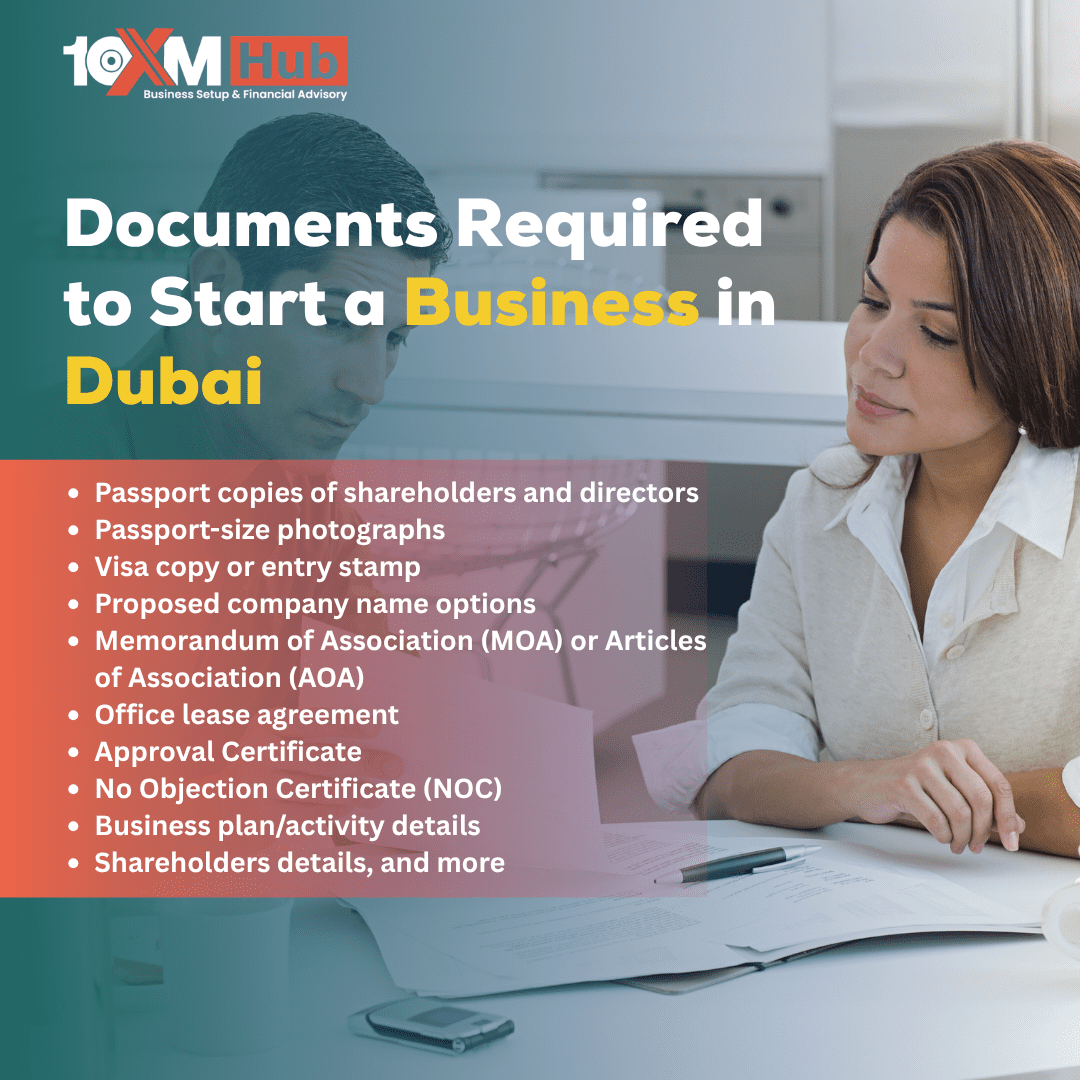
When setting business in Dubai, it is important to prepare all relevant documents. Key documents required include:

- Passport copies of shareholders and directors
- Passport-size photographs
- Visa copy or entry stamp
- Proposed company name options
- Memorandum of Association (MOA) or Articles of Association (AOA)
- Office lease agreement
- Approval Certificate
- No Objection Certificate (NOC)
- Business plan/activity details
- Shareholders details, and more
For a complete list of detailed documents, you can visit the Freezone Guide and Mainland Business guide pages.
There are certain generic requirements, such as passport copies of shareholders, visa copies (if applicable), passport-size photographs, and trade name reservation.
Before business setup in Dubai, companies must also have legal documents like the MOA/AOA, lease agreement, and the initial approval certificate received in the first stage. Other documents may be required for a new company setup in Dubai, which include NOC, shareholder details, and the business plan, depending on the sector.
Before you start a business in Dubai, it is wise to ensure the paperwork is done right.
Common Challenges Entrepreneurs Face
While setting business in Dubai may sound simple on paper due to easy procedures, entrepreneurs and investors often have the toughest time managing things on the ground. Challenges include:
- Not knowing jurisdiction differences
- Not knowing accurate setup costs
- Confusions about regulations
- Inability to handle paperwork
- Difficulty opening a business bank account
- Not knowing jurisdiction differences: Broad definitions don’t help investors looking to open a company in Dubai. Choosing the wrong one could mean operational hassles and additional restrictions.
- Not knowing accurate setup costs: The generic figures often don’t outline the actual cost of owning a business here. This is one of the few reasons why investors and founders rely on company formation services in Dubai to get accurate information based on their investment goals and business needs.
- Confusions about regulations: Compliance is one of the most vital aspects that businesses cannot ignore in the UAE. Rules and requirements vary across zones, which can confuse investors. Just reading through documents can be overwhelming, unless one has a clear understanding of the local compliance needs.
- Inability to handle paperwork: Documentation alone can be a tough task to manage, especially without ground support. Many entrepreneurs go with instinct, only to deal with delays and rejections later. Hiring the best business setup consultants in Dubai is the best way to ensure that the paperwork is done right.
- Difficulty opening a business bank account: Opening a business banking account can be tricky, as UAE banks have an extensive due diligence process. Delays are normal due to missing documents, improper descriptions of business activities or lack of UAE presence. If entrepreneurs are not prepared, they may get their account rejected or caught up in processing for months which can impact vendor payments and the first few months of revenue.
Tips for Successfully Starting a Business in Dubai
Here are five essential steps to setup a company in Dubai:
- Get help
- Pick your business activity carefully
- Know your jurisdiction from the start
- Plan financially
- Spend time knowing compliance
- Get help: Instead of Googling blog posts or printing guide sheets, look into business setup services in Dubai. Experienced consultants will walk you through an overview of getting started, what to expect along the way, and how to keep everything organised so you don’t miss compliance and regulatory expectations.
- Pick your business activity carefully: Going into this without a consultant or a clear vision will lead to wrong decisions. This can cause setbacks to your business setup in Dubai or create licensing issues. Spend time really understanding how you want to grow and scale in the future, and pick your activity based on that.
- Know your jurisdiction from the start: If you are looking into Freezone vs Mainland business setup, knowing the differences between jurisdictions is crucial. Work with your consultants to know whether a free zone entity is a better choice or if you need a mainland business license to operate within the UAE.
- Plan financially: For setting up a company in Dubai, it is critical to have a practical idea of the costs involved. There are setup costs, which must be paid upfront, but there are also other expenses, including license renewal and operational costs. Planning finances with the vision in mind is the best way to ensure ongoing business and determine the need for loans.
- Spend time knowing compliance: Long before you start a company in Dubai, it is a wise idea to consider renewals, reporting, and auditing requirements. Compliance issues alone can stop operations and can mean fines and other penalties. Rather than assuming things, ensure you talk to local business consultants, who can guide better because of their experience with other clients.
Why Choose 10XMHub for Business Setup in Dubai
As a dedicated consultancy for business setup in Dubai and the UAE,10XMHub ensures complete support for entrepreneurs, investors, and global companies. The team includes consultants and experts with decades of collective expertise in handling business setup services in Dubai, company formation, licensing, banking, visas, and more. We know how hard it can be to understand compliance requirements, which is why our services are ongoing, ensuring clients never have to worry about rules and paperwork alone.
Our goal is to ensure that setting business in Dubai remains a smooth process for entrepreneurs. We also help clients get the benefits of the incredible financial ecosystem in the region. 10XMHub continues to rate among the top business setup services in Dubai!
Conclusion
Setting up a business in Dubai isn’t about having a great idea, but also about ground requirements and compliance. Going through the entire licensing and setup process can get confusing in no time, and errors can mean serious consequences, including license suspension. Talk to business setup consultants in Dubai, and let experts guide you through each step. Discuss Freezone, Mainland, and Offshore entity options with pros and cons before preparing paperwork for business registration in Dubai.
FAQs
1. How to start a business in Dubai as a foreigner?
2. Company formation in Dubai starts with identifying the business activity and deciding on the jurisdiction. The next step is getting a trade name and completing the other steps to get a license, after which a business can start operations.
3. How long does it take to start a business in Dubai?
Depending on the setup type and jurisdiction, it can take anywhere between two days and a month for company setup Dubai.
4. Do I need to live in Dubai to start a company there?
It is not mandatory to live here for setting business in Dubai. An offshore entity is an option.
5. What is the minimum investment required to start a business in Dubai?
The minimum investment depends widely, but freelance permits can cost around AED 5,000–15,000, while a company setup can be done within AED 50,000.
6. Can I run my Dubai business from outside the UAE?
Yes, it is possible to run operations from an offshore site for offshore and some free zone setups. Talk to company formation consultants in Dubai to understand these details.
7. Is it mandatory to rent an office to start a business in Dubai?
Mainland companies must have a physical office, while this is optional in some free zones.
 info@10xmhub.com
 +971522527368